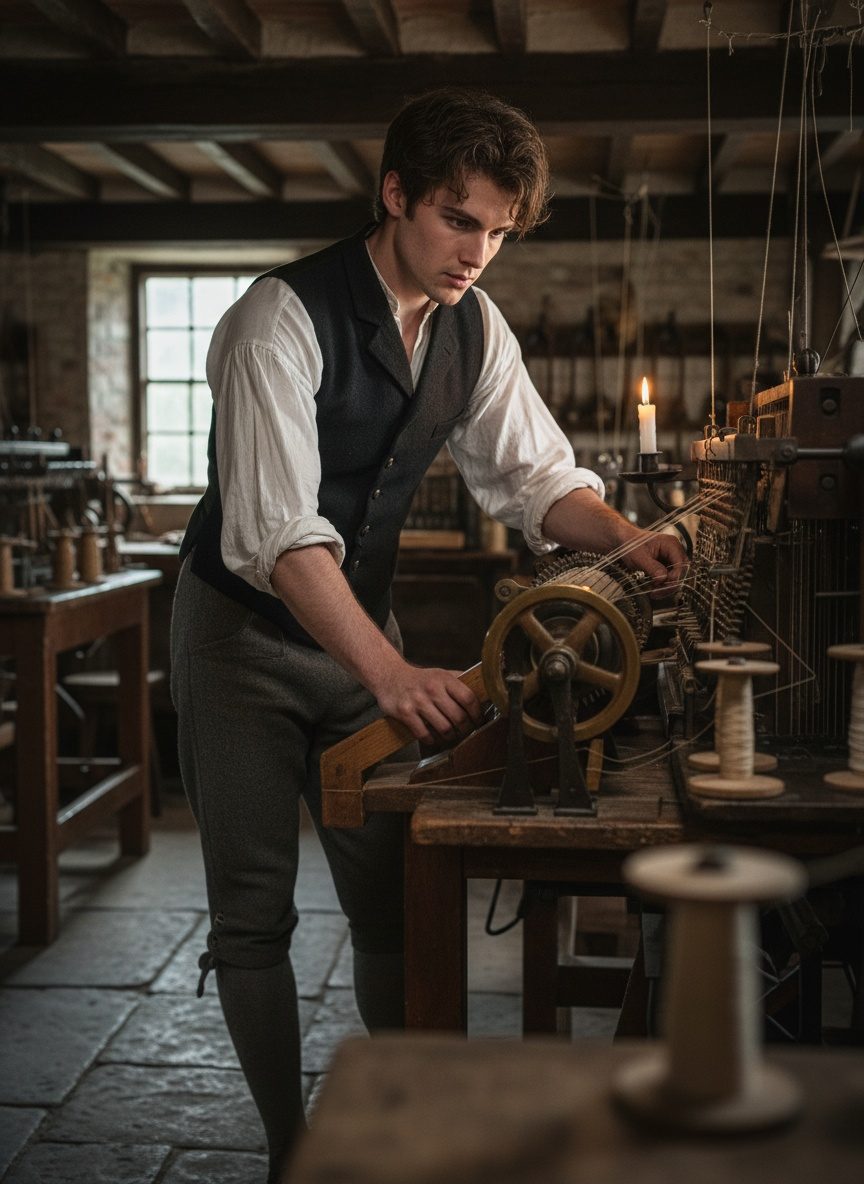
He was just twenty years old. James Heathcoat had never taken a formal engineering class.
In the bustling town of Nottingham in 1808, where the clattering of carriage wheels over cobblestones played alongside the constant chatter of men and women engaged in their daily trades, a remarkable scene unfolded. Within a small and unassuming workshop, young Heathcoat, a man incredibly perceptive for his age, found himself mesmerized by the repetitive motions of nimble fingers dancing across threads of lace. This was not simply idle curiosity; his eyes were alight with the glint of insight. At the time, lace was an exquisite luxury, its creation demanding the deft hands and keen eyes of skilled lacemakers. Twelve threads, forty fingers, hours of painstaking labor, all for a mere yard of intricate lace. Heathcoat saw the beauty, but more importantly, he saw the potential for change.
In an era where industrial ingenuity was beginning to redefine the landscape of Britain, Heathcoat stood before a challenge that seemed impossible. Born in 1783, in the heart of the Industrial Revolution, Heathcoat was no stranger to innovation. His mind was not burdened by the constraints of formal education, nor influenced by the seasoned cynicism that often curtailed creativity. Instead, his perspective was refreshingly unorthodox, driven by raw curiosity and an innate understanding of mechanics gleaned from practical observations. However, the notion of automating lace production was audacious. Existing knitting methods, steeped in tradition and human touch, appeared ineffable to mechanization.
Undeterred by the profound complexities of the task, Heathcoat set his mind to designing a machine that would mimic, if not surpass, the dexterity of human hands. The initial evenings turned into restless nights, as he scrawled sketches, calculations, and ideas on any scrap of paper he could find. The rudimentary tools and materials available to him were scant comfort, yet his determination wove itself into each thread of his concept. This wasn’t just about fabric; it was about revolutionizing an entire industry.
Read next: The Day a Weaver's Son Lit Britain's First Public Railway
His relentless pursuit spanned months, evolving in complexity as he discovered new ways to maneuver the fine threads with precision and control. Each setback was met with renewed vigor, each breakthrough celebrated with the solemn satisfaction of a visionary who sees the future just a little more clearly with each step. Finally, his efforts coalesced into what he considered a viable machine — a creation that promised the delicate artistry of lacework at an extraordinary speed. This mechanical marvel, upon its completion, stood as a testament to human ingenuity, imitating the coordinated efforts of delicate fingers with a precision that bordered on the miraculous.
Heathcoat's knitting machine was initially met with skepticism. The claim was bold — this contraption, appearing rather like an overgrown typewriter, could outperform human hands? Factory owners, shackled by tradition and wary of the financial investment needed for such untested technology, were hesitant. Yet, those who witnessed its operation found themselves captivated by its efficiency and consistency. One yard of lace it produced in mere minutes, eclipsing hours of human labor.
As word spread, the industrial world watched with a mix of amazement and concern. The laborious hand-knitting of lace was not just a tradition; it was a source of livelihood for many. Skeptics feared the new technology would displace workers, while optimists trumpeted the dawn of a new era where access to such beautiful fabric would no longer be a privilege for the wealthy few. The debate reflected a broader tension of the Industrial Revolution—one that balanced the proverbial scales between progress and preservation of the old way of life.
Read next: The Day a Mill Owner Walked Into Court and Freed His Rivals' Children
Despite the controversy, the invention’s impact was undeniable. Orders began flowing in, and factories eager to capitalize on this technological leap saw a proliferation of lace, spurring the rise of Nottingham as a textile powerhouse. Heathcoat's machine did not eradicate human employment but transformed it, creating new opportunities within expanding industries and boosting the local economy. With more lace on the market, a once-exclusive luxury became accessible, democratizing fashion in a way previously unimaginable.
Beyond the tangible achievements lay Heathcoat's intangible legacy. His knitting machine catalyzed further innovations, inspiring other inventors to challenge the limitations of their crafts. The Industrial Revolution thrived on such bold leaps of faith, and Heathcoat’s story exemplifies the era's essence: a relentless drive towards reimagining the role of technology in everyday life.
In understanding his story, we grasp more than the details of an invention; we appreciate the profound message about the nature of human ingenuity. Heathcoat’s work was a beacon illuminating the possibilities that lie in adaptive, creative thinking, even in the face of daunting challenges. As we reflect on his contribution, we are reminded that progress often requires not just intelligence and determination, but vision—the sort that dares to see beyond what is to envision what could be. In doing so, Heathcoat not only changed how lace was made but also how we perceive the potential of human innovation and enterprise.