The explosion at Messines was a meticulous, calculated affair. It was also a moment of unexpected, haunting beauty thanks to a lone Welsh singer in the dark.
A Silent Symphony Under Earth
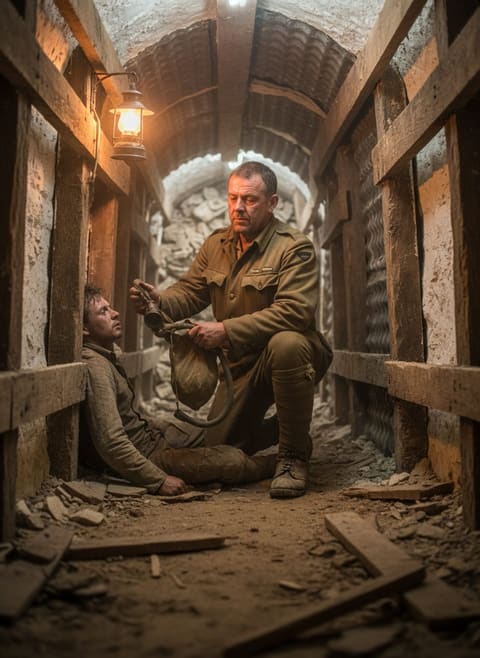
The Messines Ridge, a strategically critical elevation in the landscape of the Ypres Salient, masked a hidden theatre of war—a theatre where battles were fought not with rifles and artillery, but with pickaxes and sheer endurance. Beneath its surface, the Welsh tunnellers from the misty valleys of Wales embraced the silence of the bowels of the earth. These men, accustomed to the coal seams of their homeland, traded black dust for cold mud as they ventured into the claustrophobic world of underground warfare.
For two grueling years leading up to June 1917, these miners in khaki stealthily carved the path towards what would become the largest man-made explosion in history at that time. Their work required absolute silence, as even the faintest sound above a whisper could reveal their presence to the enemy. It was an eerie, monotonous task under a constant cloud of danger. Yet, each shovel of soil shifted was a note in the crescendo they were composing beneath enemy lines.
The Eruption That Shook the World
On the 7th of June, 1917, the earth finally betrayed its stoic facade. At precisely 3:10 am, a spark ignited a chain of nineteen massive mines placed strategically beneath the German positions. The blast was heard as far away as London, its reverberations a grim testament to humanity’s capacity for destruction.
Read next: The Day a British Stretcher-Bearer Refused an Order to Save Lives
In one cataclysmic moment, the serene, pastoral landscape was transformed into a hellish tableau of upheaval. The air shattered as columns of dirt, stone, and men were hurled skyward by the detonation, leaving vast craters in their wake. The ridge, a formidable bastion of the German Empire’s defensive line, crumbled into a chapter in history. What had once seemed impregnable now lay vanquished within hours, erasing years of entrenched warfare in one staggering stroke.
The Phantom Singer in the Darkness
Yet amidst the roar of this orchestrated devastation, a sound defied the chaos—an unexpected, haunting melody. Emerged from the depths where men had toiled in silence, a Welsh tunneller, his voice rich with the miner’s love for song, filled the void left by the explosions. The anthem resonated through the tunnels beneath the tumultuous earth, a tribute to the unforeseen beauty that can arise even from the bones of war.
This act of defiance—of humanity—seemed almost surreal against the backdrop of mechanized destruction. Songs of their homeland and hymns perhaps tied him, like the others, to a gentler, earlier life. It echoed past the rubble, underscoring the resilience of the human spirit in times of unimaginable horror.
Redrawing the Lines
The success at Messines did not just mark a tactical victory; it was a testament to innovative warfare that shifted the paradigm of the First World War. The German army, caught entirely off guard, witnessed their defensive stronghold reduced to a chaotic wasteland. This seismic event not only facilitated the Allied advance into enemy territory but reshaped the very nature of combat on the Western Front.
Read next: The Day a Army Chaplain Gave His Coat to a Dying Stranger
The operation was a meticulously planned endeavour illustrating the importance of scientific foresight and engineering prowess in warfare. The Welsh mining expertise, honed far from the European battlefields in the coal mines of their homeland, had played a vital role in this watery, labyrinthine underworld, effectively changing the landscape of power on a global scale.
Echoes of a Forgotten Melody
In the quiet aftermath of history's reverberations, the story of the Welsh tunneller’s song remains a powerful reminder of the human dimension in warfare. Beyond strategies and numbers lies the capacity for beauty, even in the darkest of times. The tale of a solitary voice rising above the clamor of explosions speaks to us across the years, demanding to be remembered in the cacophony of world events.
This act, seemingly small against the enormity of war, is a poignant reminder of the indomitable human spirit. As we dig into the earth of our past, these stories of resilience teach us more than just tactical victories—they underscore the enduring echoes of humanity amid the plights and machinery of war. In the silence that follows even the most deafening explosions, the power of a single voice can ring clear and true, reverberating through time with a message of hope and defiance.