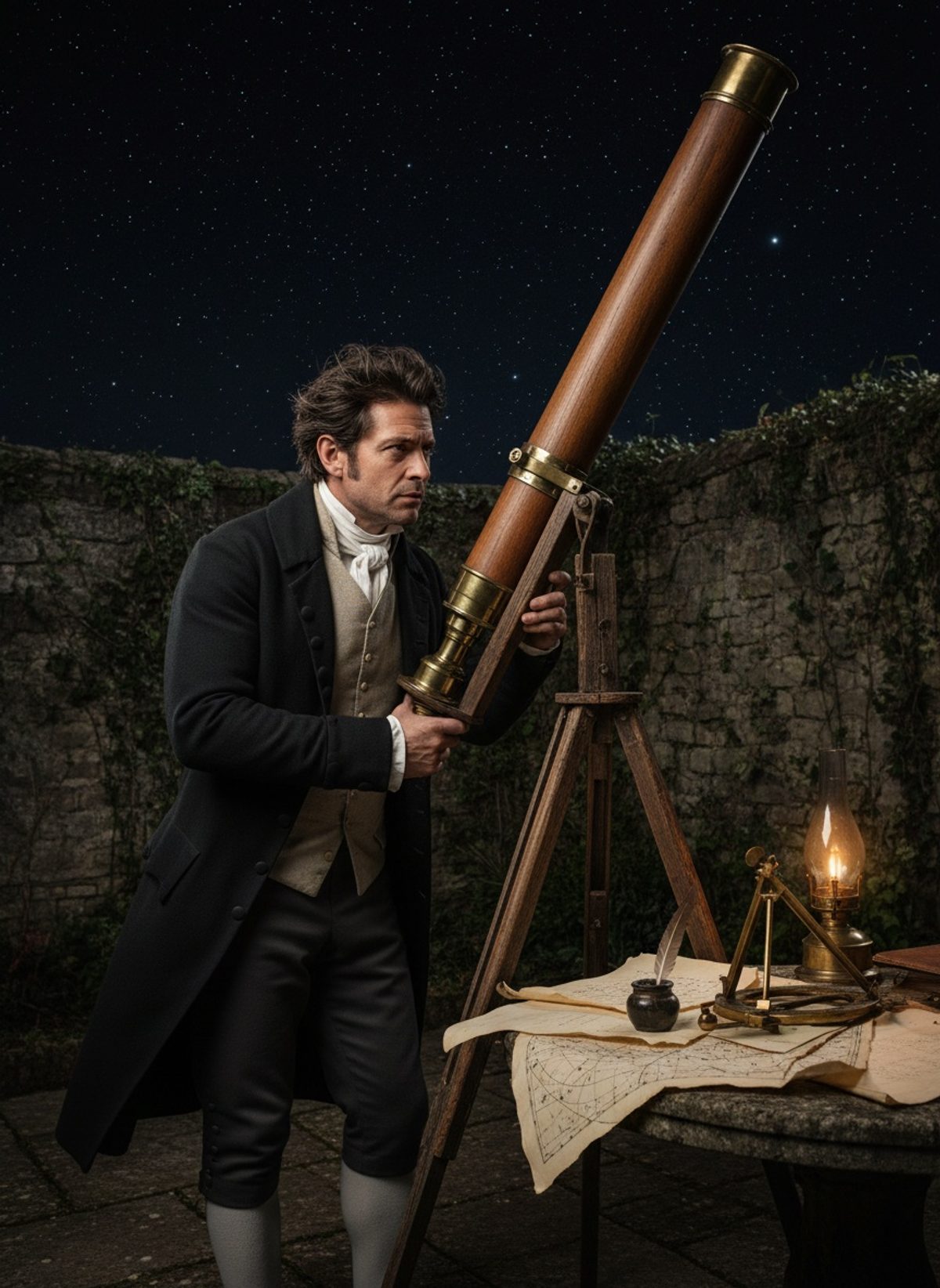
March 13, 1781. The chill of an English evening settled over Bath, shrouding it in silence save for the occasional trill of a distant nightingale.
A Celestial Symphony
Amidst the muted hum of this Georgian town, William Herschel hunched over his telescope, eyes alight with the stubborn flicker of curiosity that had kindled his nights more than any candle. A musician by trade, Herschel was no stranger to orchestrating harmonies that dance along the strings of violins and echo through grand halls. Yet here, in the earthy embrace of his garden, it was the cosmos that his heart composed—a symphony of stars, each note a shimmering testament to the vastness beyond the human grasp.
Not just any symphony, for Herschel wielded an instrument of his own making. His telescope—crafted meticulously by his own hands, each lens ground with precision and passion—was unlike any other. It was the extension of his vision, literally and metaphorically, into spaces where no human eyes had dared venture. While Bath's streets slumbered under a canopy of constellations, William's boundless curiosity propelled him into these star-strewn realms.
On that fateful March evening, as his gaze swept the heavens, something peculiar arrested his attention. Amidst the familiar constellations, a faint object persisted in defying invisibility. It moved contrary to the stars, slow and determined—a whisper in the vast arena of the night sky. Not a star, not a comet, this enigma was a celestial puzzle begging for resolution.
Read next: The Day a Joiner's Son Gave the World Its First Steam Hammer
The Unveiling of Uranus
The discovery of this mysterious wanderer was an astronomical milestone that reshaped the boundaries of the known universe. For centuries, since ancient astronomers had first recorded their observations, five planets danced within the earth's celestial sphere: Mercury, Venus, Mars, Jupiter, and Saturn. No more. With his unyielding determination and homemade telescope, Herschel had stumbled upon an uncharted world.
This new planet would come to be known as Uranus, a name rooted in myth and the heavens, suggested by Johann Elert Bode, an influential astronomer of the time. The implications of this discovery were profound. The very idea that the cosmos held more secrets than humanity had fathomed reverberated through the halls of scientific inquiry and beyond. The solar system, once constrained to the observations of antiquity, now found its boundaries expanded, its map rewritten by the hand of a simple Yorkshire-born musician turned astronomer.
Yet, this was no overnight revelation. In an era where science was as much philosophy as it was empirical study, Herschel's findings initially faced skepticism. Indeed, the recognition of Uranus as a planet was informed as much by Herschel's meticulous notes and robust reasoning as it was by his infectious zeal. Within a few years, the scientific community acquiesced, and Herschel’s rouser of wonders was formally acknowledged as the seventh planet.
A Vision Beyond
One might wonder why this nocturne among the stars, played out in the solitude of an English garden, resonates so deeply today. In Herschel's era, the challenge of discovery was not a march towards mere knowledge but a quest for perspective. To gaze up at the unpredictable chaos above and find order was to reaffirm the human capacity for enlightenment—a defiant answer to the darkness of ignorance.
As we stand on the shoulders of such quietly defiant visionaries, Herschel's celestial breakthrough reminds us of an eternal truth: that the act of discovery is not confined to knowing; it is the rekindling of wonder, the stirring of imagination, and the quiet rebellion against the boundaries that others presume eternal. Even in the smallest of gardens, under the smallest patches of sky, worlds await the gaze of those daring enough to look beyond and chart the uncharted. Herschel’s legacy is not merely of scientific achievement but of the enduring human spirit's reaching beyond the confining veil of its time. As we look to the heavens and beyond, we are reminded that each new discovery is a step towards the infinite possibilities of the universe—a testament to those who dare to dream beneath its stars.