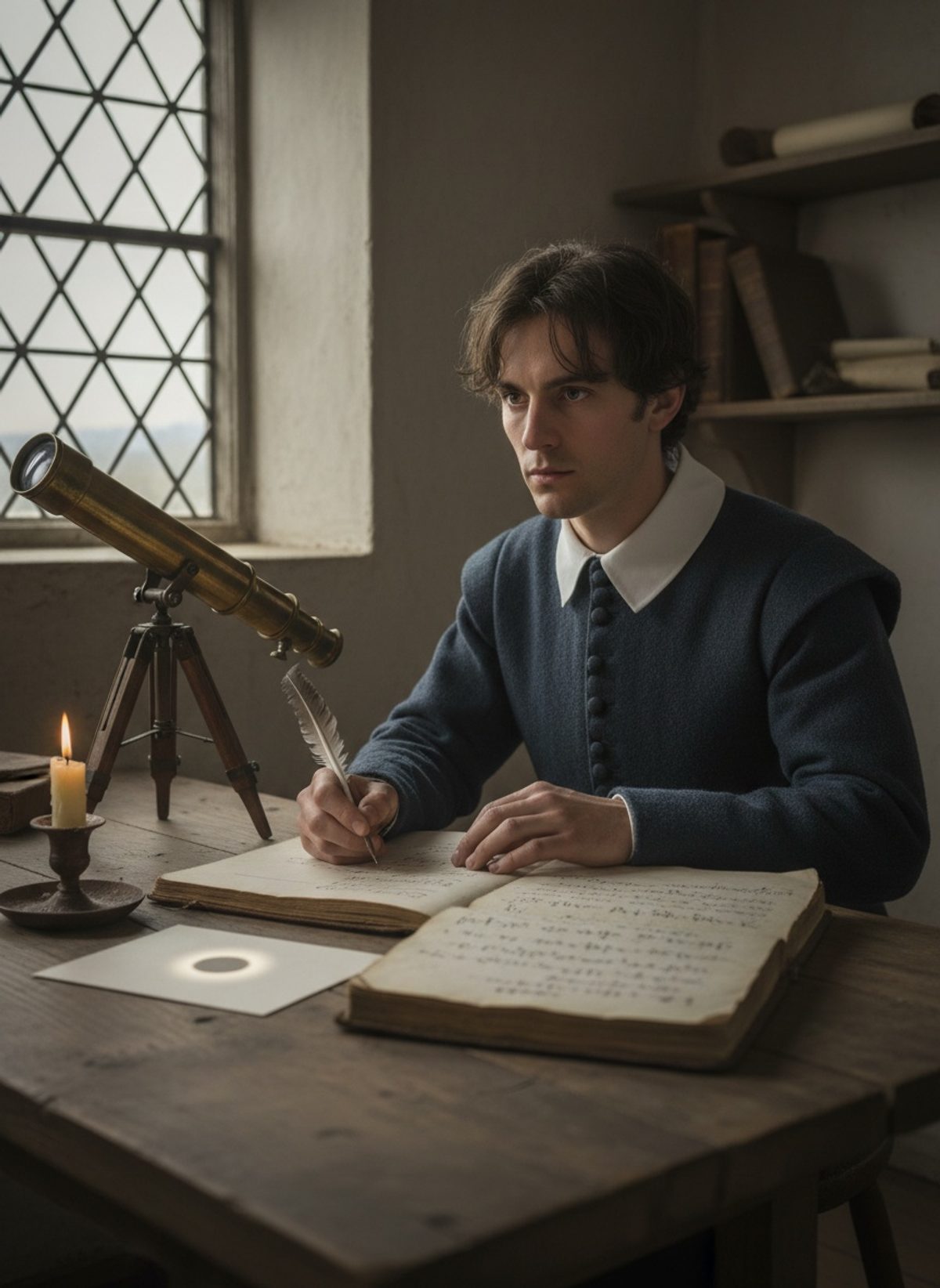
He could read by the age of two. Before he was in his twenties, Thomas Young was ready to challenge a cornerstone of modern science. His audacity lit the way to a groundbreaking revelation.
The Unlikely Challenger
Dr. Thomas Young, hailing from the pastoral heartlands of Somerset, was a polymath in the truest sense. Known as a physician, but with a mind that traversed realms from languages to the depths of optics, Young was an unexpected figure to shake the foundations of scientific orthodoxy. At the dawn of the 19th century, the reputation of Isaac Newton was like a towering edifice—unchallenged and seemingly unchallengeable. Newton’s theory of light as particles was gospel, written into the intellectual fabric of the time. Nobody, it seemed, had thought to seriously question the great mind's conclusions.
Yet, Young was not one to be constrained by the prevailing winds of thought. By the age of 14, he was already a master of several languages, and his curiosity knew no bounds. It was this remarkable intellectual versatility that armed him with the tools needed to innovate—a fertile ground for his daring experiment that would confront the behemoth of Newtonian theory.
The Candlelight Experiment
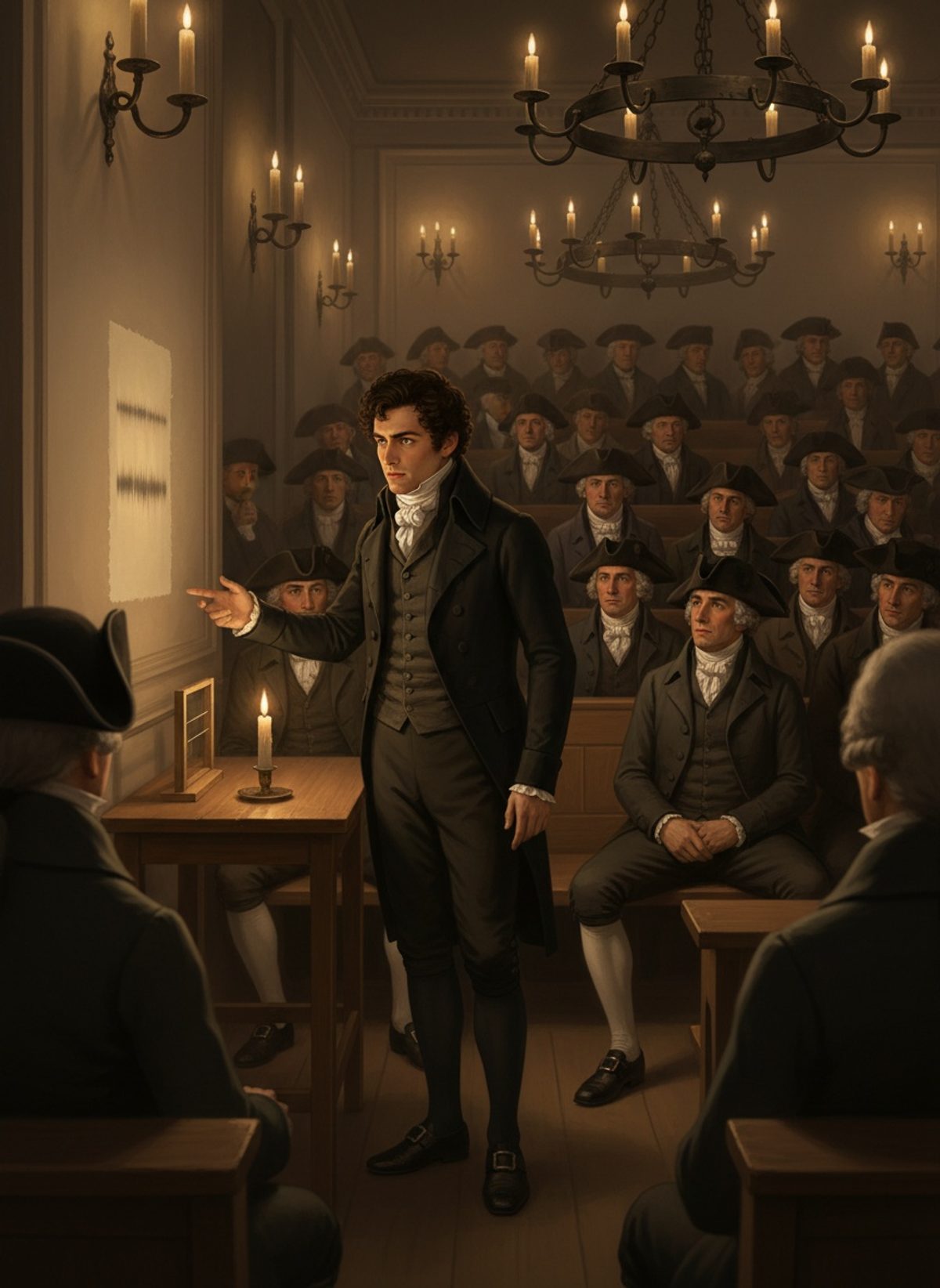
The setting was the Royal Institution, a venue where London’s finest minds gathered expecting little more than affirmations of known truths. The year was 1801. On this particular occasion, however, the air was electrified with an undercurrent of something different. The genial Young stood before an assembly of eminent scientists. With simplicity that belied its seismic implications, Young placed his apparatus—a mere candle and a meticulous setup of slits—at the center of attention.
Read next: The Day a Glassmaker's Son Gave the World Its First Telephone
He illuminated the room with little more than a glimmering candle. As its light passed through two slender slits, the audience, steeped in Newtonian theory, anticipated merely two images on the opposite wall. What appeared, though, startled them. Instead of two clear streaks, they saw interferences of light and dark—an expression of waves overlapping and negating one another, much like ripples in a pond.
Young stood there, his demonstration unembellished but profound. This was no elaborate contraption suggesting complex trickery—just the simplest of means painting a revolutionary picture. It was a sight as mesmerizing as unexpected, an arrangement that courageously suggested light might not always march through nature as a regiment of particles.
Breaking the Mold
The reception was a blend of astonishment and skepticism. Many in the room had spent their lives venerating Newton, whose particle theory of light was rooted deep in their beliefs. How could a young physician—armed with little more than curiosity and logical deduction—dare to reverse a century of certainty? Such was the bravery and clear-sightedness of Thomas Young, whose model suggested that light could behave as a wave.
Young’s assertion hinged on the principle of interference—a common occurrence in water waves but hardly imagined for light. His work proposed that light's interaction with thin structures, a phenomenon observable right before one's eyes, could reflect complex underlying processes. It was an idea at once too straightforward and too profound. Ironically, the complexity of nature was being untangled through simplicity.
Reverberating Through Time
Though Young’s ideas faced resistance, they gradually gained ground, shepherded by subsequent scientists like Augustin-Jean Fresnel in France. Over the years, Young’s double-slit experiment became a bedrock demonstration in physics, laying the groundwork for wave theory in optics. In the vast corridors of scientific exploration, his insight traveled further, intersecting with quantum mechanics and enlightening our understanding about the dual nature of light.
In an era governed by certainty, Young's story remains a powerful illustration of the courage it takes to look beyond the revered and discover anew. A single candle and some slits; from such humble beginnings sprang a change that would ripple through the ages. It serves as a poignant reminder that true exploration lies not in the comfort of past knowledge but in the courage to see with fresh eyes, to question—like Young did—the very lights that guide us.