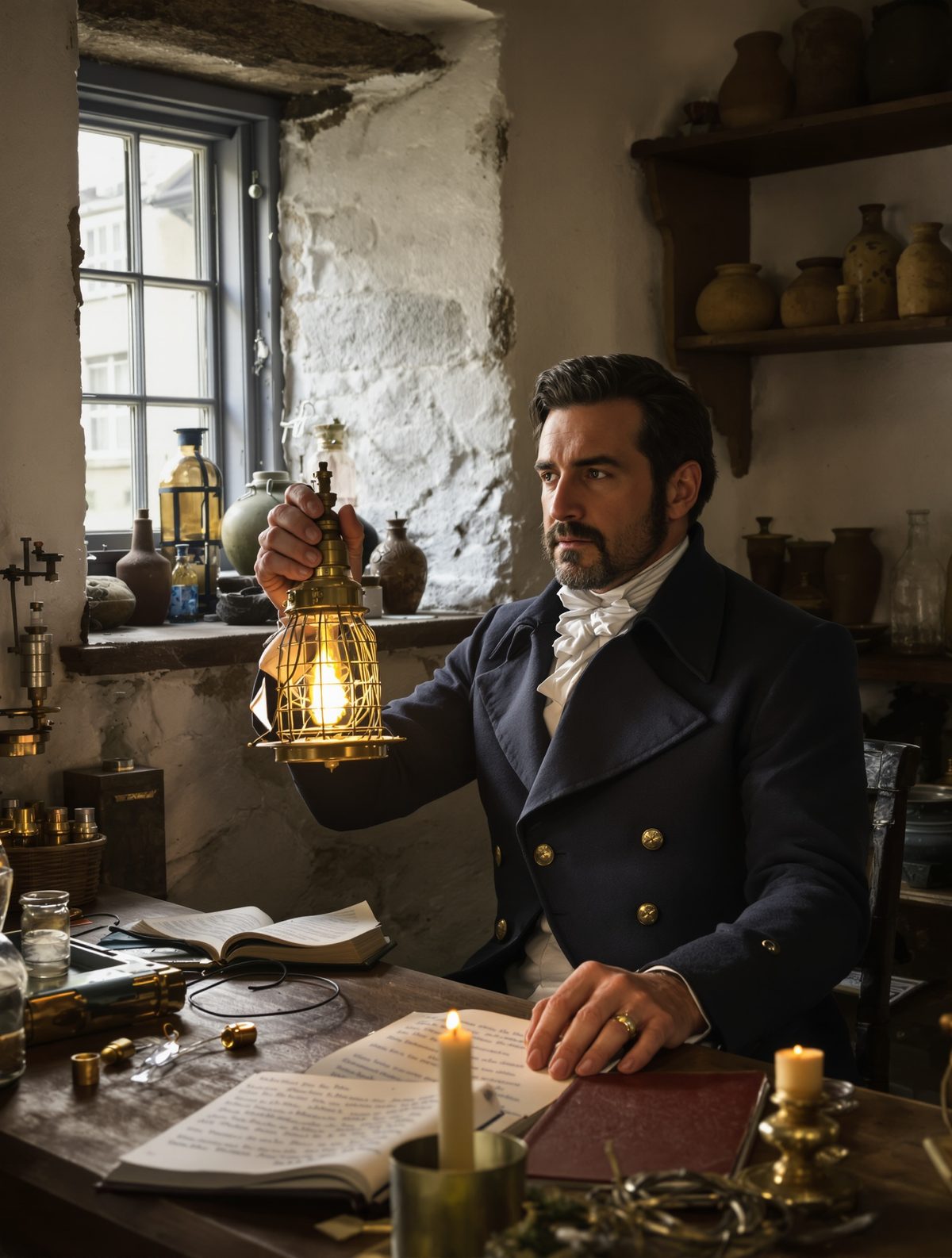
Imagine descending into the belly of the earth, where shadows dance with the flickering lights of miners’ lamps, aware that a single spark can transform the depths into a fiery tomb. The volatile and invisible foe — firedamp, a noxious blend of methane and air — looms over every moment. In the early 19th-century coalfields of northern England, this was an everyday terror. Yet, from these perilous depths emerged stories of profound ingenuity and bravery. Among these was the tale of a young Cornish chemist, Humphry Davy, whose gift to the world was not a discovery hoarded but freely given — a lamp that brought light without destruction.
The Perilous World Beneath
The dawn of the industrial age was ignited by coal, fueling a burgeoning empire and a new era of production. It was a time when the soot-streaked miners of northern England ventured into the gloom of mines that sprawled like dark labyrinths beneath towns and moors. Day by day, they chipped away at the coal seams, their thoughts ever aware of the deadly firedamp. In 1812, a catastrophic explosion at Felling Colliery killed 92 men and boys, a grim reminder of the lurking peril. Open flames hung on miners’ caps only worsened the risk, a necessary peril in the absence of a safer alternative.
A Challenge Delivered
Enter Sir Humphry Davy, born in 1778 to the humblest of beginnings in Penzance, Cornwall. Davy, by his late twenties, had carved a name for himself in scientific circles through his work with nitrous oxide, famously known as laughing gas. By 1815, the horrors of mine explosions had reached such a climax that Davy was presented with a morbid request: create a lamp that could withstand the explosive temperament of mine air. Working in a small cottage in the town of Alston, Davy accepted the challenge in September 1815, armed only with a sample of deadly gas and his razor-sharp intellect.
Illuminating Genius
In the secluded confines of the Alston cottage, Davy began a six-week journey through the web of chemistry and mechanics. By understanding the nature of combustion and the properties of gases, he formulated a revolutionary concept: a screen made of fine metal gauze. The gauze permitted light while dissipating heat, preventing the ignition of explosive gases outside the lamp enclosure. Davy's invention was a steel gauze encasing the flame, acting as a barrier against the deadly firedamp, a feat of engineering with uncanny simplicity. By December 1815, the first prototype was ready, and subsequent tests in Newcastle mines proved it a success, saving innumerable lives from that moment forward.
Selfless Science
In an era when patents were beginning to define legacies, Davy made a choice that set him apart from the industrialists of his age: he chose not to patent his invention. Instead, viewing the lamp as a vital contribution to the public good, he released it to the world — a gift, freely given. The "Davy Lamp" not only became a standard tool for miners but it also symbolized the scientist’s role in serving humanity. This decision positioned Davy as both a scientific luminary and a humanitarian, lighting both the minds and fields of the Industrial Revolution.
Beyond the Flame
Davy’s ambitions and contributions did not end with the miner's lamp. He was knighted in 1812 and went on to make significant contributions to the field of electrochemistry, isolating elements such as sodium and potassium. Yet, despite his various accolades, it is the unpatented miner’s lamp that remains his most profound legacy. It is emblematic of a science that stands for service, more than personal gain. The tragedy of so many lives lost to preventable accidents was transformed into a safer dawn for workers around the world, due to Davy’s singular effort in applying scientific thought to an urgent problem.
A Legacy That Burns Brighter Still
In the centuries since Davy transformed the mining industry, the principles of selflessness and innovation continue to resonate. Today, the challenge of harnessing science for public welfare remains imperative amid issues like climate change, resource scarcity, and global health crises. Humphry Davy’s life serves as a beacon for future generations of inventors and scientists, reminding us all of the potential within ingenuity, compassion, and the courage to light up the dark corridors of human endeavor. In the story of a lamp that “could not kill,” Davy illuminated the path that technology should tread—where the gift of knowledge is a light for all.