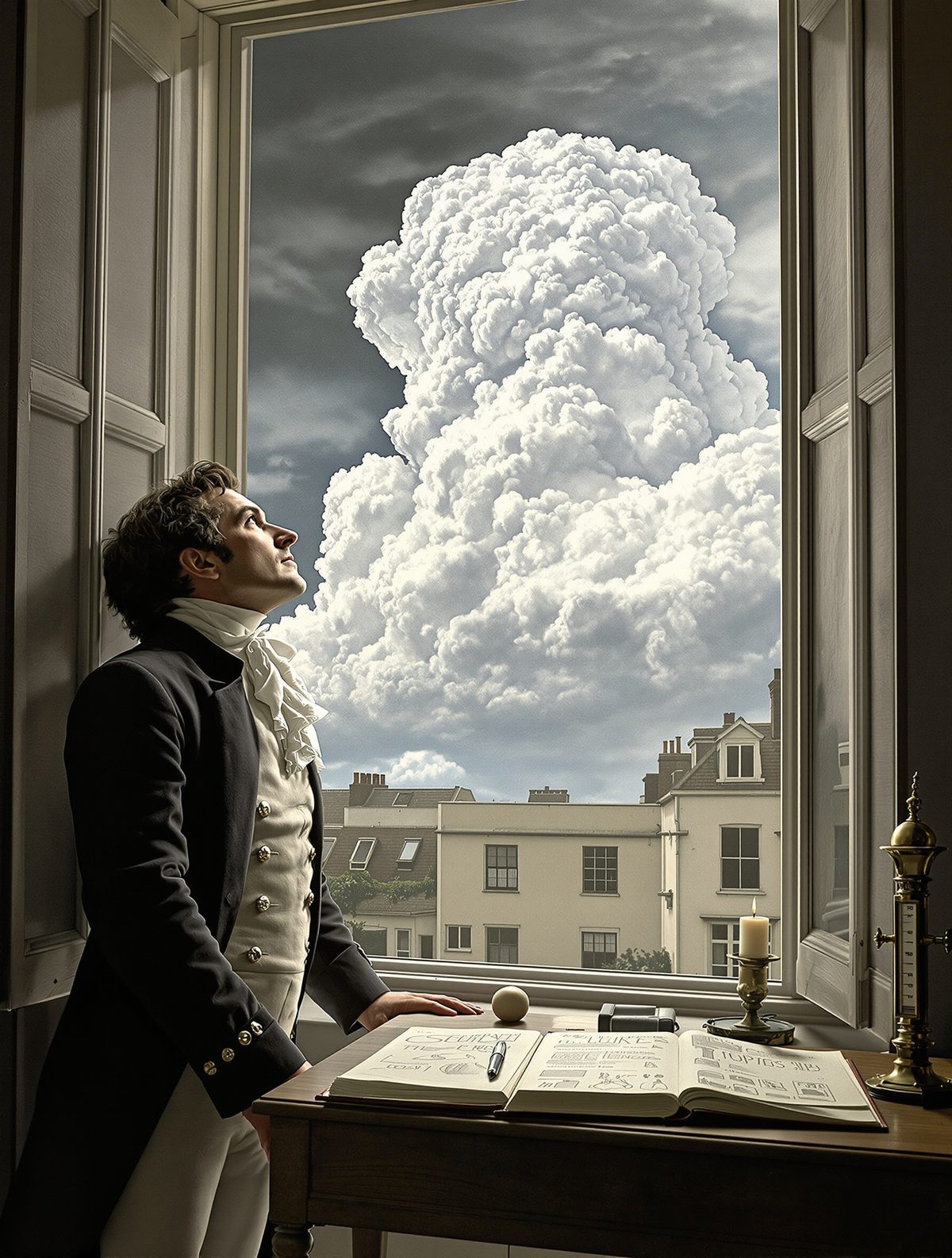
In the frost-bitten winter of 1820, when the River Thames lay encased in ice and London's rooftops flinched under the chill of the Great Frost, a Yorkshire-born Quaker sat at his desk, entirely unfazed by the biting winds beyond his window. That man was Luke Howard, a pharmacist by trade, a meteorologist by calling, and on this day, he was about to create a legacy that would transcend centuries.
The Boy Who Named the Clouds
Born in 1772 in London to a devout Quaker family, young Luke Howard possessed an insatiable curiosity about the world that enveloped him, particularly the skies. Formal science education was not his path; instead, he embraced his surroundings with a keen, observational eye. Howard’s professional journey began in a pharmacist’s workshop where, amidst the vials and scents, his mind wandered upwards to the celestial canvas.
At a time when scientific exploration and discovery were predominantly the domains of the university-educated elite, Howard broke barriers by naming the clouds — cumulus, stratus, cirrus — thus gifting meteorology a vernacular as uplifting as the skies themselves. The clouds had been a source of wonder and metaphor for centuries, but it was Howard's structured nomenclature in his 1803 treatise, *"On the Modification of Clouds,"* that transformed a poetic fascination into descriptive science.
From the Apothecary to the Atmosphere
The intrigue of clouds could have all too easily been dismissed as an absurd hobby for anyone else. Yet Howard found recognition among the intellectuals of his time. His classification of clouds was adopted almost immediately in meteorological science across Europe, a testament to its clarity and applicability.
Read next: The Day a Baronet Stood Up in Court and Freed His Slaves
What makes Howard’s achievements more remarkable is his background. Without university training, financial backing, or institutional support, he channeled his zeal into creating paradigms from scratch. Howard worked by day in the pharmacy but spent his nights observing and documenting weather changes — a true autodidact whose work was powered by passion and pursued in solitude.
The Frost That Encircled a City
In the year 1820, London's winter was whimsically monstrous. The Great Frost set in, and the city was gripped in an icy clasp. The citizens of London, clad in their heavy woolens and darting through streets filled with the sharp whisper of icy winds, could hardly fathom the potentials of documenting such weather. Yet for Howard, the frost was an opportunity to delve deeper into atmospheric phenomena.
While others saw only white and felt only cold, Howard saw patterns. Despite the harsh conditions, he systematically captured atmospheric data. The frosty tableaux painted by nature became Howard's fountain of knowledge. With precision and rigor, he drew upon his previous work on clouds and translated it into the language of weather.
The Groundbreaking Mapping of 1820
The winter of 1820 is significant not merely for its harshness but for the fact that it inspired Howard to create one of the most important innovations in meteorology — the first weather map. Using recordings from London’s bitterest nights, Howard meticulously mapped atmospheric conditions, setting a precedent for future meteorological cartography.
Before Howard's effort, weather was tersely noted in naval logs and parish records, often overshadowed by more urgent concerns. But Howard’s map embraced the concept of weather as a variable yet determinable phenomenon. He crafted a visual representation of meteorological data — an original manifestation of what we today might easily pull up on a smartphone.
A Legacy in the Skies
As horse-drawn carriages creaked over icy cobblestones and the echo of bells rang through the frozen air, few could have foreseen the impact of Howard's work. His methods for cloud classification and his weather map laid the groundwork for modern meteorology, influencing notable scientists such as FitzRoy and Darwin, and eventually all of weather science.
Luke Howard died in 1864, well before the era of satellites and Doppler radar, yet his contributions indelibly shaped our understanding of and interaction with mankind’s most universal experience — the weather. His work symbolized a shift in perspective, valuing observation and documentation over philosophical ponderings, marking a significant progression of scientific inquiry.
Why This Matters Today
Fast forward to the present, where climate change and extreme weather conditions command global attention. Howard’s pioneering efforts seem ever more prescient. In an era when the unpredictable nature of weather impacts agriculture, economics, and everyday life, the legacy of a Yorkshire farmer's son underscores the importance of curiosity, resilience, and seeing potential where others do not.
Luke Howard's vision turned the transient sky into a permanent archive, demonstrating that even in the absence of formal education or institutional support, profound contributions to human knowledge are always attainable for those who pursue them with unwavering dedication.
He painted the sky with new brushstrokes and left a legacy that encourages today's explorers and innovators to look beyond the obvious — to pierce the clouds of uncertainty and chart new paths in the pursuit of understanding our world.