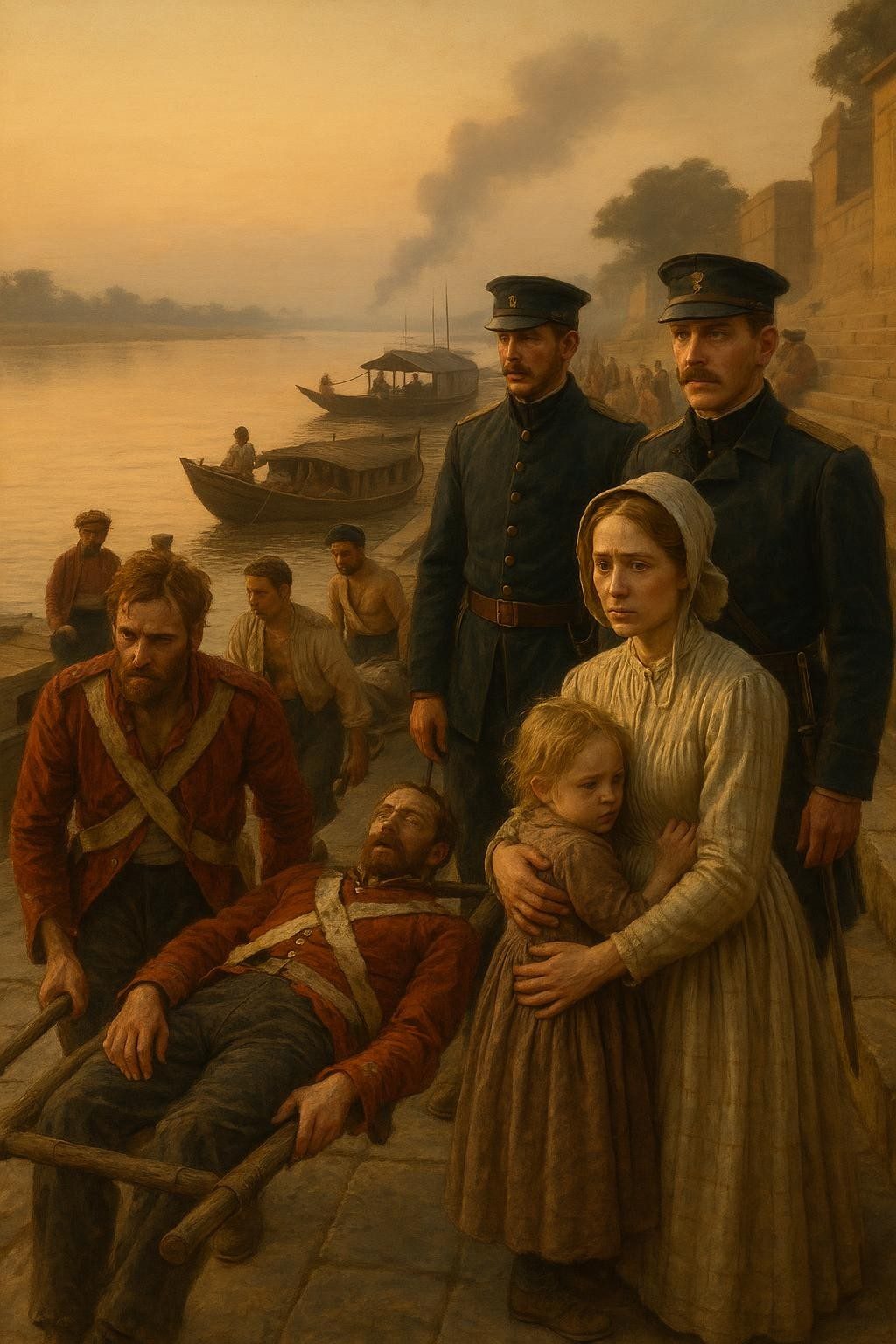
The air clung heavy and oppressive, the heat of June bearing down as if all the sun's wrath had concentrated upon the earth. The landscape lay dry and parched, with only the shimmering bank of the river Ganges promising a semblance of relief. But even the great river seemed subdued, its waters languid and murky. Birdsong had been long silenced, replaced by the thrumming tension of a desperate hope, as nine hundred British souls looked eastward to see their savior approach. The wind carried an acrid mix of smoke and dust, whispering of the three harrowing weeks of relentless siege they had endured. The promise of deliverance was at hand, the promise spoken by a man they knew as their enemy, yet few had strength beyond clinging to any chance of survival.
It was the summer of 1857, a pivotal year in the Victorian epoch, when the vicious uprising known as the Indian Rebellion, or the Sepoy Mutiny, weave its bloody tapestry across the Annex of the British Empire. Cawnpore was beset, the siege laying waste to its sunlit streets and colonial charm. Here the British had entrenched themselves in their entrenched refuge, combating not merely with arms but with hunger, disease, and the unbearable heat. Within their fortified compound, melancholy mingled with determination as they awaited a reprieve that refused to come. Cholera spread like a phantom, thirst clawed at their throats, and those early dreams of Empire shone dull and tarnished.
Among them was dread and skepticism. Nana Sahib, a prominent leader of the uprising, had offered safe passage to Allahabad. It was an offer nearly too cruel to trust. But these beleaguered individuals, whose ranks spanned from soldier to spouse, child to civilian, were left with little choice but to accept the uncertain terms. For their wills were waning and beside the risks of betrayal, a grim certitude hovered: stay and surely perish. Thus, they made their decision. Tentatively and with what scant hope they could muster, the beleaguered survivors began their march to Satichaura Ghat.
The morning broke softer than expected, the dawn cool against skin burnt and parched. The spectral quiet as they trekked to the water's edge was both a mercy and a menace. Satichaura Ghat lay like many river lands along the Ganges, its steps descending sharply into the silvery tide, boats moored like sleeping leviathans. Faces drawn, hearts thundering, they filled these vessels, trusting them to journey back to safety. Yet, as the oars dipped into the water's calm surface, that first glimpse of reassurance was shattered by the crackle of gunfire. Betrayal stained an already turbulent history.
Read next: The Day a Widow's Son Lit Up the Victorian Night
The river, it appeared, was not merely an avenue for troubled passage but a silent theatre of massacre. Those who thought themselves saved faced instead a calculated ambush, orchestrated by those they believed had a vested interest in their departure — an escape was never the intent. The sound of rifles rang unrelenting through the morning haze, mingling with the cries of horror and discord. Innocents and fighters alike slumped against each other, some meeting their end before even understanding the foulness of the betrayal. As the bodies slipped beneath the water’s surface, stories would later say that not even the heavens wept, for the skies remained relentlessly blue and unsparing.
What transpired at Satichaura Ghat resonated beyond the banks of the Ganges, reverberating through the corridors of power and in the murmurs of hushed conversations back in Britain. British colonial policy in India was to be scrutinized, with cries for retribution mixing with declarations lamenting those lost. The river, sacred in the Indian subcontinent, had witnessed an atrocity that would sear into the collective memory, the incident serving as a catalyst for retribution that would define the rebellion's harsh conclusion.
As night cloaked the Ghat in shadows, word spread of those survivors, torn from the river only to meet a crueler fate. For many who were transported back to Cawnpore, survival offered no sanctuary. They were held captive in the grim confines of the Bibighar, their continued existence conditional on revolt against the English crown. Their hopes, once buoyed by the prospect of deliverance, succumbed to a reality defined by captivity and hopelessness.
Days later, as disorder consumed the region, a rescue did come, but not for those who had banked their trust upon deceitful assurances. Cawnpore was retaken by British forces; however, vengeance writ its own tragic path, sowing seeds of further violence and reprisals upon those associated with the mutiny. What unfolded at Cawnpore came to symbolize the brutal tit-for-tat that defined both sides of this conflict, stitching scars that would run deep through Britain's imperial tapestry and India’s own road to freedom.
Reflecting on this dark episode, there is a haunting resonance in the lesson learned at the banks of the Ganges. It underscores the fragility of human morality when power contests principle, echoing the perennial struggle defined by imperial ambition and the devastating costs it exacts. As much an act of treachery as a tragic inevitability, the massacre at Satichaura encapsulates the vulnerability of those caught between binaries of dominion and resistance. With echoes reaching through history, the story of those nine hundred souls endures not merely as a tale of betrayal but a profound reminder of how far humanity will go when driven by the fever of revolt intertwined with the lucidity of faded hope. Repose rests uneasily beside remembrance, against a river whose waters took more than they gave that fateful June morning.