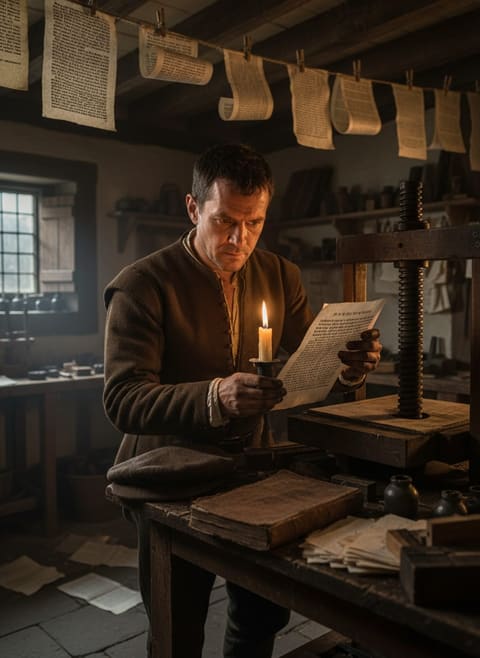
His hand was marred and twisted, yet he found dexterity others only dreamed of. John Pounds, the man who would mend more than shoes, spent his whole life defying expectation.
Patching More Than Soles
In the heart of Victorian England, a city wrestling with the growing pains of industrialization, the poorest were often invisible. London, not unlike many urban centers of its day, bustled with enormity and indifference. For John Pounds, a cobbler from Portsmouth, this was unacceptable. Crippled by a childhood accident that left his body broken but his spirit unyielding, he could have easily slipped into obscurity, just another face among legions of struggling workers. Instead, Pounds stitched together a revolution as quietly as he repaired the shoes of well-heeled patrons.
His workshop, cramped and austere, was a haven amidst the tumult. With a heart that seemed to mirror the city's vast expanse, Pounds welcomed the tattered and neglected children of the rookeries. These slums were festering with disease and despair, breeding grounds not just for fever but for destitution and illiteracy. It was in this cauldron of hardship that John Pounds found his purpose. With no formal training or institutional support, the cobbler began teaching hungry eyes and eager minds, instructing them on the basics of reading and arithmetic even as he earnestly repaired the worn-down footwear of more affluent clients.
The model was deceptively simple but profoundly impactful. A single cramped room, dimly lit and perfumed with the murky smell of leather, became a classroom. Pounds might have appeared to be anything but a teacher—his posture was stooped, a consequence of his physical difficulties, and his fingers calloused from years of labor. Yet he exemplified resilience. Children flocked to him, seeking not just knowledge but affirmation that someone did care about their plight. What began as a modest effort quickly took root in the minds of a community grappling with the shadows of disenfranchisement.
Read next: The Day a Cornish Surgeon Walked Into a Condemned Cell
From Sole Trader to Social Innovator
Pounds’ work may have seemed inconsequential to the broader machinations of a country in the midst of the Industrial Revolution, but what he accomplished was revolutionary in its simplicity. In a society that often judged worth by wealth and social standing, Pounds’ initiative quietly challenged prevailing hierarchies. He was a shoemaker, a builder of shoes, but he became unwittingly a builder of futures. The ripple effect of his creation, the ragged school, extended far beyond anything he himself could have predicted.
The ragged schools became emblematic of a profound yet overlooked movement within the social reform efforts of the Victorian era. These were not merely places for children to gather but sanctuaries from the brutal realities of their everyday existence. While Dickens and others wrote of the tragedy and squalor faced by London's poor, Pounds performed an act of subtle defiance with every lesson he taught. He offered a chance to escape the deterministic cycle of poverty endemic to the era.
Read next: The Day a Vicar's Son Walked Into a Debtor's Cell and Freed Them All
John Pounds inspired others to follow in his path, the most notable being Thomas Guthrie who, roused by the tales of the cobbler’s impact, established several ragged schools across Britain. Pounds' influence coursed like a hidden stream beneath the surface of Victorian society, unseen yet nourishing a movement that would demand reform. The matter-of-fact benevolence of an individual with nothing to gain and everything to give reshaped public consciousness regarding education for the underprivileged. An everyday hero, Pounds modeled a kind of moral leadership that transcended the gross inequalities of his time.
A Legacy Bound with Thread
Though John Pounds passed away in 1839, decades before the fevered chaos of 1870, his legacy stitched pieces of society back together. The ragged schools would eventually form part of the impetus behind more structured educational reforms, culminating in the Elementary Education Act of 1870, which set the stage for compulsory education in England. His contribution was a patch woven into the quilt of larger social change.
What is compelling about John Pounds’ story is not just the breadth of its impact but its intimate inception. It serves to remind us that significant change often begins with small acts of kindness, driven by an unyielding commitment to justice and equality. His narrative compels us to consider who we might overlook in our modern-day shuffle, just as Pounds saw potential in every child who crossed the threshold of his shop. John Pounds may have never left a grand estate or written a seminal work, but his life is a testament to the enduring power of grassroots action and the indomitable spirit of compassion. In his modesty, we find a reflection of possibility for our present and future, bound together with stitches of humanity and hope.