Most people have never heard of William Fothergill Cooke. They should have.
A Chance Encounter and an Unbelievable Claim
In the swirling fog of Victorian London, 1837, a scene unfolded that would alter the currents of history. While Londoners bustled through lamplit streets, a young inventor named William Fothergill Cooke entered a smoke-filled railway boardroom, itching with anticipation and nerves. Here was a man on the brink of unveiling a marvel that no one, not even the city's most forward-thinking skeptics, could yet comprehend. As Cooke stood before iron-faced investors, he made an audacious promise—to transmit messages faster than any could have imagined, swifter than the hoofbeats of the fastest horse courier.
Flanked by an ally in Charles Wheatstone, a prominent scientist, Cooke unfurled the idea that would electrify the Victorian era. His proposal defied conventional wisdom: messages sent not by physical means, but by wire, leaping across distances in a flash. Yet, it was not the words that shocked his audience, but the power of what he was about to demonstrate.
The Deaf Printer's Son and the Spark of Innovation
The singular man who would step into grandeur hailed from humble beginnings. The son of a deaf printer, Cooke did not find himself hindered by societal expectations; rather, he carried a keen sense of mechanics from a lineage acquainted with the page and ink. From the clatter of printing presses and the meticulous alignment of typefaces, young Cooke's curiosity evolved in unexpected ways, transforming into a fascination with electricity and its mysterious potential.
Read next: The Day a Miner's Son Gave the World Safe Light
Despite his modest beginnings, Cooke's intellect bridged worlds. He befriended scientific luminaries, absorbed their knowledge, and emerged with a vision—an electric telegraph. But the journey was far from straightforward. It was an uphill struggle fraught with doubt, setbacks, and the shadows of skepticism that loomed as large as London's winding alleys.
Electrifying Demonstrations and Skeptical Minds
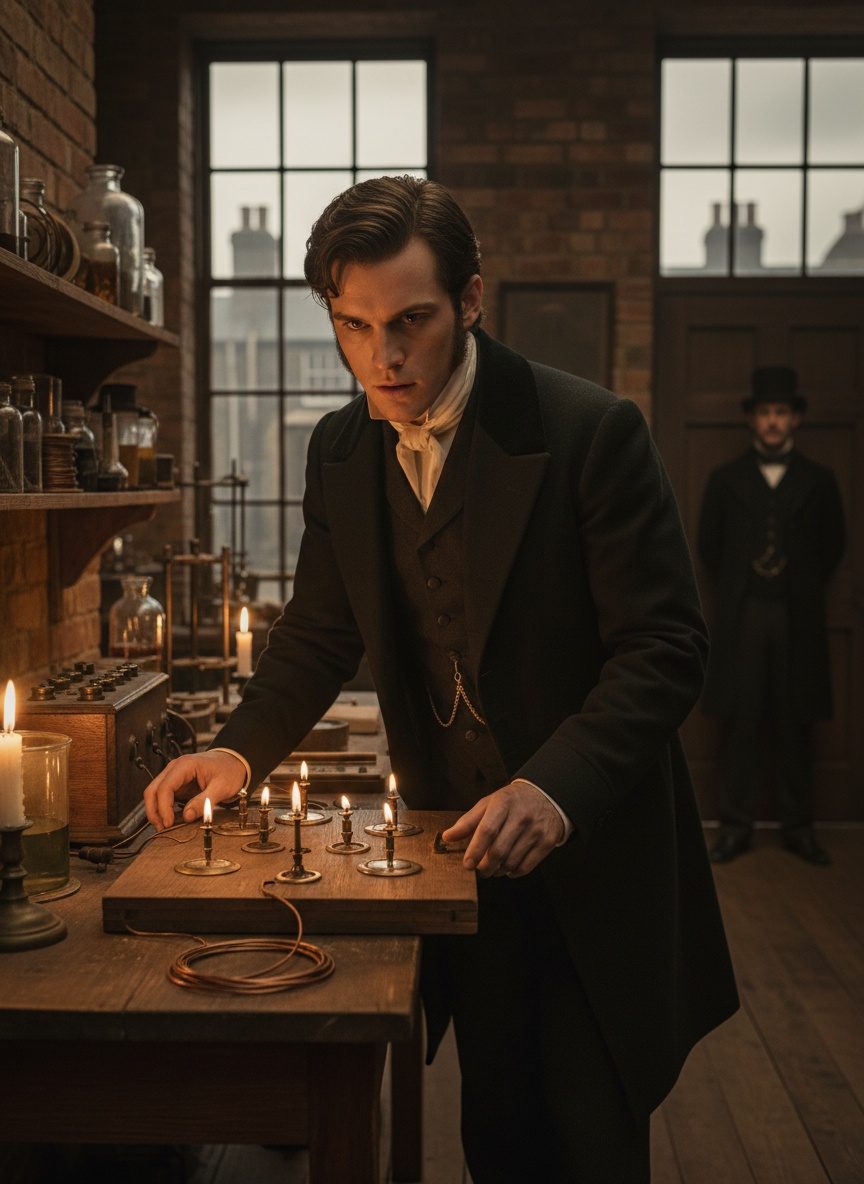
Cooke's opportunity to showcase his device came in a rather unconventional laboratory setting—a wire stretched between two rooms, glinting with promise. Across the building, anticipatory eyes tracked the wire's path, charged with suspended disbelief as Cooke's fingers hovered over the device's key. As he pressed down, the silence erupted in a new language—needles quivering, inscriptions dancing on dials, a message traversing space without a whisper.
With each keystroke, Cooke's electric telegraph translated electricity into information, bypassing the laborious, time-consuming methods of message relay that society had long accepted. Skeptic minds were astounded, the weight of centuries of tradition crumbling under the flutter of suspended metal needles. It was more than a solitary success; it was Cooke's declaration that communication would soon surpass the speed of imagination itself.
The Iron Horses Embrace the Spark
The railways, the bustling arteries of industrial Britain, were the first to embrace this technological godsend. British trains coursed the landscape like iron veins, binding the nation's cities and towns tighter than ever before. Rail operators, ever in search of efficiency, were among the first witnesses to the utility of Cooke's invention. The electric telegraph promised not just speed in messages, but safety—a means to avoid locomotive calamities resulting from miscommunication or delay.
In a blend of foresight and urgency, the railway directors agreed to install Cooke's telegraphic system. Signals made of dots and dashes now pulsed along railway lines, heralding a new era of secure, rapid communication. What began as a speculative venture in a dimly lit room became instrumental in the symphony of rail travel, ensuring schedules stayed precise and goods flowed uninterrupted across the empire.
Beyond the Telegraph's Initial Transmission
The fruits of Cooke and Wheatstone's electric telegraph extended far beyond the railways. Their collaborative genius found its way across the seas, stitching together colonies with the motherland through wire and pulse. Britain's imperial reach was electrically tethered, resonating through an intricate web of telegraphic lines veining the globe.
The implications of their invention spiraled outwards, heralding seismic shifts in commerce, journalism, and even warfare. As messages exchanged with unprecedented speed, geopolitical landscapes reeled and adapted. Nations harnessed this newfound propulsion, forever altering the trajectory of diplomacy and trade. Each dot and dash, each mine of wire strung across landscapes and oceans, resonated with the deaf printer son's legacy—a pioneer standing defiant against the passages of time.
In the echo of that first transmission, in a room where disbelief once took refuge, Cooke's brainchild bridged more than just physical distances; it converged ideas, cultures, and ambition—drawing a line through history from ignorance to illumination. As we consider the grasp of today’s instantaneous communication, let us not forget those rare innovators who dared to leap into the unknown, connecting us in ways once deemed impossible.