He was seventy years old. His legend was already sealed in stone yet his greatest hour was still to come.
The Broken Crown
In the tumultuous October of 1216, England found itself in a precarious situation. King John, a monarch often beleaguered by his own shortcomings, had been reduced to a shadow amidst a disastrous reign filled with grievances and the looming threat of civil war. His death left behind a country fractured and vulnerable. Prince Louis of France, seizing the discord, ruled London, and his influence extended its shadow across the landscape like a creeping tide. It seemed only a matter of time before England's sovereignty drowned beneath it.
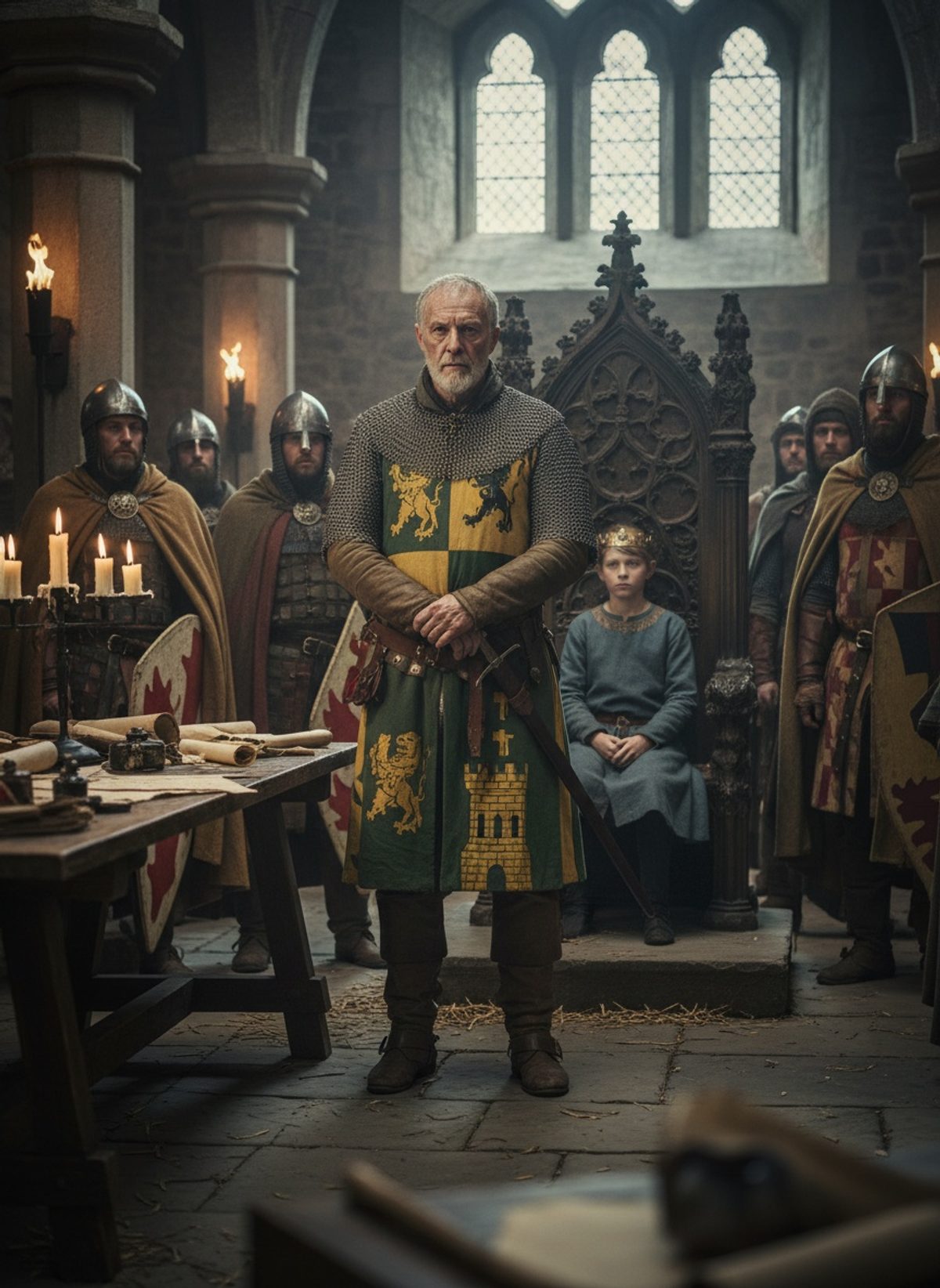
Enter the young and unassuming Henry, just nine years of age, newly crowned amidst the chaos to succeed his controversial father. The boy was thrust upon the throne, his small hands holding the reins of a kingdom on the brink. To many, he was a symbol of infancy, not strength — a puppet for the barons who held true and the French invader who sought to stake his claim. England needed more than a child; it needed a bulwark, a figure capable of uniting furious lords and standing firm against foreign encroachment. The man who stepped forward to fill this void was a figure of dignity and gallantry. Age may have held him tighter than any other weapon, but his resolve was as fierce and steadfast as ever — William Marshal, the Regent of England.
The Knight's Oath
William Marshal was a man whose life composed verses known throughout the knightly realms of medieval Europe. Born into the chaos of the 12th century and raised amid the turbulence of knightly combat, Marshal had cultivated a reputation that danced across banquet halls and echoed through battlefields. He was lauded as the "greatest knight that ever lived," a master of the joust, and a beacon of chivalric ideals. By the time England faced her 13th-century crisis, Marshal was not only a knight but a statesman whose experience was surpassed only by his loyalty to the crown.
Read next: The Day a Blacksmith's Son Faced a King and Did Not Flinch
The journey to his historic act of bravery began with vows made decades ago. Marshal had served loyally under four kings, witnessing them fall to trials and tribulations alike. As the regent, his wisdom was now called upon by a woefully divided council. Aged but undaunted, Marshal took his sword — the same weapon that had forged his legend — and swore allegiance to young King Henry. His voice cut through the uncertainty with clarity and strength, promising to guard the throne not just with brawn, but with guidance and wisdom.
Against a backdrop of suspicion and trepidation among England's barons, Marshal’s stature provided a rallying point. His presence reminded them of the oaths sworn to the Plantagenet line, conjuring a shared past strong enough to transcend the current rifts and single enemy encamped in London. The dying Earl’s resolve to act not as sovereign but as guardian lent weight to his honor and challenged those who wavered with a vision of a united realm.
The Battle for Unity
With Marshal’s leadership, England embarked on a course of pragmatic resistance that aimed to dislodge Prince Louis and his supporters. The task was immense. The French prince had acquired allegiances from discontented barons, many of whom saw France’s success as a route to their own gain. Marshal’s roots of loyalty grew deeper, nourished by relationships forged over decades. In leveraging these bonds, he bent the will of the warring lords towards a truer foe of French conquest.
Marshal orchestrated the defense with a tactician’s elegance, employing skirmishes in crucial territories fashioned to disrupt French advances and secure key strongholds that had faltered in allegiance. It was at this point, within the halls of Worcester Cathedral, that the coronation ceremony of young Henry amid sacred chants cemented Marshal’s status as the king’s steadfast protector and symbol of unwavering sovereignty. His was a united force battling time itself, not just the swords of divided loyalties.
The defining moment came at Lincoln in 1217, where Marshal’s strategy and leadership saw a decisive victory against Prince Louis’ forces, a turning point that began to tilt the scales away from chaos and foreign supremacy. William Marshal’s efforts did not just conquer invading armies but restored prestige to the young king’s rule. His breath and soul, though set to depart, had gifted a breath of life to England.
A Legacy of Loyalty
The chronicles of history often mark their legends by the warriors on battlefields. Yet in 1216, it wasn’t just swords but relentless dedication that shifted England’s fate. The tale of William Marshal, the seasoned knight who gave his final years to ensure a child-king’s ascension, rings as a profound echo of loyalty and honor. It challenges the very notion of age, positing instead the enduring power of experience and the wisdom of a life wholly devoted to service.
Marshal’s unwavering resolve not only reinvigorated faith in a splintered crown but safeguarded an inheritance of future struggles met with unity rather than discord. While much of the landscape of medieval England has faded into the world of dismissed annals, Marshal’s image stands carved in its soil, warning against treachery and foreign ambition. His story reminds us that the true weight of a crown rests not just on a ruler’s head but is steadied by the shoulders upon which it is borne.