October 19, 1216. The damp chill of a dim October morning clung to the stone walls of Gloucester Cathedral.
Within those somber walls, the echoes of footfalls and hushed whispers filled the air, a stark contrast to the tumult that raged outside. England, normally vibrant with its rich landscapes and bustling markets, found itself in the throes of uncertainty and division. Just days before, King John, infamous for losing Normandy and coercing the nobles with onerous taxes, had drawn his last, agonized breath. His reign had been turbulent, marked by arguments with the Pope, disputes with his own barons, and a kingdom teetering on the edge of collapse. Now, with the French forces of Prince Louis occupying half of England's lands, it seemed that John's death might finally open the door to foreign rule.
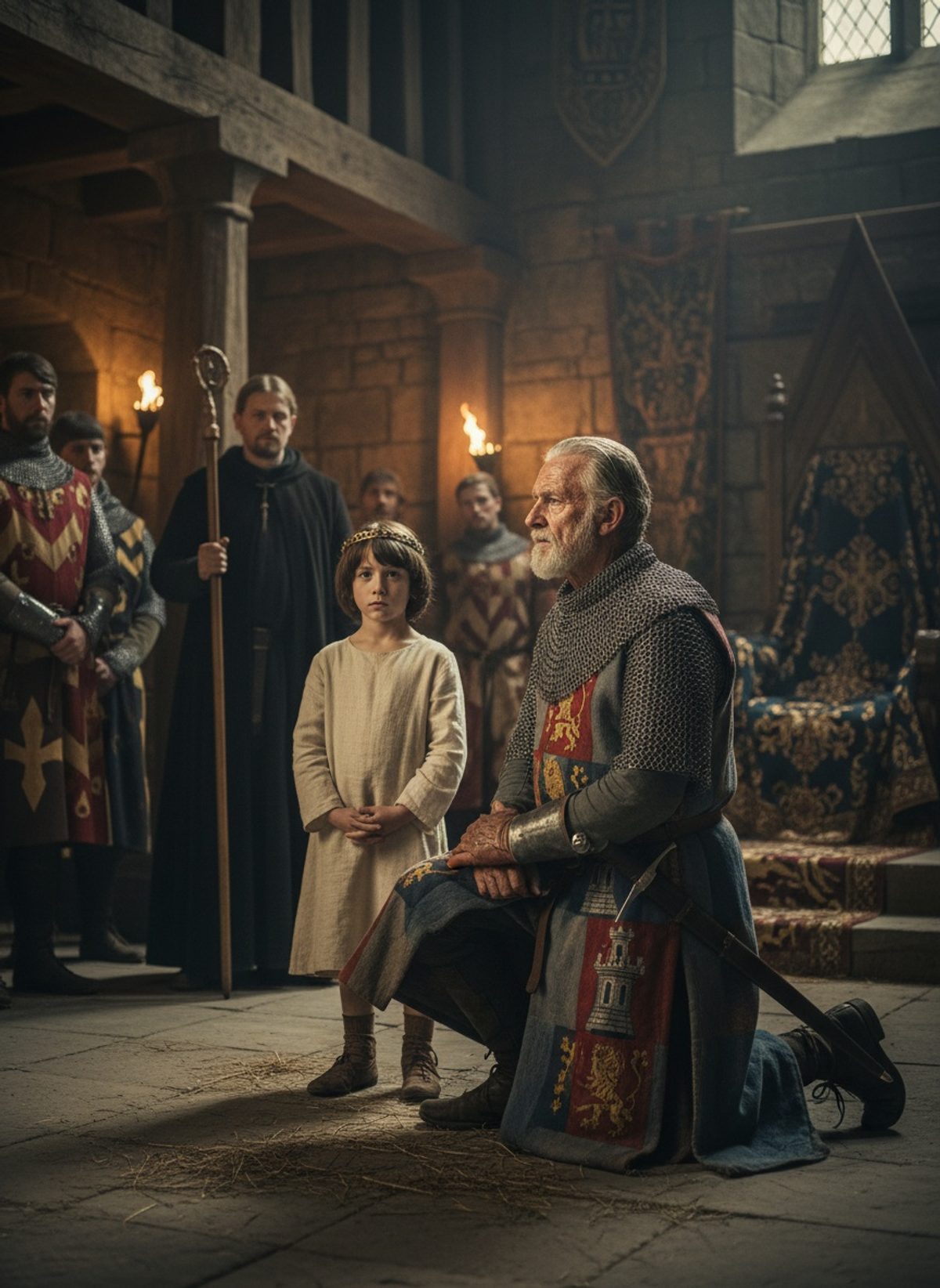
In these dark times, a boy of tender years, nine to be exact, stood at the center of the great cathedral's nave. It was here that Henry, John's son, was about to face a moment that would determine the future of the realm. Though his body was small and his age tender, the weight of the crown that hovered near his head was heavier than any crown that had graced the brow of a Plantagenet before him. Even the shimmering rush of his princely cloak could not obscure the enormity of the trial ahead. To his side, the great and legendary figure of William Marshal, Earl of Pembroke, a man well into the legacy-laden years of seventy, stood poised to enact a duty few could ever fathom.
William Marshal, known across the continent for his unmatched prowess and knightly honor, had been a steadfast ally of the Plantagenet dynasty. Both soldier and statesman, he possessed a reputation for not only martial skill but unwavering loyalty. On that fateful morning, Marshal's actions would echo through the halls of history. Stepping forward amidst whispers of uncertainty and eyes clouded with doubt, he took the symbolic circlet, a plain band devoid of the usual royal opulence, as if to signify England’s bare reality. Kneeling before the young Henry, he placed it gently upon his head, anointing the boy as King.
Read next: The Day a King Held Out His Hand to His Own Executioner
The simplicity of the act belied the magnitude of its implications. It was more than just a ceremony; it was a statement of allegiance and a moment that would rally the kingdom from the brink of division. William Marshal, bearing the forces of history upon his stalwart shoulders, then pledged his unyielding loyalty with a legendary vow: should need arise, he would bear Henry on his own back if the young king failed, even if the countryside quaked under every foreboding step.
It was no mere declaration of fealty, but a call to arms to all of England, a rally of unity to those still steadfast amidst the lure of foreign promise. It was not young Henry alone who found himself fortified by the Great Marshal’s words. The kingdom, fraught with dissonance, found threads of hope to weave into new strength. Knights who once skirmished in disagreement now found common purpose under Marshal’s influence, drawing in a protective circle around their nascent king.
The keen decision to crown Henry in Gloucester was no accident, for Gloucester was a locale less touched by rebellion, a stable outpost amidst the turbulence. Outside those protective walls, however, the baronial dissent had transformed into outright defiance. Castles abandoned the faltering standard of John for the would-be regent, Louis. The march of foreign boots in familiar soil too easily reminded the English of the ancient invasions best left in lore. But Marshal's decision to stand by the young King Henry served as a beacon, drawing the disparate Lords away from their foreign inclinations and back to the flicker of a native monarchy.
It was this steadfastness which William Marshal utilized as he moved swiftly across the land, weaving compromise and combat with a diplomat’s tongue and a warrior’s arm. Legitimacy and continuity fashioned a double-edged sword that Marshal deftly wielded to sever ties with the French. A master tactician in spirit and deed, Marshal took charge as regent, his veteran experience guiding England amidst the tempest. For the realm knew no greater guardianship than his: wise and judicious, resolute and empathetic. From the newly flowered Kingship of Henry to the lofty echelons of the baronage, it was the elder statesman that unified intentions and reconciled old grievances.
The efforts bore quick fruit. The tide that had risen to support young Prince Louis of France now found itself challenged by the unyielding resolve of English identity and loyalty. Battles and negotiations ensued, not mere contests of steel, but cerebral campaigns for allegiance. Within months, the principal instigators of rebellion began to falter in their resolve. Recognizing the weight and wisdom of Marshal’s regency, many barons returned to their English loyalties. By reinstating the masterfully revised Magna Carta, Marshal quelled much of the discontent that had fueled the initial call for French intervention. It was now a charter no longer stained by acrimony but rather polished into a promise of balance.
In these transformations lay the seeds of what would become a resilient dynasty. The paper crown once made sturdy drew breath from Marshal’s tutelage, shaping young Henry into a king of necessity and competence. As détente replaced despair, season by season, the odorous tide of conflict receded into history’s embers, leaving in its wake the model of an enduring monarchy. Yet the tale also stands as a testament to the power of individual influence upon the grand tapestry of time: how one man, past his silver age in years but gilded in spirit, took upon himself the burdens of a nation as though they were no more than his knightly armor.
Thus, the draping twilight of William Marshal’s life bestowed an unexpected dawn upon the English throne. The knighting of history and destiny intertwined in a tale surprisingly guarded from the passage of time. Just as the legend of young Henry’s coronation withstood the chaos of its inception, so too might we find parallels to ponder: ideals of loyalty and leadership, anchored amidst chaos, can usher an age from destruction to dignity.