The sound of booted feet echoed across the frost-blanketed courtyard, punctuated by the murmur of a restless crowd gathered to witness an event that had the air of both a grisly spectacle and a somber ritual. The king stepped forward, his breath mingling with the chill of the January morning. With each measured stride, Charles I kept his gaze forward, maintaining the dignity of a sovereign even as he approached the end of his reign—and his life—on a wooden scaffold outside Whitehall, a place he had once ruled.
In that moment, it seemed as though the entirety of England was suspended in time. January 1649 marked not an end but a crescendo in a symphony of conflict that had torn apart England's social fabric. The recent Civil War had pitted the king’s forces, the Royalists, against the Parliamentarians, whose pursuit of a nation governed by representatives of the people had culminated in this extraordinary turn of events. Only years earlier, the notion of putting a monarch on trial would have been akin to blasphemy, yet there stood Charles, condemned by the very Parliament he had once sought to dismiss.
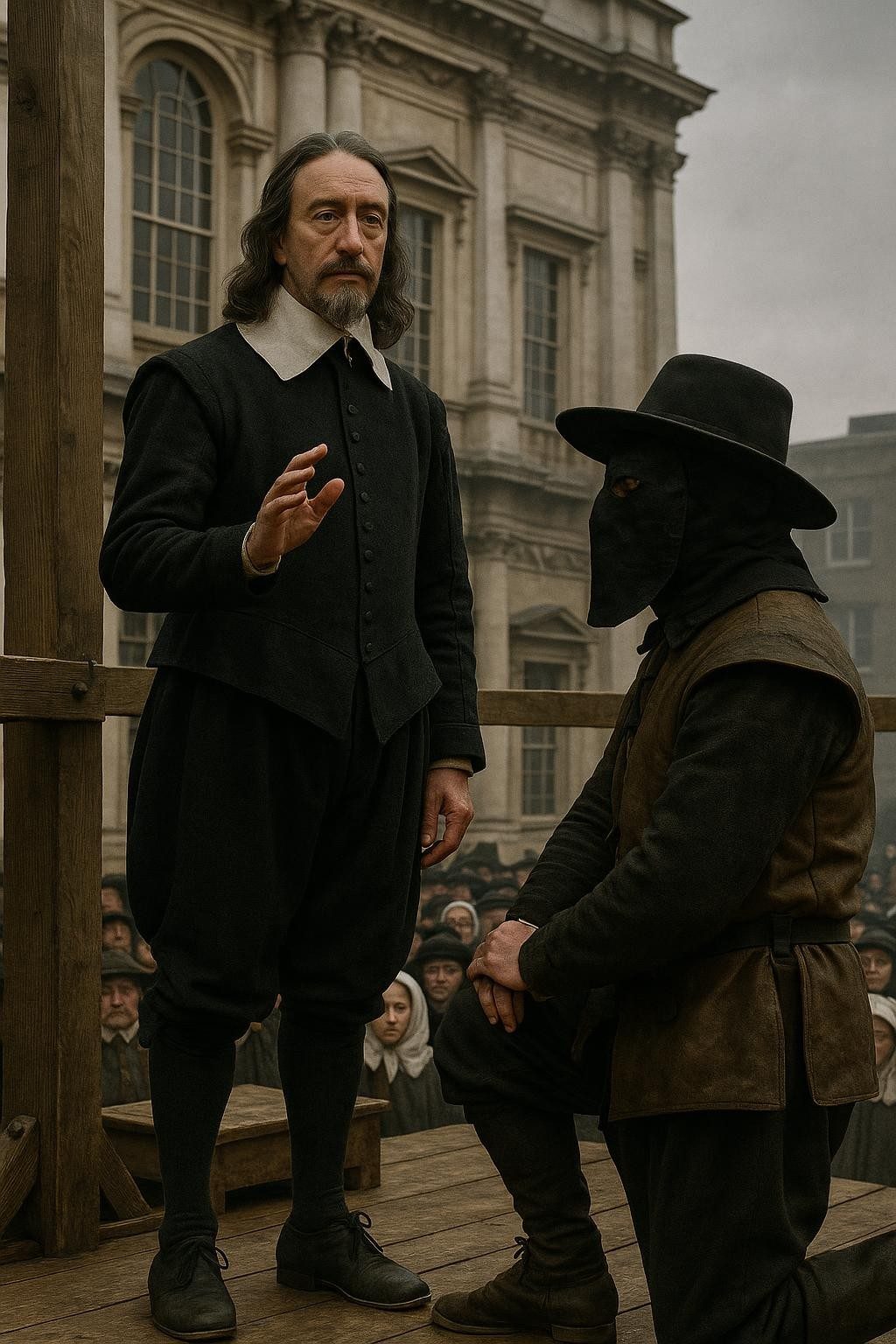
The scaffold was plain, almost austere—a direct counterpoint to the royal finery Charles had donned, as if to remind himself and others of the divine right he believed he embodied. Beside him, the masked executioner, known as the axeman, awaited orders. The executioner, chosen in part for his anonymity, knew his role was met with both a sense of duty and a heavy burden; to sever the head of a living monarch was to cut through history itself. Yet, as he knelt before the king, the executioner was met with a remarkable act of grace. Charles, maintaining composure beyond understanding, forgave the man tasked with delivering the blow, embodying a spirit that seemed both poignant and tragic.
The crowd watched intently—noblemen, commoners, soldiers—all representing the various facets of a nation grappling with its own identity. Whether for justice or spectacle, their presence testified to a new power dynamic, one that was still being forged. The axeman, now having stood and taken Charles’ offered hand, stepped back to his post, and the king prepared himself for the final act of his command. Charles addressed those gathered, his voice unwavering but muted by the crisp air and somber occasion. His last speech was brief but earnest, underscoring his belief in the sanctity of his office and expressing hope that his death might renew peace.
Read next: The Day a Young Prince Knelt and Refused a Crown
With dignity and a stoicism that belied the gravity of his end, Charles removed his cloak and cap, laying his neck over the block in an act of humility that few had expected. A single blow from the executioner's axe brought a sudden finality to years of unrest. The executioner lifted Charles' head and displayed it to the now-quiet crowd, a silent signifier of the monumental impact of what had just unfolded. This act, though brutal, had been uncannily civil, marked by a surreal serenity that accompanied the cold efficiency of one swift strike.
The aftermath of this moment was met with an eerie stillness. The crowd seemed to collectively hold its breath again, grappling simultaneously with shock and the unimaginable reality that the king had been executed. Whispers of disbelief spread through the ranks of onlookers, from ordinary citizens to the high-born members of society. Some lamented the loss of their anointed king; others felt a glimmer of hope that a new era might finally begin.
Read next: The Day a Queen Rode Alone Into a Mutinous Army
The scaffold, now only a wooden platform devoid of its central actor, became a symbol for both tragedy and transformation. England stood at a precipice, the struggle of past years crystallized in this one moment. Charles I's death was both the conclusion of an era and the uncertain herald of another. The government that had condemned him grappled with its newfound authority, the burden of governance placed upon so many shoulders.
This extraordinary chapter in England's history provoked questions far beyond the immediate—and left a legacy that reshaped the country's political and moral compass. Where previously there had been divine right and absolute rule, there emerged the stark democracy of an accountable power. The execution of Charles I was more than the fall of a man; it was the symbol of a seismic shift, the reverberations of which were felt not just across England, but the world.
Today, we look back on this day not only as a historical fact but as a powerful meditation on governance, power, and the endless push and pull between ruler and ruled. The scaffold outside Whitehall serves as a distant yet poignant reminder—the day a king held out his hand to his own executioner was a moment when the course of a nation held its breath, teetering on the brink of an uncertain but undeniably transformed future.