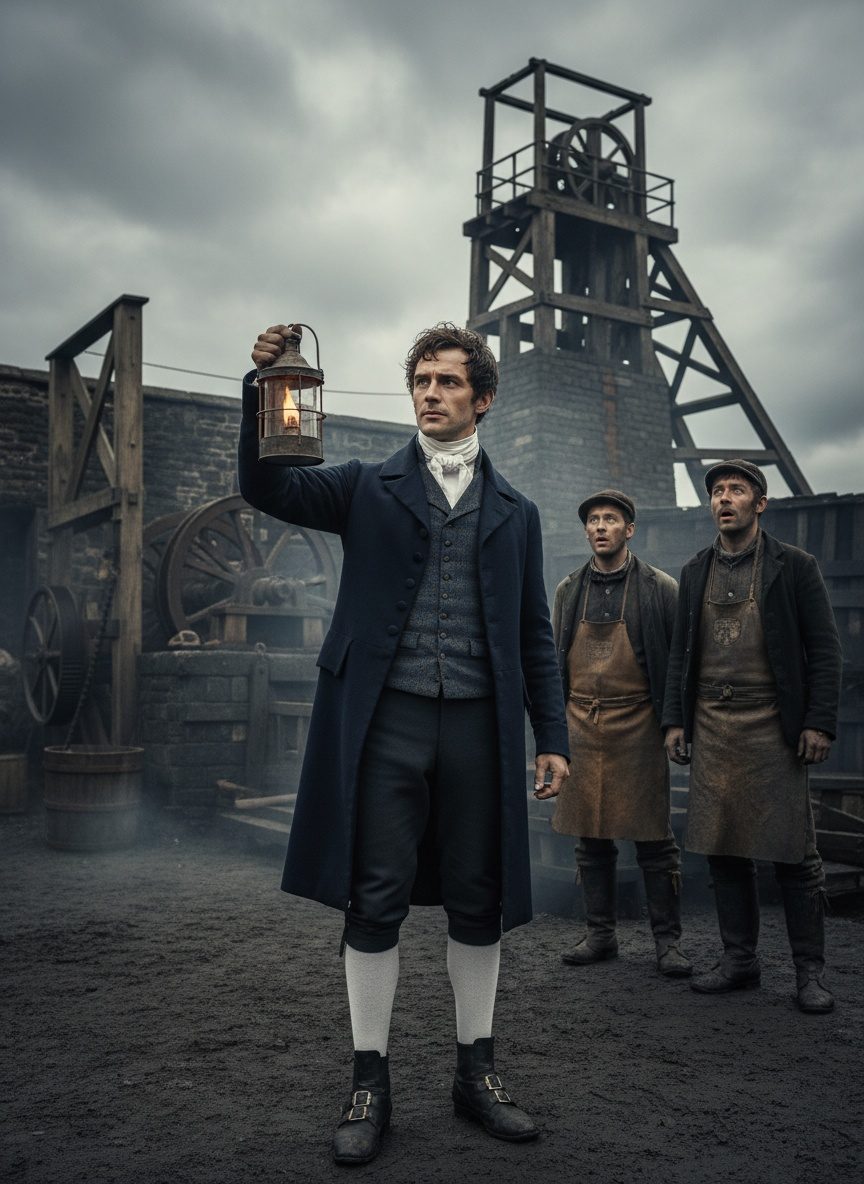
May 25, 1812. Thick smoke crept out of the yawning mouth of the Felling Colliery as if the earth itself was sighing in anguish. Just moments before, an explosion had torn through the depths of this Durham coal mine with a ferocity unknown to those who toiled below. Ninety-two souls, many of them mere boys, had been consigned to the shadows, victims of a phenomenon they feared yet could hardly understand: fire-damp.
Coal miners in early 19th century Britain faced an unpredictable adversary. Methane gas, seeping invisibly through the seams, was a silent killer. Ordinarily inert, it became a lethal weapon when ignited by the open flames of miners' candles. The Felling catastrophe was, tragically, only one among many such disasters. Yet it was a prompt, a harbinger of change, for it drew the attention of a brilliant mind determined to illuminate the darkness.
Sir Humphry Davy, a pioneering chemist of his era, was renowned for his work on gases. By the time Felling's disaster cast its deathly pall, Davy had already made significant contributions in the realms of chemical innovation. His spirit was uncontained, restless, unfettered by convention. When the news of the explosion reached him, it sparked not just horror, but determination—a resolve that the invisible killer could be tamed.
Upon receiving a plea from John Buddle, a fervent advocate for miners' welfare and manager of the Felling Colliery, Davy set to work. While Buddle mourned at the pithead, Davy delved into the theater of alchemy: his laboratory. He was a man driven by necessity—a spirit undaunted by the fringes of knowledge. It was here that he began experimenting with the properties of gases and their interactions with flame, scrutinizing how one could illuminate without inciting fatal combustion.
Read next: The Day a Baronet Stood Up in Court and Freed His Slaves
For six relentless weeks, Davy tinkered and toiled away from the soot and sorrow of the mines. His experiments evolved through trials and repetition, the empirical dance of a scientific mind chasing a tangible solution. What emerged was both remarkable and profoundly revolutionary: a lamp encased in finely wrought iron gauze. This humble sheath was no ordinary design but a precise filter that could allow light to pass while stifling the igniting nature of methane's venomous breath.
The Davy lamp, as it came to be known, was a revelation. On the day it was first tested, the air was thick with anticipation and trepidation. Miners, so accustomed to the miserly flicker of wax and wick, now carried hope wrapped in wire. This device promised salvation—a new era where entombed flames could dance safely amidst dangerous vapors.
A mere six inches tall and deceptively simple, the lamp was a triumph of insight and ingenuity over catastrophe. Yet its introduction was not free from skepticism. Initial trials, conducted in the unpredictable wilds of real coal seams, required braving lingering fears and historical hesitancies. Confidence was a currency earned through demonstration, and soon stories of the lamp's success burned as brightly as its flame.
The spillover from Davy's work went beyond mere utility. It underscored a paradigm shift in industrial safety and scientific application, heralding an era where prevention became possible, and where human ingenuity could render the unseen safe and the unknown tame. Davy's brilliance lay not just in invention but in his willingness to share, to communicate his understanding with miners and laypersons alike, demystifying the peril and embracing practicality.
This tale, forged in the crucible of risk and innovation, carries an enduring resonance. The Felling disaster reverberates through history as a turning point—a moment when an industry reliant on darkness saw a new light. The subsequent reduction in mining fatalities was a testament not only to technical prowess but to the potential for compassion to steer the course of progress. Humility before the elements and daring in their mastery merged to form the foundation of modern industrial safety.
The flames of Felling did more than scar; they ignited a movement. Davy's lamp transcended its functional origins; it became a symbol of human endeavor, faith against adversity, and the resilience of the forgotten. To tread into that historical shaft is to walk alongside the men and boys who once faced their own crepuscular battlefield, armed with courage and a newfound ally in the form of a glow born not of candle or kindling but of curiosity and resolve.
The history of Davy's lamp, in its unassuming simplicity, shines a light on the broader journey of human progress. It invites us to reflect on the significance of persistence in the face of danger and the extraordinary outcomes achieved when society holds firm to the belief that accidents are not destiny, and that even the cruelest of environments can be made to yield under the mind's gentle insistence.