His schooling was cut short by illness. Yet, John Logie Baird reshaped the future of entertainment.
The Unlikely Inventor
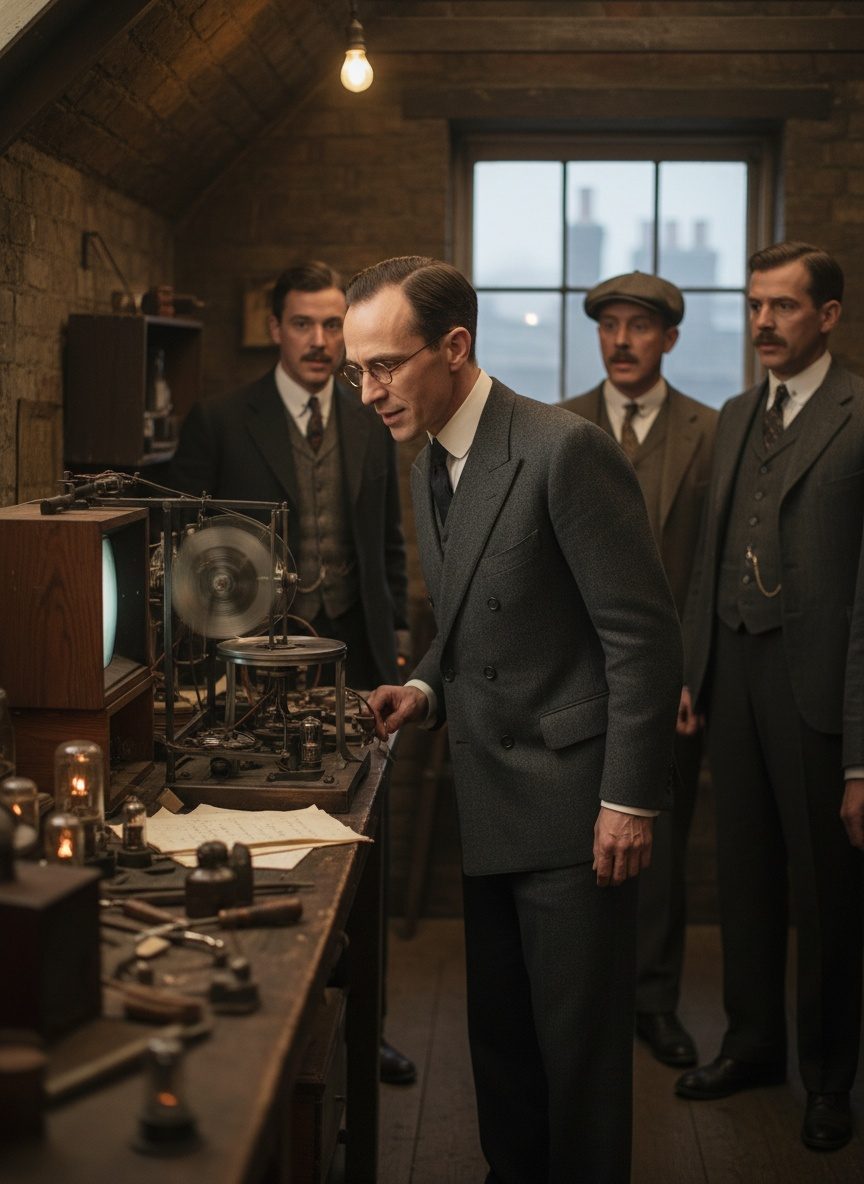
On a typical January evening in 1926, a young Scotsman by the name of John Logie Baird stood in an attic above the bustling streets of Soho, London. It's easy to picture the scene: a cramped, dimly-lit room cluttered with an assortment of what, at first glance, seemed like an inventor's peculiar collection of junk. Amongst broken biscuit tins, darning needles, and mounds of borrowed lenses, Baird patiently pieced together the contraption that would change the world. This was not the workspace of a polished inventor backed by prestigious degrees and academic accolades. Born in Helensburgh, Scotland, Baird was remarkably self-taught, his formal education interrupted by a debilitating illness during his youth. To outsiders, a career in electrical engineering seemed improbable, yet Baird was undeterred.
The Soho Trial: A Ventriloquist’s Dummy
January 26, 1926, marked a day unlike any other. It was neither a grand exhibition nor a public spectacle but rather a modest gathering among scientific minds. With palpable anticipation, Baird invited an audience of scientists upstairs to witness what, until then, had been just a dream. At the heart of his apparatus was a laboriously pieced-together mechanical television, which in its rudimentary form was far from the sleek devices we cherish today. Placing the lens on a ventriloquist's dummy named "Stooky Bill," Baird held his breath as he flicked the switch.
Images danced across the screen—a flickering visage that was both eerie and enchanting. The scientists, initially skeptical, watched intently. Against the odds, the experiment unfolded successfully before their very eyes: clear evidence that visual transmissions were no longer confined to science fiction. Though the imagery was primitive and spectral, the broadcast of this grinning dummy was monumental. In that intimate space above a shop, the seeds of modern television had been sown.
Read next: The Day a Weaver's Son Mapped the Invisible World
Beyond the British Isles
The man who transformed this lofty dream into tangible reality had created more than just a technological marvel; he had laid the groundwork for a cultural revolution. Following the success of his demonstration, it didn't take long for Baird's invention to stir curiosity beyond British borders. Across continents, inventors and industrialists alike took notice. As the 1920s rolled into the more frenetic 1930s, the rapid advancement of television would shape public life, leisure, and media in unforeseen ways.
In the years following the Soho demonstration, television studios began to emerge, bringing new challenges and opportunities. Baird's technology reached Germany, the United States, and beyond, each nation eager to embrace this new medium. Channels devoted to news, entertainment, and the burgeoning world of televised sports dominated living rooms. During an era otherwise marked by economic depression and social upheaval, Baird’s work provided a rare glimpse at the unifying potential of shared stories and images.
The Man Behind the Machine
Despite his immense contribution, Baird remained an enigmatic figure whose genius often bordered on the eccentric. Often plagued by poor health, much of his life was a testament to personal perseverance against the odds. His ventures led not only to technological strides but also to financial tribulations, since resources were sparse and support was scarce. The challenges he faced were innumerable, yet he wielded a fierce, unyielding optimism that cast a long shadow over the television industry.
Read next: The Day a Clockmaker's Son Rewired How We See the Stars
Baird’s experimentation was relentless—his mind in constant motion. Even after the success of his early trials, he remained insatiable, pursuing color television and stereoscopic 3D images, pushing his inventions further into the realm of possibility. This unquenchable thirst for innovation was both his source of triumph and, at times, personal agony. A modest, self-effacing man, Baird shied away from the limelight, preferring to let his creations speak for themselves.
A Changed World
The quiet miracle that transpired on a January evening in 1926 paved the way for a media landscape that we now take for granted. Television redefined communication, knitting a tapestry that linked people across the globe, generation upon generation. Baird, with his unconventional methods and indomitable spirit, was the linchpin in this narrative arc.
Today, television is an omnipresent force that educates, entertains, and informs billions worldwide. Its roots trace back to a cluttered, dusty attic in Soho and a man whose name slipped through the pages of many textbooks, yet left an indelible mark on our history. In understanding the genesis of this innovation, we not only glimpse the past but also gain insight into the ceaseless human endeavor to connect and create. Baird’s story serves as a powerful reminder that even in solitude, one mind's relentless pursuit of an idea can illuminate the world.