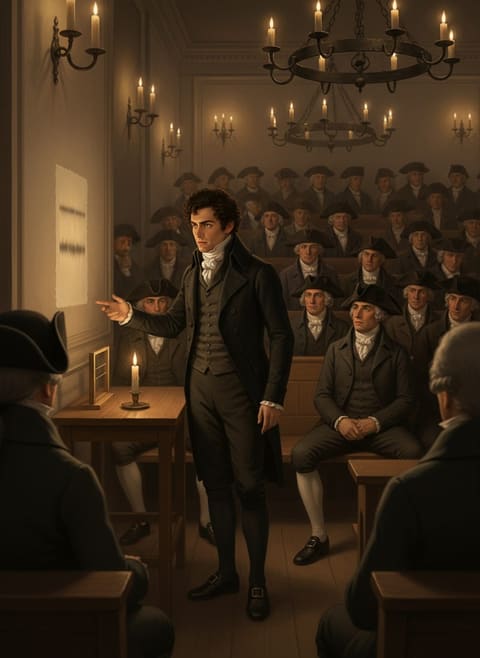
He was a clockmaker, not a sailor. Yet, it was his tool that guided the ships, not the other way around. This is the story of John Harrison, a man whose legendary craftsmanship brought precision to the chaos of the seas, solving a navigational enigma that had haunted explorers for centuries.
The Fatal Mistake of Losing Longitude
Imagine the unforgiving open seas of the 18th century, vast and unpredictable, where danger lurked not just in storms but in unseen calculations. For centuries, seafarers wrestled with the fear of losing their bearings. They sailed the north-south latitudes with some accuracy using the stars and the sun, but the hidden killer was longitude. This east-west positioning was elusive, and without it, even the most seasoned captains could only guess their positions, often with deadly miscalculations.
The loss of a ship could be catastrophic, both in human lives and valuable cargo. The most notorious example before a solution was found was the disaster of 1707, where the British fleet, led by Admiral Sir Cloudesley Shovell, was wrecked on the Isles of Scilly, resulting in nearly 2,000 deaths. The resulting public outcry led to the introduction of the Longitude Act in 1714, promising rewards for anyone who could solve the problem of determining longitude at sea.
Harrison’s Beginnings: Humble yet Unyielding
John Harrison was born in Foulby, in West Yorkshire, and moved to Lincolnshire. He was the eldest of five children in a carpenter's family. Without formal schooling in the sciences, his education was born from a relentless curiosity and hands-on experience. By age 20, he had already constructed his first pendulum clock entirely out of wood, a testament to his unique approach to engineering.
Read next: The Day a Weaver's Son Mapped the Invisible World
Harrison's genius lay not in complex theories or grand gestures but in meticulous craftsmanship and innovation. When the Longitude Act dangled its lucrative promise, academics and astronomers scrambled for solutions, devising astronomical methods that proved unreliable in the practicalities of sea navigation. But Harrison looked to the mechanics of time itself and saw a different path forward: perfect the clock, and you perfect navigation.
The Long Journey to the First Timekeeper
In 1735, after more than 20 years of research and tests, Harrison brought to life the H1, the first of his marine chronometers. The device was expansive, like a grandfather clock on a ship. Its complexity and precision were unprecedented, offering a way to calculate longitude by comparing local time with the known time at a reference point, such as Greenwich.
The Board of Longitude, intrigued yet skeptical of a clock's ability to withstand sea voyages, decided to test Harrison's invention. Early sea trials provided promising results, yet Harrison was his own harshest critic. The H1 was a beginning, not an end, and so he continued to refine his designs, creating the H2 and H3, each iteration bringing him closer to the elusive prize.
A Clock That Changed Everything
In 1761, Harrison presented what would become his masterpiece: the H4. Unlike its predecessors, H4 was not a clock but a watch—a modest 5 inches in diameter—and it was this compactness that revolutionized precision navigation. Its intricate technology married finely tuned pivots and balances in a robust design that resisted the unpredictable motions of a ship at sea.
Read next: The Day a Clockmaker's Son Rewired How We See the Stars
The H4 was handed over for a sea trial, crossing the perilous Atlantic aboard HMS Deptford, sailing from Portsmouth to Jamaica. The timekeeper returned after five months with accuracy never before seen— a deviation of a mere five seconds. This astonishing precision equated to an error of less than two miles, a feat that astonished the Board and proved the ultimate solution to the centuries-old conundrum.
The Unappreciated Triumph and Its Legacy
Despite Harrison's monumental achievement, his journey did not end there. The Board, comprised largely of astronomers with vested interests, hesitated to release the full prize of £20,000. Harrison spent years fighting for recognition and reward, a struggle that continued until the twilight of his career.
Harrison's contribution to navigation was transformative, yet his recognition came too slowly for the impact he left on maritime history. It was this innovation that allowed seafarers to map the globe with confidence, expanded trade routes, and laid the foundation for the age of exploration.
The story of John Harrison is not merely about a clock or a prize; it's about an improbable hero whose stubborn dedication reshaped the world. It reminds us how often true genius emerges not from the halls of established institutions, but from the quiet corners where passion and perseverance meet. The instrument that saved lives was crafted by a man who refused to accept that some things were impossible, ticking still in the heart of any sailor who ventures into the unknown.