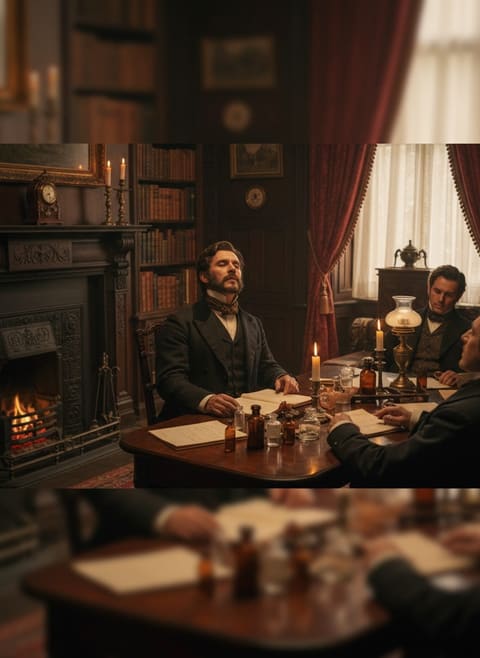
On a damp January morning in 1840, fog clung to the streets of London as if to conceal the city's impending transformation. The murmur of horse-drawn carriages and the clatter of cobblestones harmonized with the rhythm of fading gaslight. Somewhere among the labyrinthine Victorian architecture, a quiet revolution was unfurling — one that would forever change how humans connected over distances. The protagonist? A former schoolteacher, Rowland Hill, who dared to walk into the hallowed halls of the British postal system armed with just a radical idea.
The Unlikely Revolutionary
Rowland Hill was no man of rank or illustrious heritage. His background was humbler, rooted in the straightforward life of an educator. Born into a society governed by privilege and class, Hill was imbued with neither. Yet, it was perhaps his status as an outsider that allowed him a vantage point so unconfined by convention and so ripe for innovation. He studied the complex and forbidding tangle that was the Victorian postal system — a labyrinth in itself, rife with inconsistencies and prohibitive costs. To send a letter was a privilege that required financial means, and for the common person, it was often an expense too high to justify.
Undaunted by his own lack of clout, Hill turned to mathematics, his ally in logic and precision. He concocted a formula of simplicity: reduce the postage to a uniform penny per letter nationwide, a proposal as radical as the man himself was unassuming. The thought that any letter, no matter how distant its destination within Britain, could be sent for a penny seemed almost absurd enough to dismiss. And dismissive they were — the postmasters, parliamentarians, and other gatekeepers of the status quo. Yet, Hill's idea possessed the blistering tenacity of truth; it clung to him and others, slowly threading the minds of those who initially laughed it off.
It was a period of industrial and philosophical turbulence, an era where ideas could ignite more swiftly than a match over paper. The railway was beginning its spread across the landscape, and with it, the need for quicker, more efficient communication grew palpably. Hill’s proposal was not just a solution; it was an evolution of the very notion of accessibility. But could the parochial minds of parliament concede to such a sweeping reform?
Read next: The Day a Surgeon's Son Chose Death Over Silence
A Penny's Weight: The Vat of Debate
The halls of Parliament were crowded with noise — both the audible bickering and the spectral whispers of resistance that flitted through bureaucratic passageways. Hill found himself thrust into this arena, battling inertia and indifference. His proposal was examined, dissected, and plunged into the fermenting vat known as debate. It wasn’t simply that a penny seemed an impossibly small price; it was the fact that it represented a challenge to entrenched systems and beliefs.
The Victorian era, for all its lovely pretense, was also a time of stark inequities. The notion that the poor should have seamless access to communication with their distant relatives was not an idea readily adopted by the establishment, whose privilege was in maintaining the status quo. Yet Hill persisted — perhaps with the tenacity of a teacher whose duty was not just to instruct, but also to instill progress.
His arguments were cogent. He identified the inefficiencies and unfairnesses, and proposed reform. A stamp, he argued, not only democratized communication but facilitated trade and commerce by breaking barriers previously thought insurmountable. It was not a simple fight. Opposition lines formed among those who would benefit most from the postal system's complexity. But Hill, with no armor but intellect and conviction, proved indefatigable.
January of 1840 marked a victory, not merely personal but societal. Parliament finally gave way, acknowledging that Hill’s penny stamp was an inevitability grounded in fairness and necessity. The first stamp — much later known as the Penny Black — bore the simple face of Queen Victoria against its dark backdrop, as if testament to the dawning of an era where even entrenched tradition was not beyond the realm of change.
Read next: The Day a Chimney Sweep's Son Shamed a Whole Parliament
Letters Untethered: A World Unbound
The ripple of impact began almost immediately. Across the British Isles, and soon thereafter across oceans, the penny stamp unshackled communication from its previous limitations. It fostered familial connections previously halted by cost and remoteness. Trade burgeoned, and innovations that relied upon human connection flourished. Where before a simple letter symbolized privilege or desperation, it now placed the very notion of human connection within reach of many. The post office, once an avenue choked by its own inefficiency and exclusivity, transformed into a conduit of exchange.
Hill's vision germinated like seeds, taking root in foreign soils where similar postal reforms blossomed into existence, spurring global communication into new eras of accessibility. Nations took heed, seeing the value in a system that democratized both personal and commercial correspondence. The world began to shrink as ideas and information transgressed borders with newfound ease.
The penny post is, by no small margin, a forgotten fulcrum upon which the modern world balanced its journey into the era of communication. It is a story of a simple man whose foresight eclipsed his era’s imaginative bounds, posing a challenge to any who dared underestimate the power of simplicity mixed with resolve. In a world today overlaid with a tapestry of instant communication, Hill’s paper-thin stamp serves as a tangible reminder of the profound journey to get here — an ode to the courage to press beyond the visible horizon.