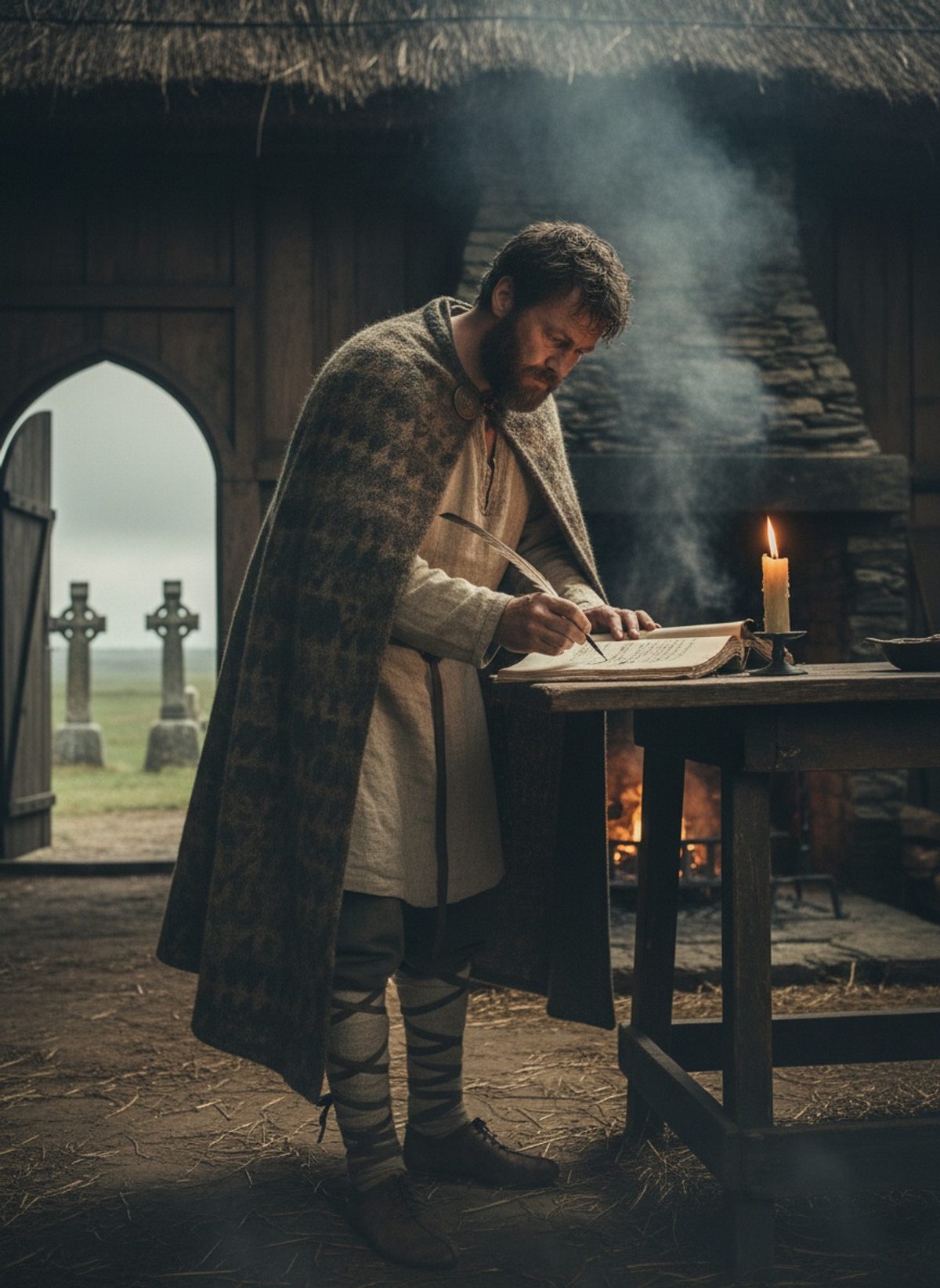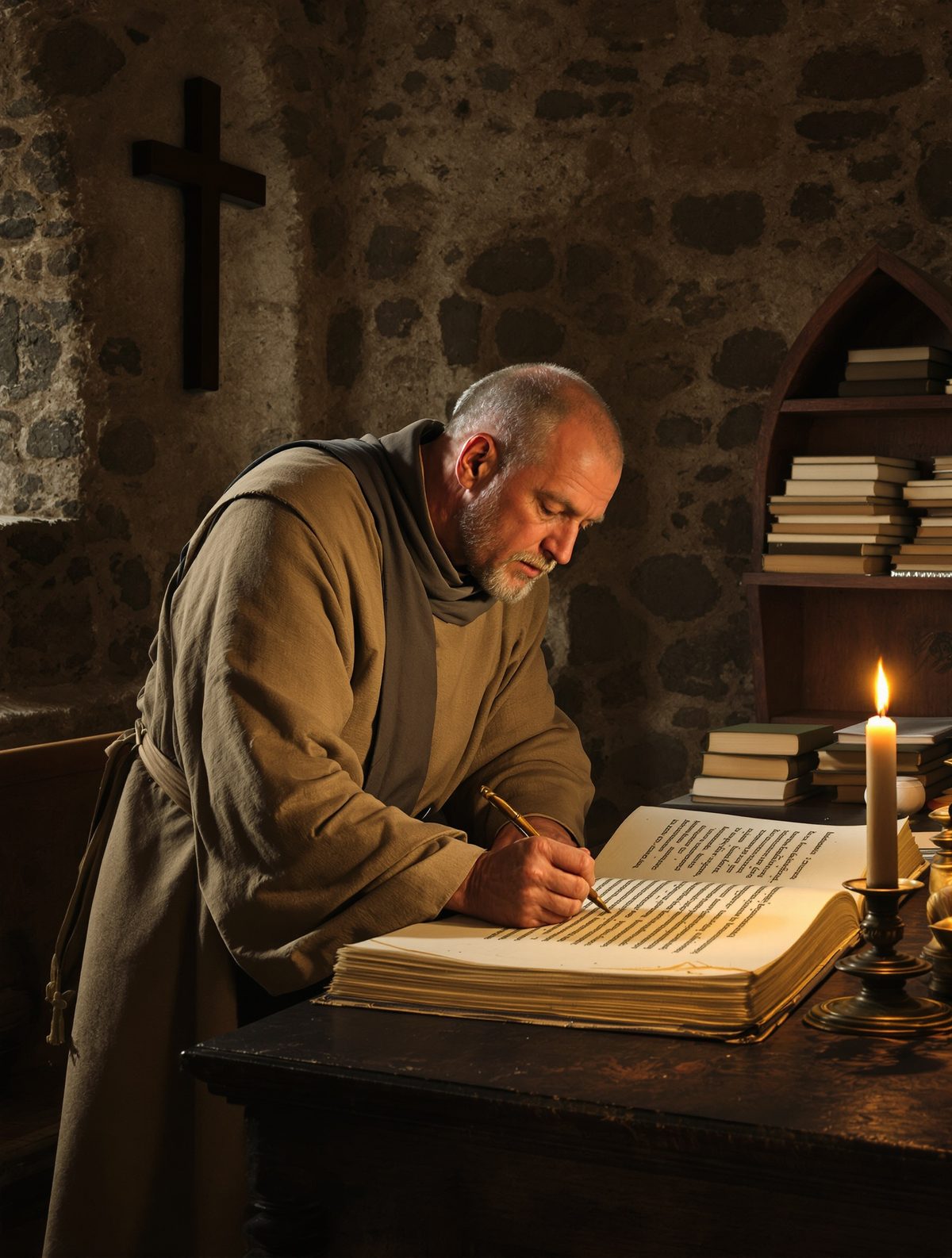
It was a cold morning in the closing days of 731 AD as the sun's first light crept across the fields of Northumbria. Inside the stone walls of a remote monastery at Jarrow, a humble monk set down his quill after completing a task that would resonate through the centuries. Unbeknownst to him, his work would stitch a fledgling country together, weaving its diverse tribes into a single tapestry known as England. That monk, the Venerable Bede, had written the *Ecclesiastical History of the English People*, a tale that gave the scattered folk of an island a shared identity and an immortal past.
A Life Anchored to Books, Not Battlefields
Bede was born in 672 or 673, in the region known as Monkton, near present-day Sunderland. He never strayed more than fifty miles from his birthplace. The world beyond his monastery's stone walls was filled with chaotic uncertainty, where warring Anglo-Saxon kingdoms vied for power in a land yet to be unified. Yet, Bede chose a different path. Instead of armor, he donned monastic robes. Instead of a sword, he wielded a quill.
Bede joined the monastic community at Monkwearmouth-Jarrow Abbey at the age of seven, where he dedicated his life to study, prayer, and the transcription of texts. It was here, amidst flickering candlelight and murmured chants, that he embarked on his greatest work — a history not just of kingdoms and kings, but of an emerging people. His world was contained within the monastery's walls, but his intellectual curiosity transcended them.
Bede's Bookshelf of Legends
To craft a history of England, Bede drew from an impressive array of sources. He consulted earlier works, oral histories, and letters, piecing together narratives like a master weaver. His Anglo-Saxon world equaled his Latin knowledge, and he borrowed heavily from the works of St. Augustine and Orosius, yet he infused his accounts with local English legends gathered from travelers, envoys, and sometimes even the stories of pilgrims passing through Jarrow. Thus, his text became a tapestry of myths and realities, speaking to both the heart and the mind.
Read next: The Day a Saxon Abbot Walked Into a Slave Market Alone
One might find it surprising that Bede's *Ecclesiastical History* was not merely an ecclesiastical account but a comprehensive chronicle — from the first Roman contact with Britannia to the latest Saxon victories. He detailed the synchronicity of celestial events and battles, a mix of chronicle and cosmos, aiming to convey both earthly and divine narratives.
The Pen as Mightier
Bede's greatest achievement, perhaps, was his keen understanding of the power of storytelling. The book is notably the first to use the Anno Domini dating system — a Christian calendar that framed England in the context of a broader, unified Christendom. This device reinforced the notion of a shared identity that transcended petty tribal conflicts and linked England's past and future to a divine plan.
His telling of the Battle of Badon Hill, supposedly led by a shadowy figure known popularly today as King Arthur, was done as much to fortify British morale against the Anglo-Saxons as it was to mythologize their victories. Bede’s narrative, though restrained and scholarly, allowed room for the imagination, planting within it seeds of unity and spirit, although his audience may not have grasped it immediately.
A Forgotten Name is Remembered
Ironically, in crafting his history, Bede ensured the survival of names and places that might have otherwise vanished. He told of the kingdoms of Mercia, Northumbria, and Wessex; places that to an outsider might have seemed insular, appeared now as integral players in a richer, ongoing drama. This sense of continuity and collective identity was revolutionary. Before Bede’s tome, the land was simply that — a land of divided realms, with little unifying them besides proximity.
The systematic recording of saints, kings, and heroes provided a framework for subsequent generations to link themselves to their past, and, surprisingly, remained a cornerstone for historians even after the Norman Conquest. When the Anglo-Saxon Chronicle was commissioned, it leaned heavily on Bede’s groundwork, essentially carrying forward the legacy he set in motion from that solitary Northumbrian cell.
The Long View: Why Bede Matters Today
Bede bequeathed a legacy to Britain far beyond his years, for the act of writing itself was a quiet revolution. Although he never led armies or erected great stoneworks, his words carved their own monument, immortalizing the concept of “Englishness.” Without him, there might have been no cohesive story for an island once fragmented into turbulent tribes.
As we navigate our technologically-driven world today, Bede's mission echoes a modern truth — that fragmented communities thrive when they discover their shared narratives and roots. Understanding and empathy often emerge when diverse voices are woven together into a single story, one that acknowledges differences yet emphasizes unity.
By stitching together England’s fractured stories, Bede showed us that history, at heart, is an interpretive act. He reminds us that our own stories — personal, communal, or national — hold power to shape identity, build continuity, and offer meaning, no matter how divided or far-flung we may begin.