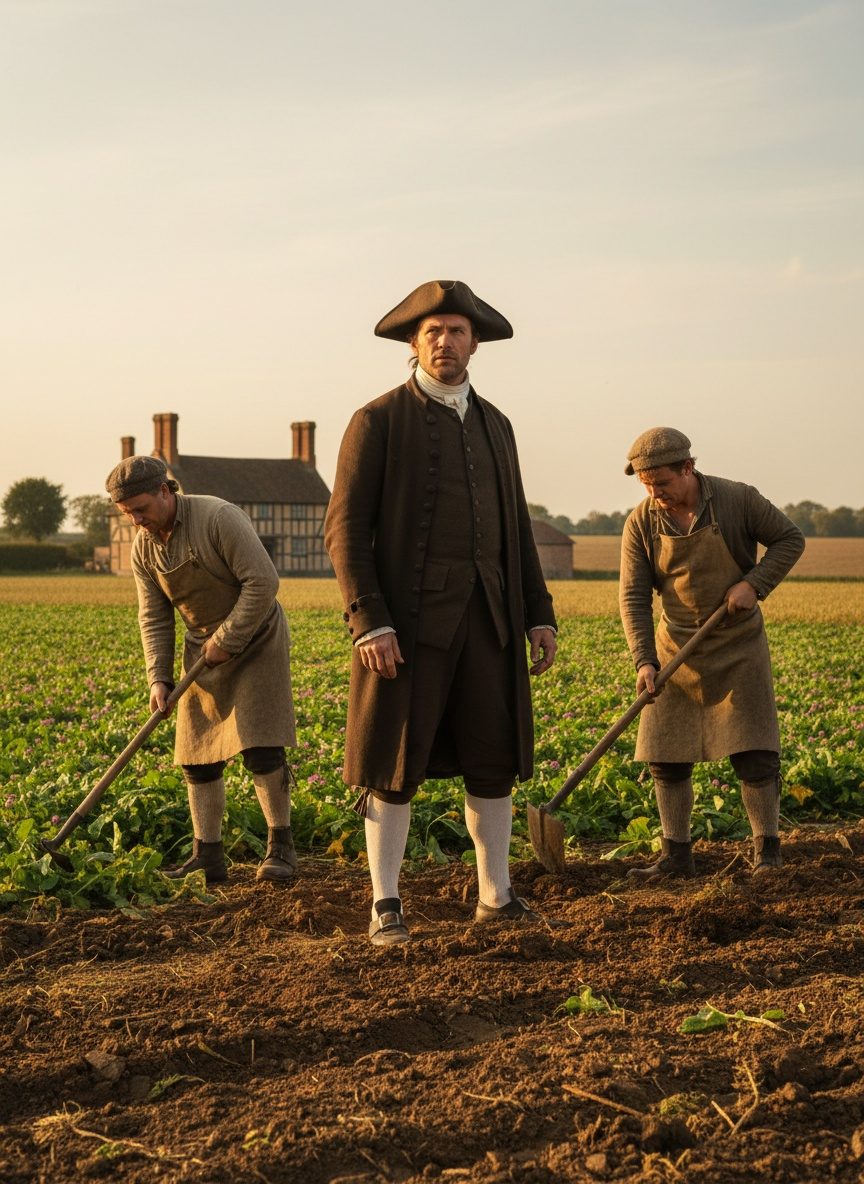
He was just a young man from Norfolk. He had never imagined his name would resonate through the annals of British agriculture.
The Inheritance of Desolation
In the early 18th century, the English countryside bore witness to a silent devastation. Fields once abundant stood listless, exhausted by the relentless pursuit of cultivation without respite. Amongst this bleak landscape, a young Thomas Coke inherited the Holkham estate in 1730. The vast land lay barren like most of rural England, its soil drained of life and prosperity. But unlike many landowners of his time, Thomas Coke saw more than just desolation; he saw opportunity.
Nurtured on tales of ancestral perseverance, Coke didn't shy away from the daunting task ahead. His estate in Norfolk was a microcosm of a larger crisis gripping Britain. A nation on the brink of famine needed someone to defy the antiquated practices of agriculture. The status quo dictated that farmers simply rotated between grain and fallow fields, a method that left both land and populace wanting.
Yet, it was the very bleakness of his inheritance that became the catalyst for ingenious transformation. Coke began to contemplate what others deemed impossible: to rejuvenate the desolate, overworked fields and to feed not just his tenants, but potentially a nation.
Read next: The Day a Baronet Stood Up in Court and Freed His Slaves
A Brave New Method
The spark of innovation was not born from whimsy but necessity. Coke, driven by curiosity and an intrinsic defiance of failing methods, set about implementing crop rotation — a revolutionary concept for his era. Rather than resigning parts of his land to uselessness, he initiated a four-field system that alternated crops like barley, wheat, turnips, and clover. This approach rejuvenated the soil, preserving nutrients and dramatically boosting yields.
This wasn't merely a gamble; it was a science. Coke's approach was meticulously calculated, each rotation nurturing the earth while sustaining the farmers who tilled it. Turnips, for instance, took root in winter fields, drawing nutrients deep into the soil and feeding cattle in the darker months. Clover revitalized the ground with nitrogen, laying the groundwork for successive crops.
The burgeoning results did more than bolster Coke's estate; they began creating ripples among his contemporaries. Noblemen, agriculturists, and even sceptics converged upon Holkham to learn from this quiet, determined young man who dared to challenge and redefine quintessential agricultural understanding.
An Unexpected Allegiance
Thomas Coke found an unlikely ally in nature herself. Where many farmers perceived animals merely as end products, Coke saw them as integral to his cycle of prosperity. By feeding livestock turnips through the winter, he ensured they survived and thrived, their manure in turn enriching the fields. This creation of a continuously fertile loop was instrumental in transforming not only his estate but also the fabric of rural British life.
The positive cycle impressed his contemporaries, gaining the attention of those in positions both high and influential across England. Coke's alignment with natural systems defied conventional wisdom, yet it set a precedent for sustainability that modern environmentalists would later emulate.
In time, Coke's method evolved beyond Holkham, inspiring countless others to emulate his success. The seemingly simple act of combining rotation with livestock feeding painted a new agrarian tapestry for Britain, departing entirely from previous destructively linear models.
The Ripple Effect of Prosperity
Thomas Coke's efforts reaped more than robust harvests; they sowed the seeds of an agrarian revolution. His innovative techniques helped lift his estate from the brink of desolation to one of the leading examples of effective land management. The prosperity spread throughout Norfolk and beyond, with his methods soon sparking broader agricultural reform across Britain.
The threefold increase in crop yield under Coke's stewardship was not just a victory against famine but an ideological triumph that endeared him to an emerging class of forward-thinking reformers. This transformation was quietly critical, elevating the nation from an inclination towards subsistence to the forefront of European farming and export.
This newfound abundance brought more than food; it fostered greater socio-economic stability and reshaped the rural economy, making room for the burgeoning changes sweeping through Britain in the advent of the Industrial Revolution.
A Legacy Worth Cultivating
Thomas Coke did not seek accolades nor titles; his reward was in the flourishing fields and the sustenance of his people. He unknowingly sculpted a legacy that would nourish millions and propel Britain into an agricultural prominence previously unimagined.
Yet, the heart of his achievement was the profound shift in mindset. Coke's story underscores the timeless truth that change emerges not from mere necessity but from introspection and the courage to question old norms. He was not just a farmer but a catalyst for reinvention, proving that one man's resolve can indeed teach a nation how to feed itself anew.
In a world still grappling with the demands of sustainability, the young Norfolk farmer's son who revolutionized agriculture demonstrates that ingenuity and respect for the natural world remain humanity's greatest allies. It is a story that does not fit neatly into textbooks but resonates expansively in the sustainable practices of today and the tomorrows yet to come.