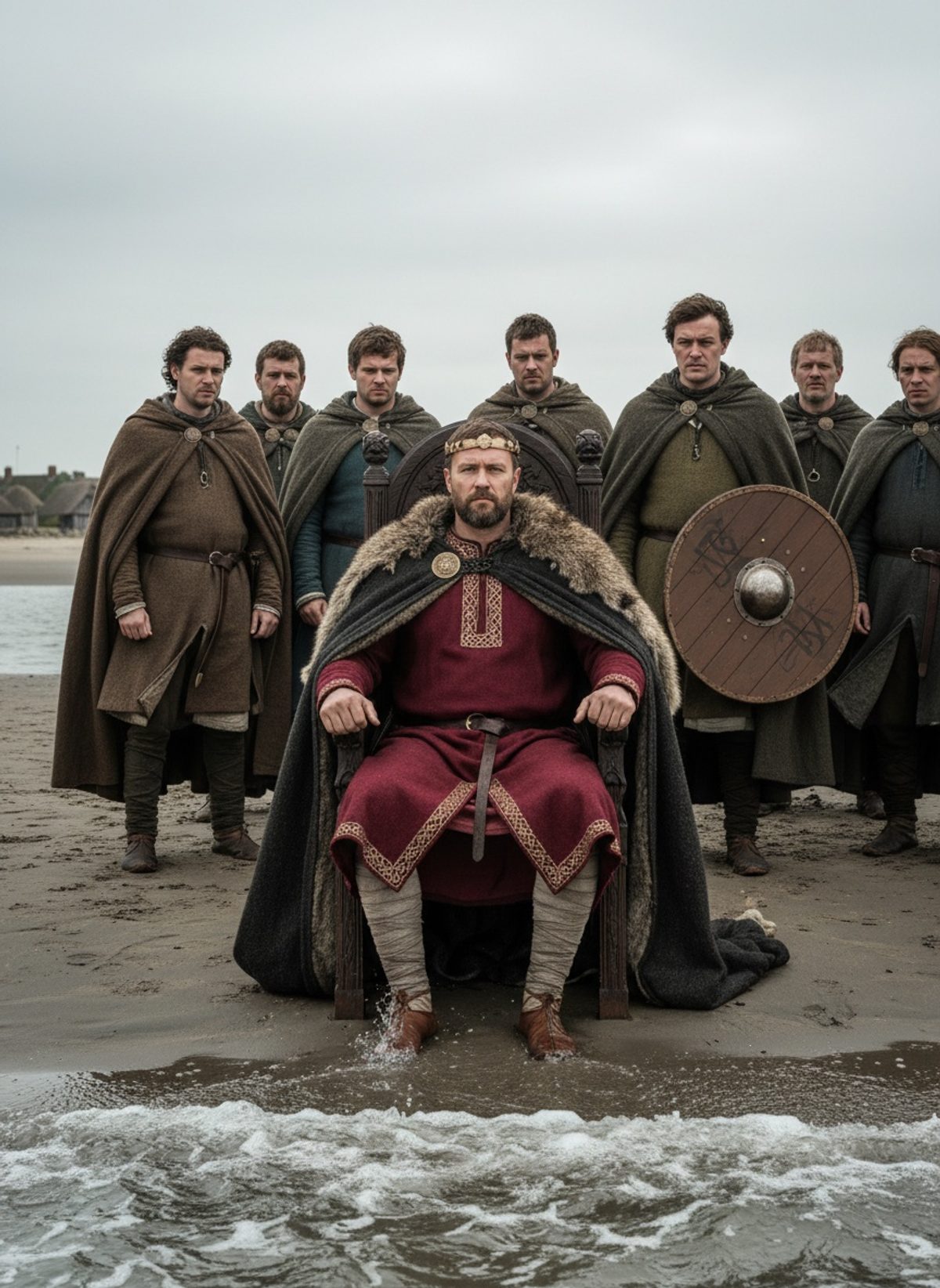
He owned the land the eye could see. Yet, he chose to watch the tide roll in from a wooden throne carried to the water's edge.
The Enigmatic King of the North
Before he was a symbol of humility, Cnut was known as a fearsome warrior king, the son of Svein Forkbeard of Denmark. Cnut became King of England in 1016, a time when England was a fractured land, threatened by Norse invasions and internal strife. Cnut's arrival on the English throne was the culmination of ambition, wrought from Viking vigor merging with Saxon tradition. By the age of 20, he had already taken control of an empire spanning England, Denmark, Norway, and parts of Sweden. To many, his earthly realm was vast and his power unmatched, but to his courtiers, it appeared infinite, like the sea to which they would soon travel.
A Display of Fealty, A Test of Fate
Cnut’s court was filled with noblemen eager to curry favor, men who spoke of Cnut’s rule as though it transcended the natural order. They fawned over him, dismissing the boundary between man and the divine. It was their flattering whispers that became the catalyst for one of the most evocative spectacles in British history. As legend has it, Cnut listened as his advisors proclaimed that even the very sea obeyed his command. Intrigued, Cnut opted to use this moment not to bolster his pride, but to reveal a truth underlining the limits of mortal power.
The Majesty of the Pageant
Imagine the scene: a chilly day by the misty shore, the horizon shrouded in gray, the sea a rhythmic rolling giant. There, Cnut, resplendent in royal robes, ordered his throne to be taken to the shoreline. With solemnity and grandeur befitting a king, the throne was placed so that the incoming tide lapped at its feet. Cnut, bemused but serious, sat on his high seat, the very image of regalia against the wild might of nature. For a moment, all seemed still as his retainers stood in anticipation. The murmur of the waves was the only sound.
A Lesson Carved in Tide
As the sea began its relentless advance, brushing against his robes, Cnut did not stir. Water soaked the royal attire, a creeping chill, slowly inching upwards. The courtiers looked on, spellbound by their own hubris unraveling. When the water reached him, Cnut stood, addressing the hushed gathering. “You see,” he reportedly declared, as the waves curled around him, “how tiny is the power of kings. The sea will not heed my command. God alone rules the waves.” It was a theatrical gesture, yet powerful in its humility, conveying the message that no earthly king, regal or revered, could command the sacred natural order.
Beyond the Salt Spray: The Echo Across Ages
The image of Cnut, drenched, standing before his throne, holds a timeless resonance. It's a story of humility against the hubris of power—a gentle yet forceful reminder of the human condition in an era of divine rights and omnipotent rulers. Cnut’s wisdom, cloaked in this simple beachside demonstration, layered the annals of history with profound clarity. In today’s world, where authority often reaches beyond reasonable bounds, Cnut’s cautionary embodiment of modesty remains both potent and relevant. His choice to defy the glorification of power, ironically by standing against the encroaching sea, continues to resonate with a message echoing into our times: the nature of power is fleeting, governed by forces far greater than those we temporarily harness.