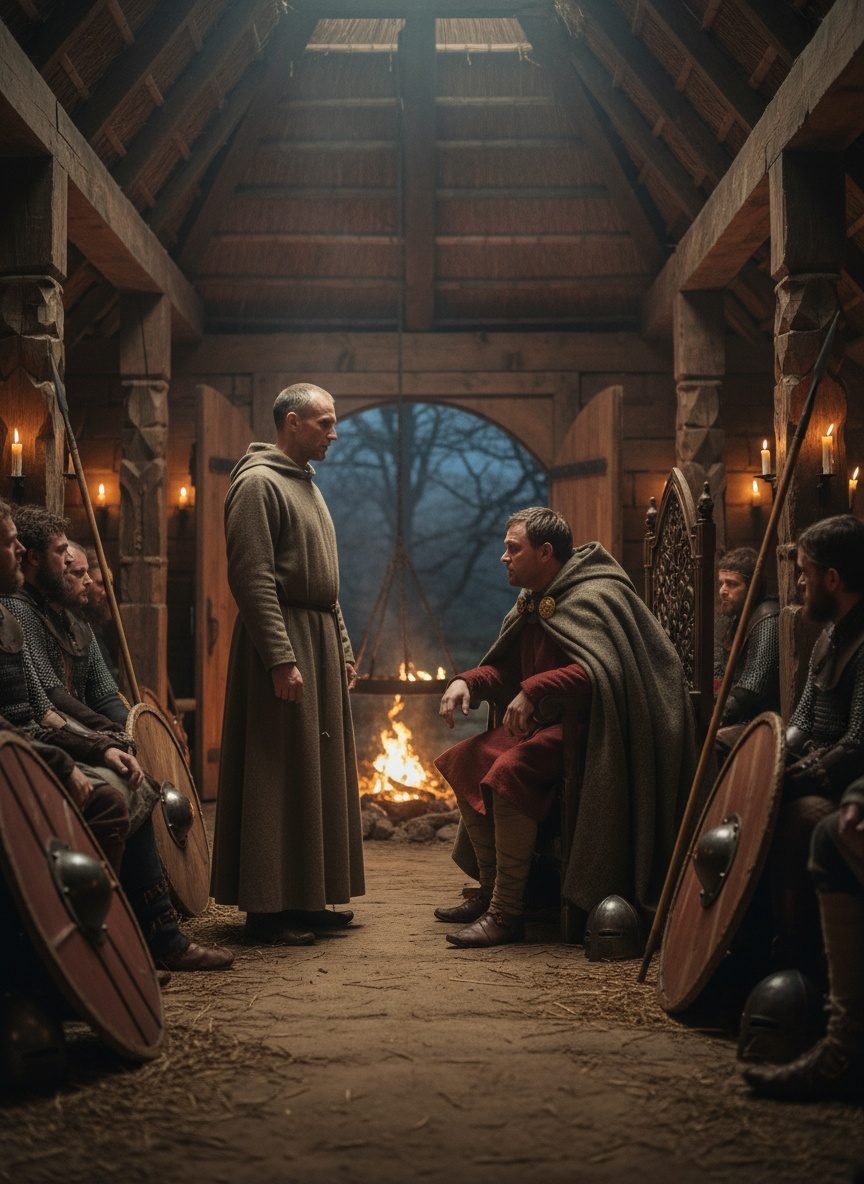
The fire crackled and hissed in the heart of the great timbered hall, sending flickers of light that danced upon the faces of battle-worn warriors and the shadow-cloaked figments of pagan deities carved into the wood. King Edwin of Northumbria leaned forward from his carved chair, a silhouette of authority against the shifting glow. The storm outside battered against the wooden walls, but inside, a different kind of tempest was brewing. A lone figure, clad not in armor but in the unassuming cloak of a monk, rose to speak. Paulinus, the Roman-trained preacher, stood with humility and conviction before the king and his assembly. His voice, though calm, held a power that defied the thunder outside.
The Monk and the King
The air in the hall was thick with anticipation, every eye fixed upon Paulinus as he began to speak. The monk's words were not adorned with the grandeur of conquest or the promise of earthly riches; rather, they carried the weight of a new faith—a call to Christianity that was unyielding in its promise of spiritual deliverance and eternal life. The teachings of Christ contrasted sharply with the tribal loyalties and pagan rituals that had long held sway in the kingdom of Northumbria.
Paulinus spoke of peace, of forgiveness, of a single God who reigned supreme over all. This message, though revolutionary, was met with skepticism and whispers among the assembled thanes and priests. After all, the old gods had served them during countless battles and harvests. Yet there was something in Paulinus's demeanor, something unshakable and serene, that intrigued even the most hardened warriors. Edwin, a king known for his wisdom as much as for his martial prowess, listened intently, weighing the monk’s words in his heart.
Here was a tale of transformation, an offering of hope in a world mired in the tumult of tribal factions and ceaseless warfare. The idea of a forgiving and resurrected savior contrasted starkly with the sacrifices prescribed by their ancestral beliefs. Nevertheless, the monk continued, unwavering, painting a vision of unity under a single divine banner. Beyond the roaring gales outside the hall, somehow amid Paulinus’s words, a silence began to stretch across the gathering.
Read next: The Day a Saxon Abbot Walked Into a Slave Market Alone
The Thane Who Held the Hall
Suddenly, rising from his place among Edwin's loyal thanes, an unexpected figure broke the tension. Coifi, the pagan priest—a man whose loyalty to the old gods seemed unassailable—spoke out. It was his voice, seasoned by years of service to pagan deities, that captured the room’s attention. He confessed a startling truth: despite his lifelong devotion, he had found the old ways wanting. For all the worship, the sacrifices, and the rituals, what tangible reward had they offered? As the hall fell into hushed and scandalized silence, Coifi's words reverberated like a dirge for the world he knew.
Coifi's admission was a seismic shift, a pivot upon the axis of belief. It was as if a castellan had questioned the very walls of his castle. He expressed a yearning for veracity and hope, a longing to understand what lay beyond their earthly struggles. In an eloquent turn, he extended a possibility to Edwin and his court—a door that Paulinus had opened into a different world order.
Outside, the storm's wrath pounded relentlessly, reflecting the inner tumult of the Northumbrian nobles as they grappled with the implications of Coifi's words. He, who had been an oracle of pagan mysteries, now stood on the cusp of a conversion that none had foreseen. The king listened, his fingers steepled, pondering this unprecedented turn. For in Coifi's words, he heard a resonance of doubt akin to his own—a question of what truly governs the world, and a challenge to his reign rooted in war and pagan rituals.
The Transformation of Faith
The meeting in the grand hall of King Edwin was not only a debate but a collective moment of introspective transformation. Coifi’s dramatic renouncement did more than shock his peers; it set in motion a ripple of contemplation that extended beyond the high walls of Edwin’s stronghold. Many warriors, who once thought their beliefs unwavering as their axes, began to envision what conversion could mean not just for their king, but for the stability and future of Northumbria.
Paulinus’s message, supported ironically by the admissions of a pagan priest, offered not just a theological pivot but the prospect of unity—an end to the fractious feuds that often spilled blood across the countryside. What emerged from this storm-laden council was more than a choice of worship; it was the dawn of a new sociopolitical landscape in Northern England, one that the old gods could not have foretold.
In the months and years that followed, Christianity and its new values began to take root in the soil of Northumbria. Murmurings of the monk's gospel spread, reaching as far as the wind carried tales of plundering raids. The shift subtly influenced the culture and governance of the area, weaving the ideas of mercy and beneficence into its fabric. Monasteries began to dot the hillsides, centers not only for worship but for literacy and learning.
The events of that night, as told by the fire that witnessed hushed agreements and bold declarations, emphasized the power of speech and belief to alter the trajectory of an entire realm. The monk’s sandals left no mark upon the wooden planks, but the paths he forged in hearts and minds extended far further. This isn't merely a legend of long past—it is a reminder of faith’s enduring power to transform and unite even the most fragmented of ideologies. As the silence in Edwin's hall demonstrated, sometimes all it takes is a single voice to turn the tide.