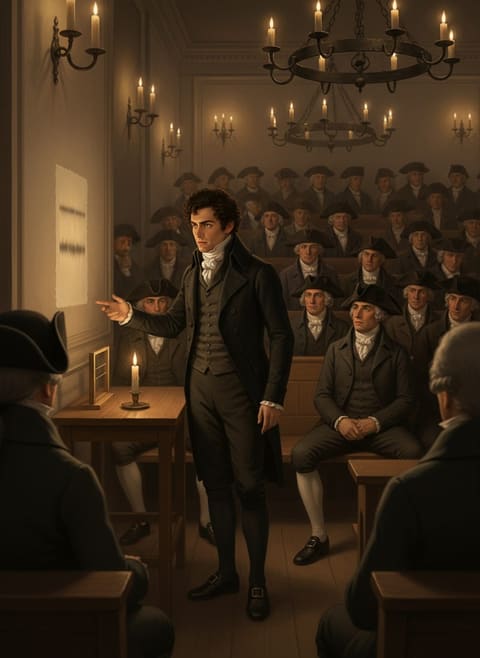
The Edinburgh air hung heavy with a chill that seeped into bones, crafting a tapestry of mist that draped the cobblestone streets like a shroud. Inside a modest workshop on a brisk morning in 1876, a young Scotsman prepared to change the very nature of human connection. With a tempered excitement and determination cast in the shadowy light filtering through soot-streaked windows, Alexander Graham Bell, son of a notable speech educator, clutched a curious contraption. As his fingers traced the wires that linked potential to reality, he prepared to speak into the annals of history. The world, until then filled with fragmented echoes of far-off voices lost to distance, was about to listen — and it would never hear silence the same way again.
The Humble Weaving of Dreams
In the midst of Edinburgh's bustling tapestry, where the hum of weaving looms sang alongside the calls of fishmongers, grew a boy uniquely attuned to the rhythms of sound. Born to Melville James Bell, a respected figure in the field of phonetics, Alexander found himself enraptured by the symphony of spoken language. Yet the world of his childhood was a cacophony of disjointed noise for many — those who could not hear. The artisan streets of Edinburgh buzzed with ambition, a fertile ground for a mind calculating the mechanics of sound not just as an art, but as a science.
Alexander's father, renowned for developing ‘Visible Speech’, had laid the foundation for communication with the deaf. This method transformed speech into symbols, painting a connection between sight and sound. Young Alexander absorbed these lessons, nurturing a revolutionary idea as he journeyed across the Atlantic — a voyage eventually culminating in the chaos of Boston's crowded streets and the clutter of invention-heavy workshops. Here, amidst the clang of progress and industry, the boy from the Scottish cobbles was poised to transform the audible world.
Unveiling Voices Through Wire
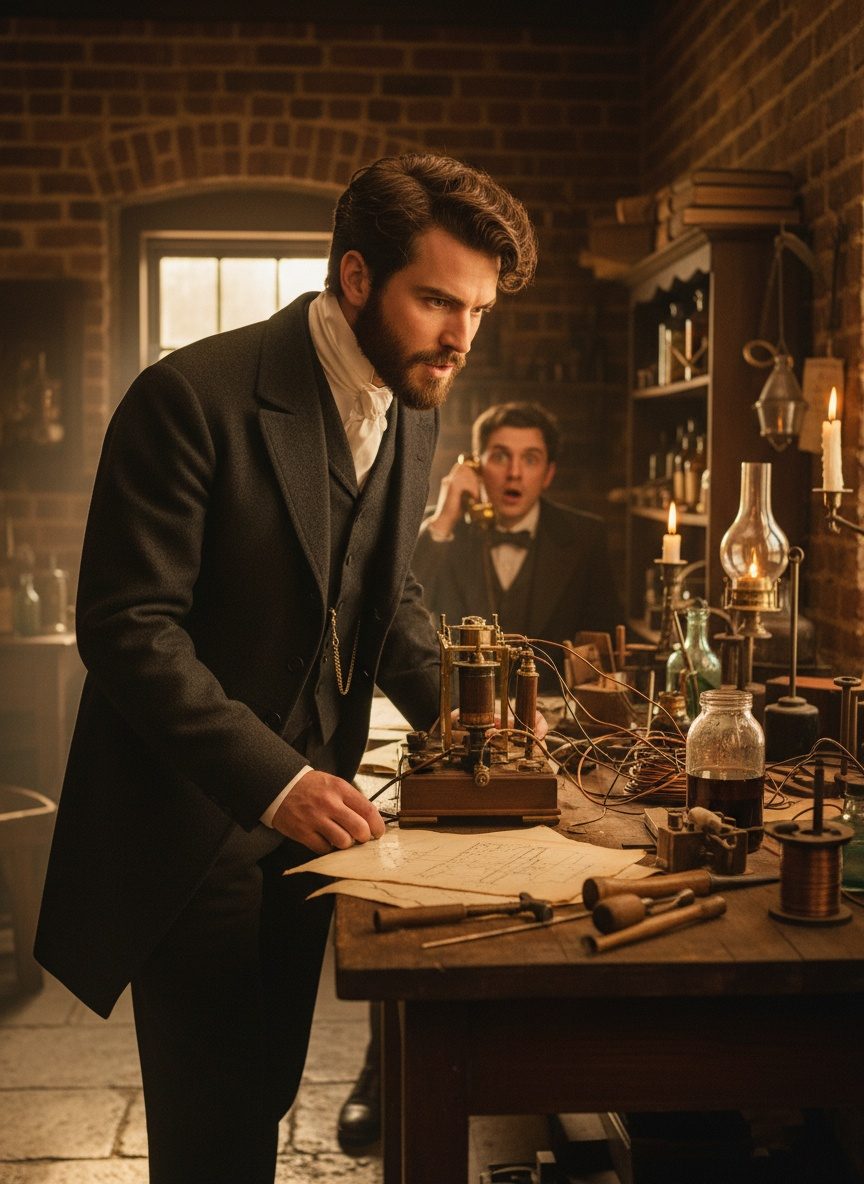
On a seemingly unremarkable day in 1876, Bell alongside his assistant, Thomas Watson, stood in a space that was half laboratory, half luthier’s shop. Fragments of inventions scattered like promises unfulfilled. Yet the room crackled with anticipation as Bell prepared to breathe life into his creation. Gold-leaf membranes lay across ebonite plates, whispering hints of the marvel they held. A reed, tuned not to string but to soul, stirred with potential energy.
Read next: The Day a Weaver's Son Mapped the Invisible World
As Bell placed the device against his lips, shaped more like a primitive horn than a tool of the future, he uttered with deliberate precision, “Mr. Watson, come here, I want to see you.” His voice hummed with the cadence of resolve and possibility, the vibrations traveling through an electrical wire connecting him to Watson in the adjacent room. Watson's arrival, flustered and alight with awe, marked the end of an era dominated by silence and the advent of unprecedented connectivity. From the whispers of a wire, the tongue of invention spoke for all humanity to hear.
Ripples Across Continents
As news of Bell's achievement rippled outwards, the structured elegance of English society and the steadfast nostalgia of highland Scotland found themselves harmonizing with the high pitch of innovation. The telephone, a world's miracle hummed into existence by an eager Scotsman, began its journey across oceans and borders, unfurling a symphony of stories once confined to face-to-face encounters. Homes and businesses teemed with the potential for immediacy that Bell's invention promised.
Read next: The Day a Clockmaker's Son Rewired How We See the Stars
Old-world Europe, laden with tradition and the echoes of past empires, found itself at the cusp of a new imperialism — one not of maps and armies, but of minds connected through invisible threads. By 1878, two years after Bell's breakthrough, telephone lines began crisscrossing landscapes, carriages of conversation traveling as effortlessly as electricity through copper veins. Each voice through wire told tales as vivid and dynamic as the Scottish highlands of Bell's origin, bringing strangers into communion and thoughts into motion.
Beyond the Echoes of Innovation
The feat accomplished within that Boston workshop transcended technological advancement; it reshaped societies, challenged traditions, and redefined humanity’s relationship with time and space. Conversations once carried by sea voyages or stallions now traversed the invisible ether in an instant. For Bell, the act of giving voice was more than invention; it was an act of liberation. Today, amidst a world saturated with digital dialogue and pixels masquerading as personal intimacy, we stand on the shoulders of those first fragile transmissions.
Alexander Graham Bell's journey from the weaver streets of Edinburgh to the electric vibrancy of Boston reflects a human impulse for connection that is timeless. His tale is a reminder of progress’ wondrous unpredictability — a testament to a world knit closer by a Scotsman's whisper to a wire. In the end, the telephone gave us more than words. It gave us the sound of ourselves, echoing across places yet unseen.