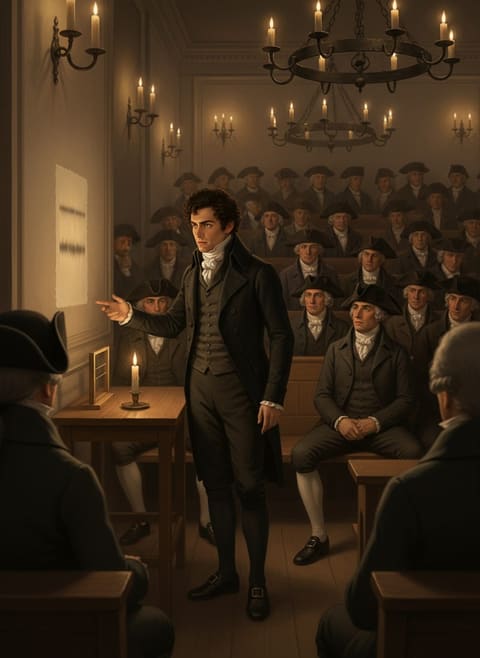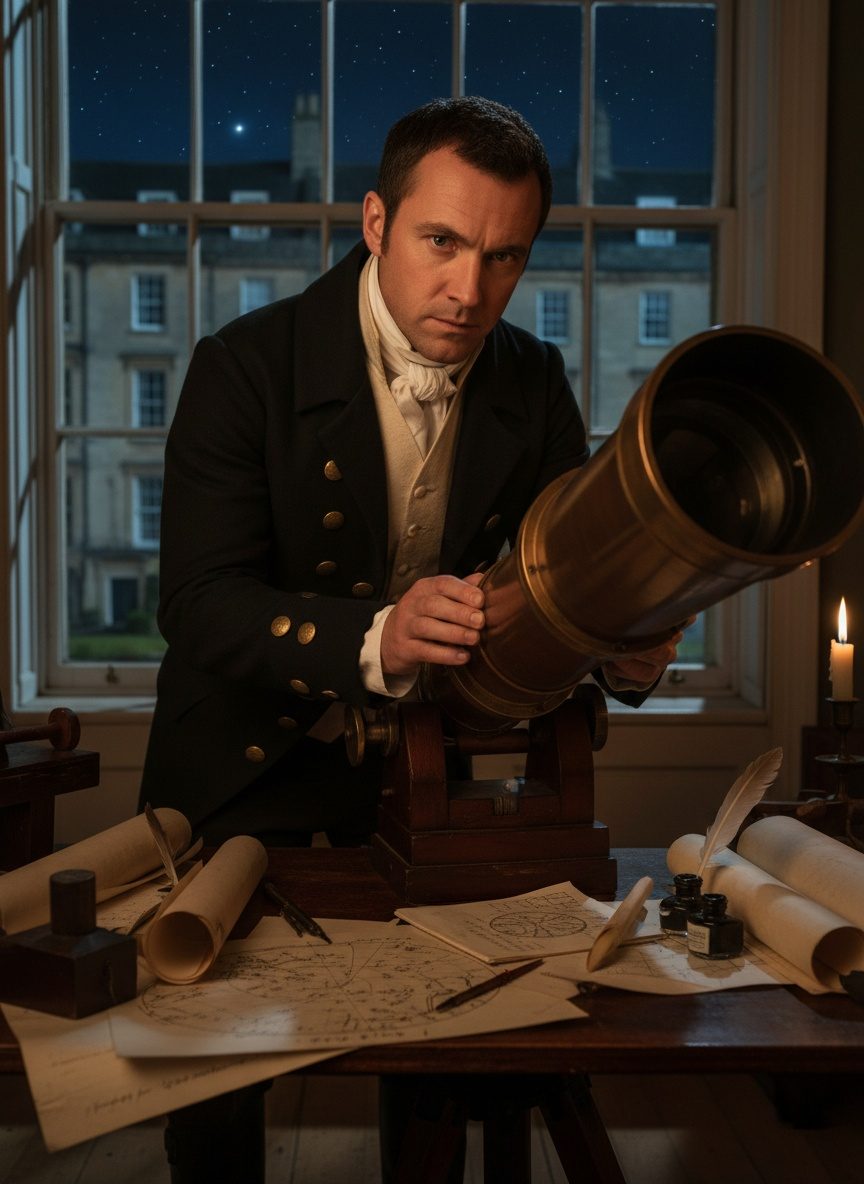
Under the cold, ink-black sky of a March night in Bath, 1781, a hush had descended upon the city, broken only by the occasional clatter of a horse-drawn carriage on cobblestones. The flickering lamps cast soft halos of light, struggling to illuminate the stone facades of Georgian architecture. Nearby, the lush countryside lay wrapped in a silver blanket of moonlight, a stark contrast to the bustling elegance of the city. Yet, unbeknownst to its citizens, something celestial was about to be unravelled—a discovery poised to reshape humanity’s awareness of the cosmos.
The Craftsman and His Celestial Vision
In a modest workshop, tucked away from Bath's lively streets, William Herschel, the son of a Hanoverian glovemaker, transformed his residence into a haven of innovation. Here, amid the metallic scents of machinery and the faintly acrid odor of molten metals, Herschel devoted himself to the meticulous art of telescope making. Without the guidance of academia, he committed himself to grinding his own mirrors—a skill both laborious and delicate, demanding precision and patience.
Herschel’s fingers were no stranger to this craft. The mirrors, once shaped, awaited their role as the eye into the vast unknown. Each telescope was assembled with the hope of unveiling the mysteries of the firmament above. It was not just the mechanical pursuit of stargazing that drove him but an unquenchable curiosity about the universe.
On the night of March 13, as the air crackled with the promise of new revelations, Herschel peered through his homemade telescope into the dark abyss, scanning a sky already pregnant with the expectations of countless previous observers. That night, however, he noticed something extraordinary—a celestial wanderer unlike the fixed stars around it. With a stillness that belied the gravity of his discovery, he found what would soon be known as the planet Uranus.
Read next: The Day a Weaver's Son Mapped the Invisible World
Against the Tide of Convention
Uranus was the first planet discovered since ancient times, a triumph that challenged centuries-old views and the comfortable, familiar map of the heavens. Herschel's discovery came not from formal training or the patronage typical of scientific breakthroughs of his era, but from a persistent passion and a willingness to question established boundaries. This remarkable achievement resonated through the corridors of academic institutions and among the many who considered the solar system an earthly certainty.
Initially, Herschel believed he had discovered a new comet. Yet, subsequent observations revealed a steady orbit, defining it as a planet. Such was the audacity of his claim that even the Royal Society, the august body of British science, was compelled to verify it. In an age when the skies were thought fully charted, Herschel boldly declared, “here lies more.”
Herschel's critical observation went on not only to expand the known bounds of our solar system but also to affirm the potential for discovery by those outside traditional spheres of influence. The gentleman astronomer had, through sheer devotion and craftsmanship, altered the dreams of what was possible in acquiring knowledge of the cosmos.
The Sky's New Architect
Bath itself, a city bathed in social elegance and civility, seemed an unlikely backdrop for such a groundbreaking astronomical moment. Yet its temperate climes and rich social fabric provided the quietude necessary for Herschel’s nocturnal explorations. Herschel’s impact on science cannot be overstated; by exposing humanity to a new planet, he shifted astronomical thought from the rigid Ptolemaic diagrams toward a dynamic, expanding universe.
Read next: The Day a Clockmaker's Son Rewired How We See the Stars
Herschel’s discovery catalyzed a cascade of scientific pursuits as astronomers and philosophers alike mused on the implications of this newfound neighbor. Uranus's existence orbited a significant question: If one planet lurked undiscovered, how many more might lie obscure beyond our sight? This question sparked fervent inquiries, ultimately laying the groundwork for modern astronomy’s evolution from a static catalog of celestial figures to an intricate tapestry of relationships and motion.
A Universe of Possibilities
In the fluid motion of Uranus across the Bath night skies, Herschel helped us glimpse the broader theater of our universe—a space still ripe with uncharted territories and tales untold. Herschel himself transformed astronomy, not just by his unprecedented contribution but also by demonstrating the power of individual inquiry and curiosity against towering odds.
Today, as contemporary scientists peer deeper into the cosmic void, seeking the faint whispers of the universe’s infancy, they stand on the shoulders of men like William Herschel, who dared to wonder if they were wrong about everything they thought they knew. In a time when facts often felt finite, Herschel revealed that human eyes could still be ever more open, ever more searching.
Herschel's tale is more than the discovery of a planet; it is a testament to the unyielding quest for knowledge and the human spirit's resilience against self-imposed limits. We are reminded that sometimes, to truly understand the depth of the world around us, we need only to look up on a clear night and question the celestial narrative we've long taken for granted.