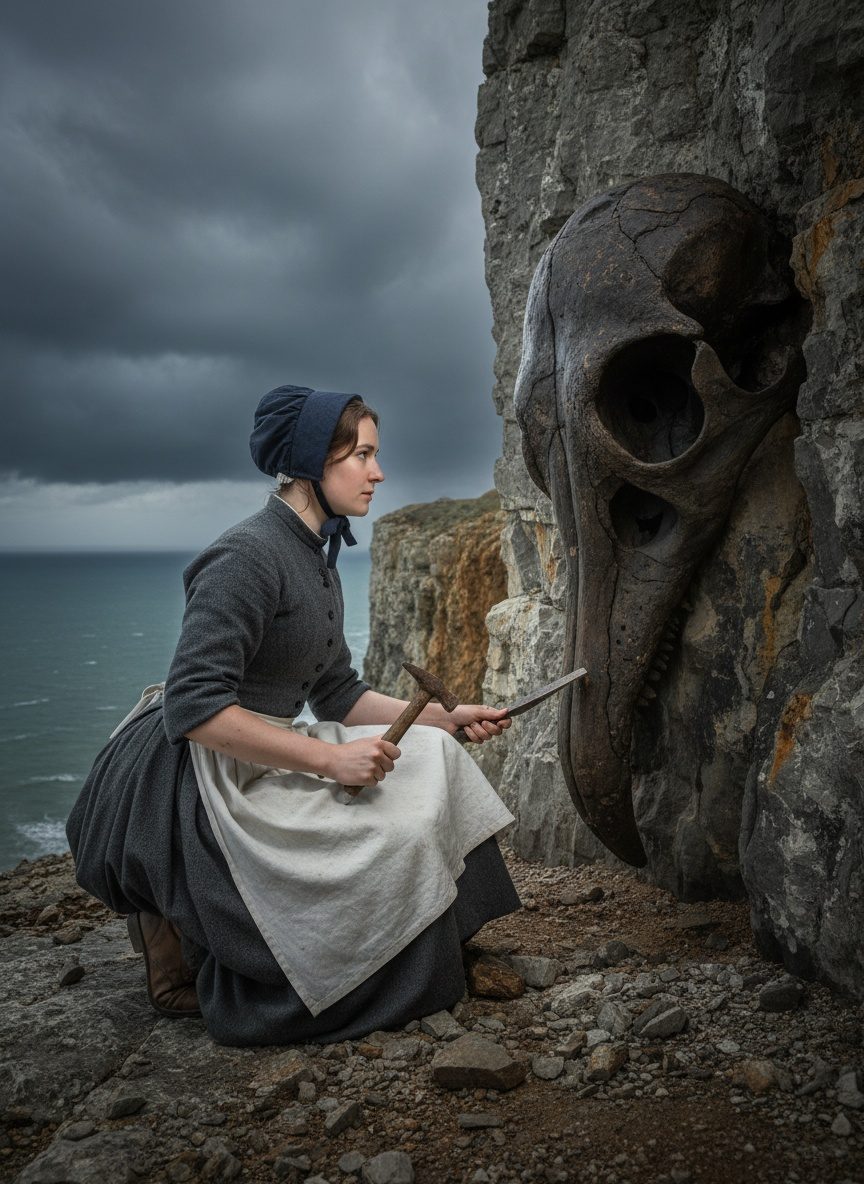
The cliffs of Lyme Regis strode defiantly towards the churning sea in the spring of 1823, their secrets long guarded by eons of geological drama. As the waves nibbled at their feet, a figure stood unfazed atop the precipice with a confidence unspoken in the tongues of regency society; that of a woman, alongside the brittle cliffs and the wisdom they withheld. This was Mary Anning, a twenty-four-year-old with no university degree, no scientific titles, and no influence in the genteel drawing rooms of London's intellectual elite. Yet, it was she who, against all odds, would unearthed a fossil from this maritime monolith, forever reshaping our understanding of the Earth's past.
Unearthing the Past: The Ichthyosaur Discovery
By the time 1823 dawned, Mary Anning was no stranger to the rugged cliffs of the Dorset coastline. Her fossil-hunting prowess was evident, cultivated from childhood in this coastal cradle rampant with prehistoric remnants. On a brisk February morning, she clambered up the rocks, her chisel and hammer echoing against stone, driven by a keen eye that deciphered the whisperings of the ancient world compressed beneath her feet.
In a remarkable feat of precision, Anning unearthed a nearly complete skull from the limestone, a fearsome beast with jaws lined with teeth like a predator's grin frozen in time. Her careful and methodical work revealed it to be an Ichthyosaurus — a "fish lizard" that defied known science. The impossibility of this new species astounded the scientific community and opened up debates that would unravel the origins of life and the Earth’s natural history.
The Girl Who Looked at Rocks
Born in 1799 to a family struggling to make ends meet, Mary Anning grew up amidst the fossil-laden Blue Lias cliffs, casually referred to as the "Jurassic Coast" today. Educated largely by her father and subsequently self-taught, she exposed subaqueous tangles of serpentine bones with every stroke of her hammer.
Read next: The Day a Miner's Son Gave the World Safe Light
Despite her contributions, Victorian England still perceived women like Anning through a lens that skewed their intellect toward gentility or servitude. Yet, she defied the centuries-old shoreline with a focus and determination that rivaled that of any educated scholar of the time — a defiance encapsulated in a famous local tongue twister popularized years later, "She sells seashells by the seashore," believed by many to have roots in her legacy.
The Scientific Establishment and Societal Challenges
Anning had to battle not just against rocky cliffs, but against the societal cliffs of class and gender as well. In Regency England, the domain of natural sciences was a gilded cage for men, privileged men at that, and her discoveries and observations were routinely hijacked and re-antedated as the successes of her male contemporaries. The British scientific sphere, then largely guided by wealthy, titled gentlemen, treated her finds with dismissive, skeptical glances.
Notably, she was not even allowed to join the Geological Society of London, which had been established in 1807. Women were barred from the organization until 1904. Thus, her monumental discovery of the Plesiosaurus in 1823 would need to find validation through men in high places. Yet, her meticulous drafts and detailed anatomical findings spoke louder than snubbed acknowledgment ever could, subtly insisting upon her due place in the annals of science.
Whispers of Recognition: Anning’s Contributions
While many contemporaries cherry-picked her discoveries, some, like celebrated scientist Henry De la Beche, recognized Anning’s brilliance. De la Beche, who knew her personally, created an illustration based on her finds, titled "Duria Antiquior," considered the first ever pictorial representation of prehistoric life based on fossil evidence and a testament to her vision.
Amidst the quiet conspiracies of nature she unravelled, it was the burgeoning field of paleontology that truly appreciated Anning's findings. Through her endeavors, she was indirectly part of the burgeoning debate on extinction, a notion almost blasphemous at the time, juxtaposed awkwardly against the age’s prevailing theological ideas.
The Impact: A Legacy beyond Time
Mary Anning passed away in 1847, her life's work primarily uncelebrated until after her death, sparking an ever-growing legacy. Her life continues to ignite discussions of both equal opportunities within the scientific communities and the countering of societal prejudice, inspiring legions of aspiring female scientists to push against the proverbial glass ceiling.
Why does this story matter today, one might ask? Beyond the history-changing impact of her discoveries, Anning's story is a resonant reminder of the oft-overlooked voices that shape our scientific tapestry. Her tenacity, unmarred by status or gender, illuminates a crucial narrative of inclusivity within the world of academia and the perpetual inspiration drawn from acknowledging and celebrating invaluable contributions regardless of the bearer's stature in society.
In echoing Mary Anning’s limitless curiosity, we pave the way forward, ensuring that no matter how tempestuous the cliffs or deep the waters of academia, every voice deserves its opportunity to be heard.