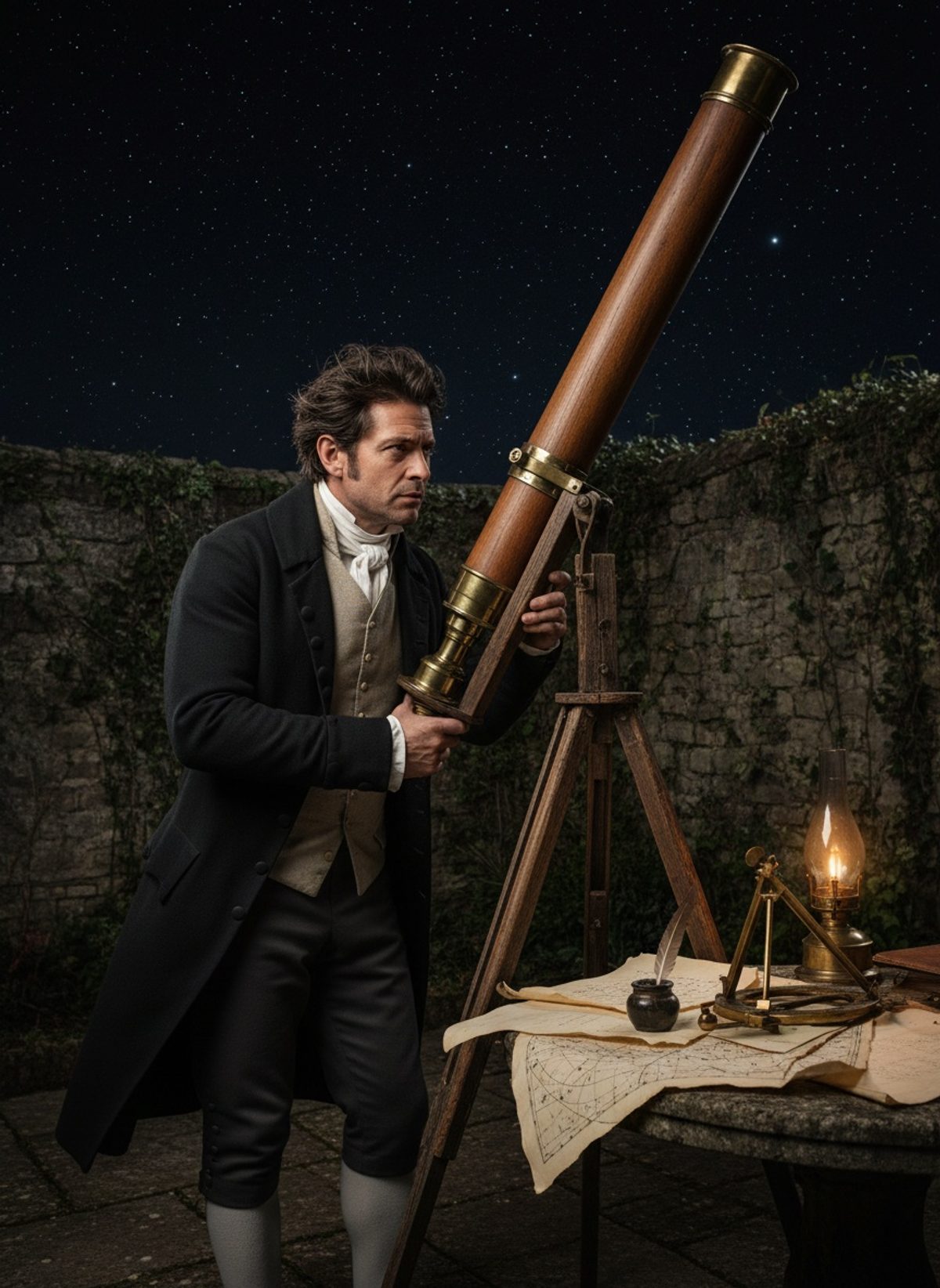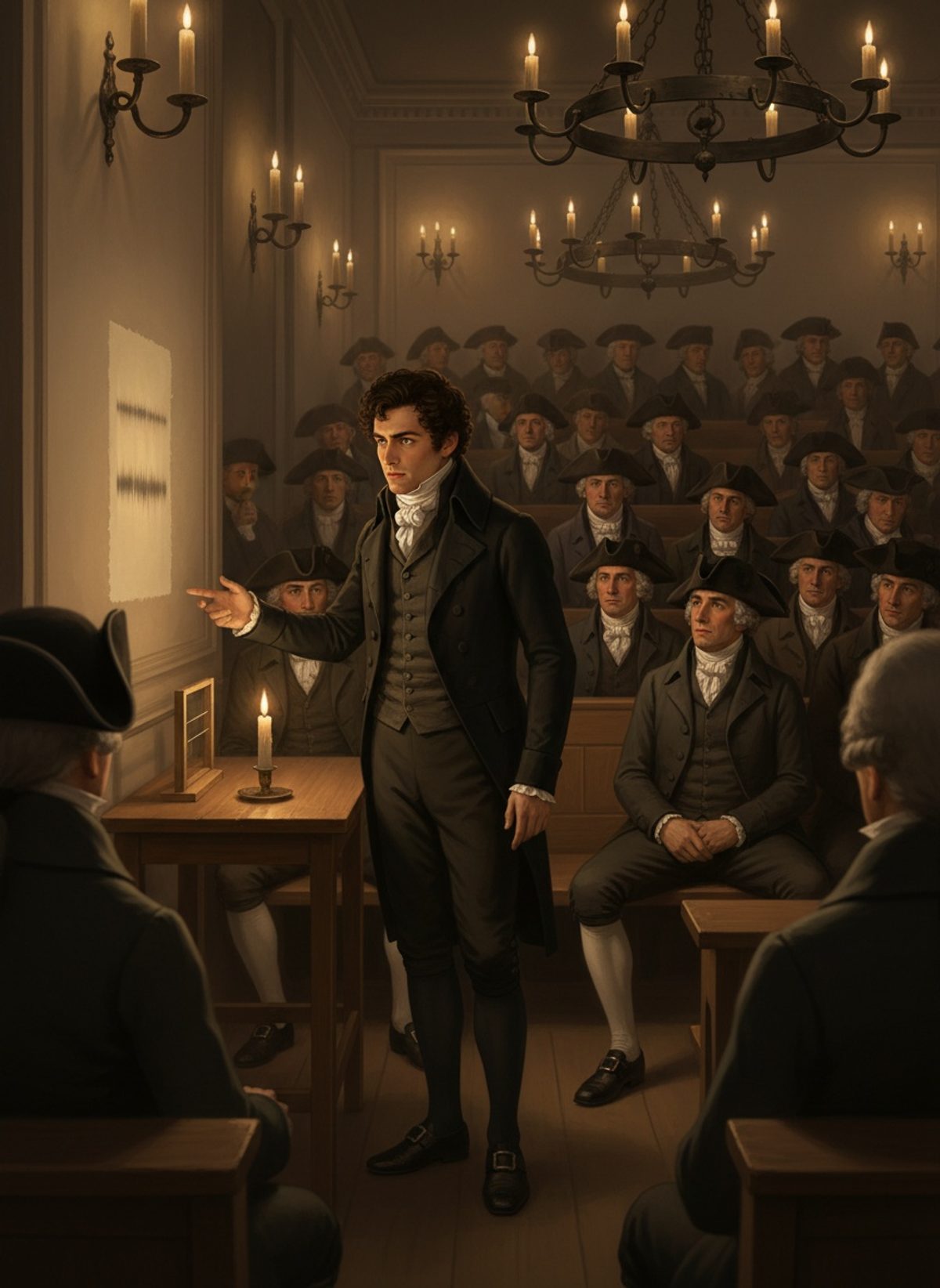
The quill scratched softly against the paper, pausing momentarily as its owner glanced out of the rain-streaked window of his modest Manchester room. John Dalton, son of a humble weaver, stared through the dreary afternoon into the endless sea of questions that filled the air outside his lodgings. Each raindrop, invisible yet real, was a reminder of the mysteries he had vowed to unravel. What lay at the foundation of everything? What invisible architecture held the world together?
John Dalton was not born into the halls of academia or nurtured in the opulence of patronage. No stately halls filled with the echo of scholarly debate awaited him. His beginnings were modest, his family's home nestled among the green dales of Cumbria. His early days were spent following his father's footsteps, learning to tease shapes and patterns from tufts of wool, his existence mirrored by the weft and weave of fabric, interconnected but distinct. Yet, in the quiet hours when his hands were still, young Dalton's mind danced with the abstract, sifting through threads of logic and nature to find where the fabric of reality frayed apart—to find the singular, indivisible pieces that formed the universe.
Without the clarity of vision, cursed by colour-blindness, his world was more a tapestry of varying degrees of contrast than a riot of hues. Ironically, this condition perhaps gifted him a clearer vision of the world beyond the visible. Dalton’s nature was one of curiosity and meticulous observation, and it was with those tools that he began his journey into the unknown. His fascination with the unseen world led him to propose an idea so simple, yet so profound and controversial, it would redraw the boundaries of science: the atomic theory.
It was the year 1803, a time when even the concept of matter was nebulous, their definitions as foggy as the smoky Manchester sky. The notion that matter, all of the tangible existence around us, could be broken down into indivisible particles called atoms, was hardly the consensus of the time. Yet Dalton, working without the grandeur of resources or the support of a prestigious institution, produced a groundbreaking body of work that described a world made up of invisible architecture no human eye could behold but which every natural occurrence belied.
Read next: The Day a Potter's Son Gave the World Its First Geological Map
Within the walls of his lodgings, Dalton's days and nights blurred together, driven by an insatiable inquiry. His instruments were not sophisticated by today's standards: simple balances, glassware, and his own methodical nature. However, their usefulness was amplified by a mind that never ceased questioning. Drawing on these modest tools, he diligently conducted experiments that would give rise to the first table of atomic weights—a simple yet exquisite representation of his theory in practice. His assertion that each chemical element comprised its own unique kind of atom, and that these could be arranged in fixed ratios to form compounds, was revolutionary.
What was it to map the invisible? In Dalton's mind, each element's weight was not just a number, but a story, a mystery solved, a universe unveiled molecule by molecule. The metaphorical fog that had obscured understanding since the days of the ancients began to lift. Atoms, long posited but scarcely pursued with rigour, became not just a philosophical abstraction, but the cornerstone of a new science. Dalton’s theory rattled the very foundation of chemistry and sent ripples through the broader scientific community, laying groundwork that eventually shaped physics and medicine as well.
The world outside Dalton's room was one of industrial burgeon. Manchester itself was a powerhouse of transformation, its factories pumping the lifeblood of industrialization into the veins of Britain. The clamour for understanding the material world was rising—and Dalton, in his own quiet rebellion against the status quo, answered with postulates that provided new perspectives on natural phenomena, the laws of gases, and elemental ratios, converged from countless hours of solitude and scribbled formulas.
The impact of Dalton's atomic theory extended far beyond the limits of chemistry. It revolutionized how scientists approached the interplay between elemental physics and chemistry, essentially fostering the growth of what would later be known as physical chemistry. Medicine too would be inevitably transformed, as understanding of molecular interactions became pivotal in the development of pharmaceuticals and treatments.
Perhaps the most profound legacy of John Dalton, son of a weaver, is that he taught generations to see differently. His theory reframed the invisible as the undeniable, paving paths through academia, changing the nature of scientific inquiries, and illustrating that the complex could indeed be understood through the simplest of truths. From Manchester to the vast expanses of scientific exploration worldwide, Dalton's legacy was a reminder that the substance of progress often lies hidden within the realms of imagination, curiosity, and conviction.
In a world ever yearning for the hidden structures behind its mechanisms, John Dalton’s quiet, relentless pursuit of mapping the invisible unwittingly began a revolution. The atoms he theorized, unseen yet all-encompassing, became the building blocks upon which modern science has been erected. His story remains an inspiring testament to the power of unfettered curiosity-born insight—the kind that yields profound truths about the universe and our place within it.