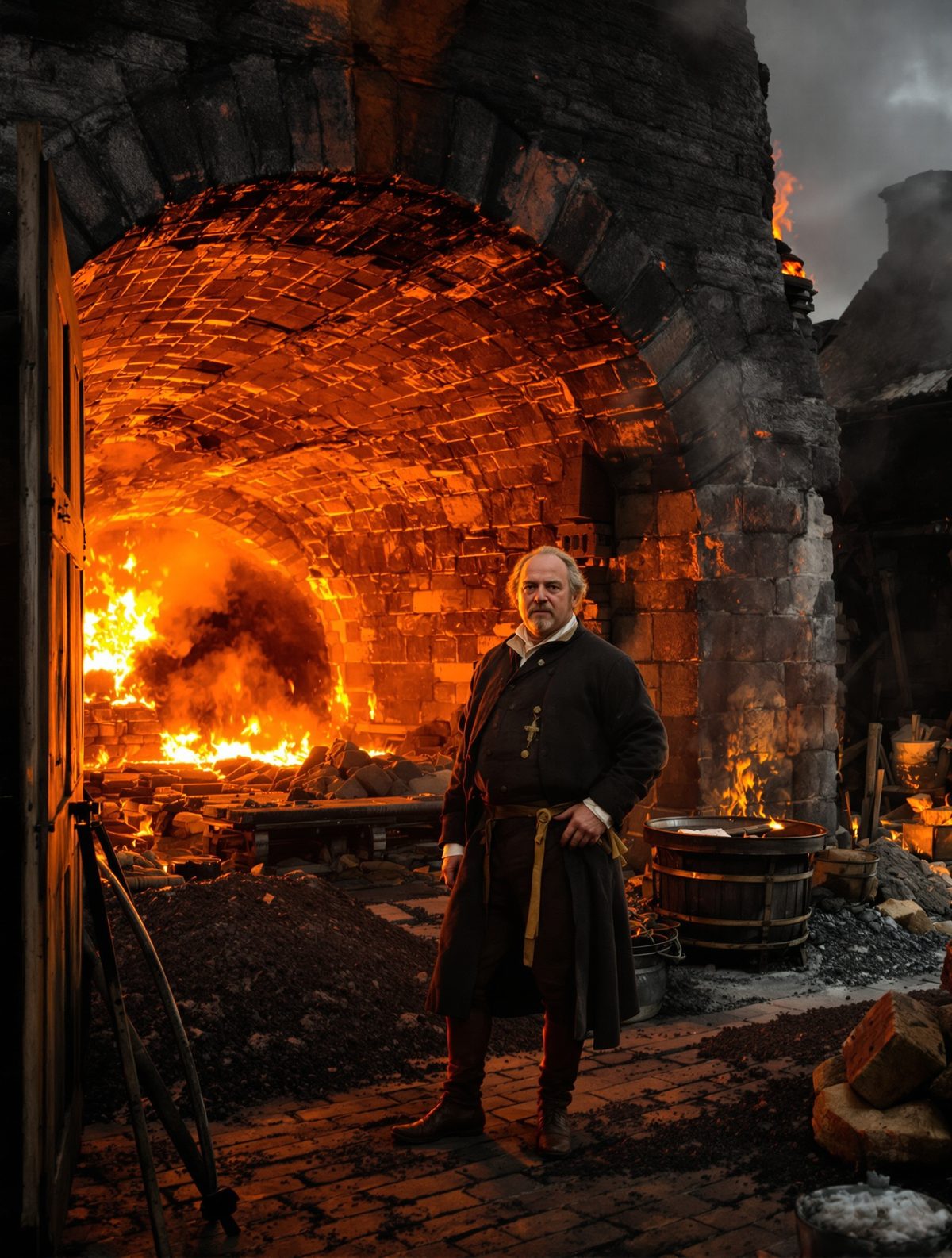
The acrid smoke billowed from the furnace at Coalbrookdale as Abraham Darby wiped the sweat from his brow. It was 1709, and the Quaker ironmaster faced a problem that was slowly strangling Britain's iron industry. The charcoal in his furnace—made from precious English oak—was producing iron so expensive it threatened to bankrupt his foundry. Across the kingdom, furnaces were going cold as forests disappeared and charcoal prices soared beyond reach.
Darby stared at the pile of coal beside his workshop. Everyone knew you couldn't smelt iron with coal. The sulfur would poison the iron, making it brittle and useless. But as he watched his expensive charcoal burn away his profits, a desperate idea began to form. What if everyone was wrong?
What happened next in that smoky Shropshire valley would transform not just Britain, but the entire world. The decision to throw coal into those flames would unleash forces that would reshape continents, topple empires, and create the modern industrial age.
The Crisis That Nearly Killed British Iron
To understand the magnitude of Darby's breakthrough, you must first picture Britain in 1709—a nation literally running out of trees. For centuries, iron smelting had devoured England's ancient forests with an insatiable appetite. A single ton of iron required eight tons of charcoal, which meant felling roughly 200 trees. The mathematician in you can do the grim arithmetic: Britain's iron industry was eating its way through approximately 100,000 trees every year.
Read next: The Day a Mill Owner Walked Into Parliament for His Children
By Darby's time, vast swathes of England resembled moonscapes. The Forest of Dean, once a dense woodland stretching across 27,000 acres, had been reduced to scattered groves. Iron masters were forced to import charcoal from as far away as Russia and Sweden, making British iron prohibitively expensive. Many foundries simply closed their doors.
Abraham Darby inherited this crisis when he established his foundry at Coalbrookdale in 1708. A devout Quaker from Birmingham, Darby had learned his trade in Holland, where he'd mastered the art of casting thin-walled pots that were both stronger and lighter than traditional ironware. But back in England, the charcoal shortage threatened to destroy his dreams before they began.
The Heretical Experiment
Coal was everywhere in early 18th-century Britain—literally underfoot. The country sat atop some of the world's richest coal deposits, and miners had been extracting the black rock for centuries. Londoners burned it in their hearths, brewers used it to dry their malt, and blacksmiths fired their forges with it. But smelting iron? That was considered impossible.
The problem was sulfur. Raw coal contained sulfur compounds that, when burned, would contaminate iron and render it useless for most applications. The resulting iron was brittle, prone to cracking, and generally inferior to charcoal-smelted metal. For generations, this had been accepted wisdom—until Darby decided to challenge it.
His breakthrough came through a process called "coking"—heating coal in the absence of air to drive off the volatile impurities, including most of the sulfur. The result was coke: a clean-burning, carbon-rich fuel that burned hotter than charcoal and was virtually sulfur-free. Darby wasn't the first to make coke, but he was the first to realize its potential for iron smelting.
On that fateful day in 1709, Darby loaded his blast furnace with iron ore, limestone, and coke instead of charcoal. As the coke ignited, it burned with an intense, clean heat that exceeded anything his furnace had ever experienced. The iron ore melted more completely, flowing like liquid silver into his casting molds. When it cooled, Darby found he had produced iron that was not only equal to charcoal-smelted metal but actually superior in many ways.
The Secret That Nearly Died With Him
Here's where the story takes a fascinating turn that most history books skip entirely. Darby's revolutionary discovery remained largely secret for nearly fifty years. The Coalbrookdale foundry quietly prospered, producing high-quality iron at a fraction of the cost of its competitors, but Darby shared his technique with almost no one outside his family.
This wasn't corporate espionage in the modern sense—it was something far more remarkable. The Darby family were Quakers, a religious sect that faced severe persecution and legal restrictions in 18th-century England. Quakers couldn't attend universities, hold public office, or join most professional guilds. They formed tight-knit communities and often kept their innovations within their religious network.
Abraham Darby died in 1717, taking many of his technical secrets to the grave. His son, Abraham Darby II, gradually refined the process, but the family's coke-smelting technique remained confined to Coalbrookdale for decades. Meanwhile, the rest of Britain's iron industry continued to struggle with the charcoal crisis, unaware that the solution lay hidden in a Shropshire valley.
It wasn't until the 1750s, when other ironmasters began visiting Coalbrookdale and reverse-engineering the Darby process, that coke smelting finally spread across Britain. By then, the Darby family had enjoyed a near-monopoly on cheap iron production for almost half a century.
The Iron That Built An Empire
Once the secret escaped Coalbrookdale, the transformation was explosive. British iron production increased by 2,500 percent between 1720 and 1840. The price of iron plummeted, making it affordable for applications that had been unthinkable just decades earlier.
The world's first iron bridge rose at Coalbrookdale in 1779—a graceful arch spanning the River Severn, built by Abraham Darby III using his grandfather's revolutionary technique. The bridge still stands today, a testament to the quality of coke-smelted iron. But this was just the beginning.
Cheap iron enabled the construction of the first steam engines, which pumped water from mines and powered textile mills. Iron rails carried the first railways across Britain's countryside. Iron ships ruled the waves, carrying British goods to every corner of the globe. Iron cannons and weapons gave Britain military supremacy that lasted for more than a century.
The numbers tell the story of transformation: In 1700, Britain produced just 12,000 tons of iron annually. By 1850, that figure had exploded to 2.3 million tons—more than the rest of the world combined. This avalanche of cheap iron didn't just fuel the Industrial Revolution; it was the Industrial Revolution.
The Ripple Effects That Changed Everything
But perhaps the most remarkable aspect of Darby's discovery was how it cascaded through every aspect of human civilization. Cheap iron meant affordable farm tools, which increased agricultural productivity and freed workers for factory jobs. Iron machinery revolutionized textile production, making cloth so inexpensive that even laborers could afford multiple changes of clothing.
The social implications were equally profound. Iron railways shrank distances and connected isolated communities to national markets. Information flowed faster, prices stabilized across regions, and for the first time in human history, ordinary people could travel hundreds of miles in a single day. The very concept of a national culture became possible.
Urban centers exploded in size as iron-built factories drew workers from the countryside. Manchester's population grew from 17,000 in 1760 to 237,000 by 1851. Birmingham, Sheffield, and dozens of other industrial cities rose from market towns to metropolitan centers, all built on foundations of cheap iron.
Even more surprisingly, Darby's innovation helped fuel the abolition of slavery. Cheap iron made steam-powered machinery economically viable, providing an alternative to human labor that was often more efficient and always more reliable than enslaved workers. The moral arguments against slavery gained economic backing when iron-built machines could harvest cotton, mine coal, and manufacture goods more productively than human hands.
The Legacy That Lives In Your Pocket
Today, as you read this on a device containing iron-based components, you're experiencing the distant echo of that moment in 1709 when Abraham Darby decided to experiment with coal. The skyscrapers that define our cities, the cars that fill our streets, the infrastructure that powers our digital age—all trace their ancestry back to that Shropshire furnace.
But Darby's true legacy isn't just technological—it's philosophical. His willingness to challenge accepted wisdom, to experiment despite the risk of failure, embodies the spirit that drives all human progress. In an age when "everyone knew" that coal couldn't smelt iron, one Quaker ironmaster dared to ask: "What if everyone is wrong?"
That question, asked in a smoky foundry more than three centuries ago, didn't just change how we make iron. It changed how we think about the impossible. Every time someone challenges conventional wisdom, every time an entrepreneur risks everything on an untested idea, every time a scientist dares to overturn established theory, they're channeling the spirit of Abraham Darby—the man who threw coal into his furnace and accidentally ignited the modern world.