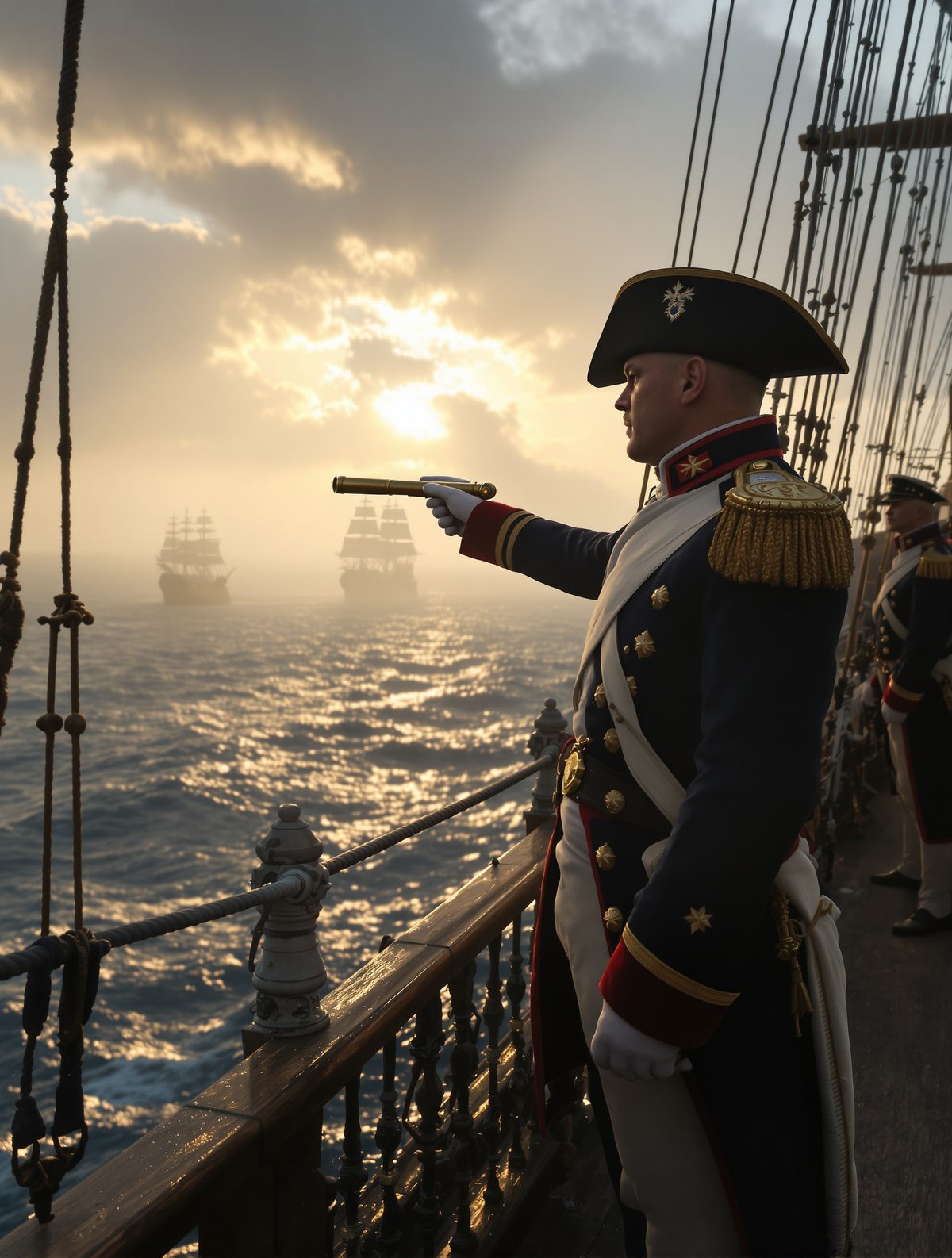
The morning mist hung thick over the Atlantic waters off Cape St. Vincent, Portugal, on February 14th, 1797. Through the gloom, Admiral Sir John Jervis squinted at his flagship's signal mast, watching as the lookouts counted enemy sails on the horizon. One Spanish ship. Then five. Ten. Fifteen. The count kept climbing with sickening inevitability. Twenty. Twenty-five. Finally, twenty-seven massive warships emerged from the fog—the largest enemy fleet any British admiral had ever faced in open battle.
Jervis commanded just fifteen ships. The mathematics were brutal: nearly two-to-one odds against the Royal Navy. Around him, his officers shifted nervously, waiting for the inevitable order to withdraw. Instead, the 62-year-old admiral did something that would echo through naval history. He raised his telescope, studied the imposing Spanish fleet, and calmly ordered: "The die is cast, and if there are fifty sail I will go through them."
The Odds Stack Against Britain
By early 1797, Britain stood virtually alone against the might of revolutionary Europe. France had swept across the continent, and Spain had recently joined the coalition against Britain through the Treaty of San Ildefonso. The Spanish fleet, commanded by Admiral José de Córdoba, wasn't just numerically superior—it was formidable in firepower. The Spanish flagship Santísima Trinidad was a monster: the world's largest warship with 136 guns spread across four decks, more than any British ship could match.
Jervis knew the stakes. If the Spanish fleet escaped to join the French at Brest, they would command nearly sixty ships of the line—enough to attempt an invasion of Britain itself. The English Channel would become a highway for enemy forces, and the island nation's centuries of naval supremacy would crumble in a matter of weeks.
Read next: The Day a British Captain Stood Between Slaves and the Sea
What made the situation even more desperate was Britain's own precarious position. The Royal Navy was stretched impossibly thin, guarding trade routes from the Caribbean to India. Jervis's Mediterranean Fleet was all that stood between the Spanish armada and its rendezvous with destiny. His captains understood the mathematics of destruction they faced, but they also knew their admiral's reputation. John Jervis was a man who had never retreated from a fight, earning the nickname "Iron Jack" for his unflinching discipline and tactical brilliance.
A Formation Born of Desperation
As the morning fog began to lift, Jervis made a decision that defied every conventional naval wisdom of the age. Instead of forming the traditional line of battle—ships arranged in a long column, each vessel following the next—he would attempt something far more audacious. He would slice directly through the Spanish line, splitting their massive fleet in two and preventing them from bringing their full strength to bear.
The British ships formed into a tight single file, with Jervis's flagship HMS Victory leading the charge. Behind him sailed some of the most famous ships in naval history: HMS Captain commanded by the rising star Horatio Nelson, HMS Culloden under the aggressive Captain Thomas Troubridge, and HMS Colossus with Captain George Murray at the helm. Each captain knew that hesitation meant not just defeat, but national catastrophe.
What the Spanish commanders didn't anticipate was the sheer audacity of Jervis's plan. Their fleet was spread out in a loose formation, perfect for a stately, formal engagement but vulnerable to a concentrated attack. The British line, like a sword thrust, would punch through their center and create chaos in their ranks. It was a gamble that would either save Britain or destroy its Mediterranean fleet in a single morning.
Nelson Breaks the Rules
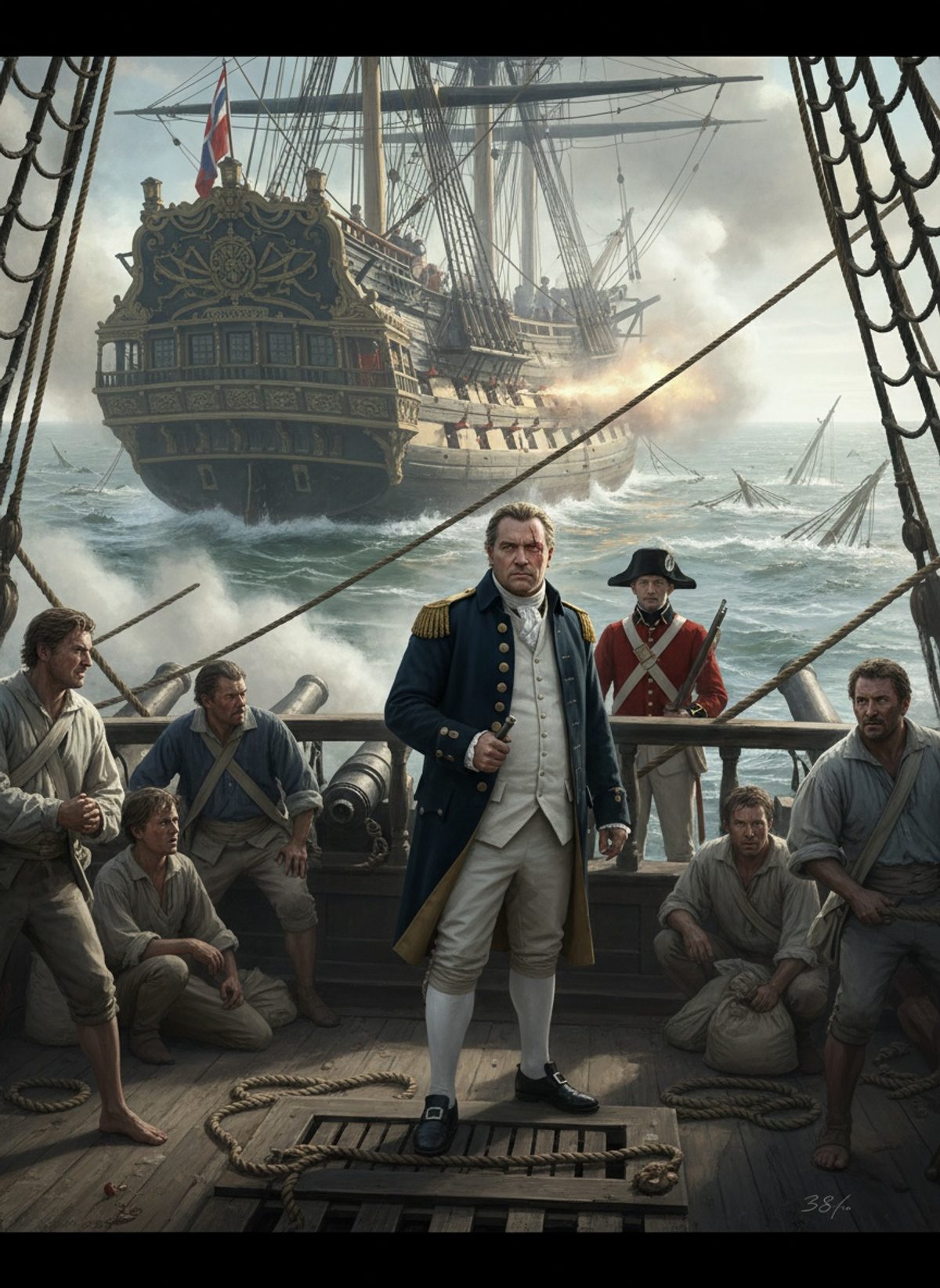
At approximately 11:30 AM, the first British ships smashed into the Spanish line. The thunder of cannon fire rolled across the water as ships exchanged devastating broadsides at point-blank range. Jervis's plan was working—the Spanish fleet was indeed splitting apart—but then the unexpected happened. A gap appeared in the Spanish formation, and several of their largest ships, including the mighty Santísima Trinidad, began to escape toward the rear of their fleet.
This was the moment that would define not just the battle, but naval warfare itself. Captain Horatio Nelson, commanding HMS Captain seventh in the British line, saw the Spanish ships escaping. By all naval regulations and the sacred principle of maintaining formation, he should have continued following the ship ahead of him. Instead, Nelson made a decision that was either genius or madness.
He ordered his ship to wear out of the line—essentially making a U-turn—and charged directly at the escaping Spanish ships. It was a breathtaking breach of naval discipline that could have resulted in court-martial. Nelson was essentially attacking four enemy ships single-handedly, including vessels twice the size of his own. His crew watched in awe as their captain steered them toward what appeared to be certain destruction.
But Nelson had read the battle perfectly. His unexpected maneuver caught the Spanish completely off-guard, and within minutes, other British ships were following his lead, converging on the confused enemy vessels like wolves on scattered sheep.
The Moment Victory Hung in the Balance
The battle now became a swirling melee of individual ship duels, with HMS Captain at the center of the storm. Nelson found himself engaged simultaneously with the San Nicolás (80 guns) and the San José (112 guns), both significantly larger than his own vessel. The Spanish ships pounded Captain mercilessly, dismasting her and reducing her to a floating wreck.
But Nelson had one more impossible trick to play. Instead of withdrawing, he ordered his ship to ram the San Nicolás. As the vessels locked together, Nelson himself led the boarding party, sword in hand, across the enemy's deck. In some of the most vicious hand-to-hand fighting in naval history, the British sailors fought their way across the Spanish ship's deck, overwhelming the crew through sheer ferocity.
Then, in a moment of tactical inspiration that would become legendary, Nelson noticed that the San José had drifted alongside the captured San Nicolás. Without hesitation, he led his men across the deck of their first prize and onto the second Spanish ship, capturing both vessels in what would forever be known as "Nelson's Patent Bridge for Boarding First-Rates." No naval officer in history had ever captured two enemy ships simultaneously in such a manner.
The Impossible Victory
As the afternoon sun began to set, the smoke of battle cleared to reveal an extraordinary sight. The Spanish fleet, despite its overwhelming numerical superiority, was in full retreat. Four of their ships had been captured, including two first-rate ships of the line. The Santísima Trinidad, battered and listing, had barely escaped capture herself. Admiral Córdoba's grand fleet, which should have swept the British from the seas, was limping back to Cádiz in defeat.
The British had achieved something that military historians still struggle to explain fully. Against odds of nearly two-to-one, they had not just survived but won a decisive victory. The secret lay in a combination of superior seamanship, aggressive tactics, and the kind of individual initiative that the rigid Spanish command structure couldn't match. Where Spanish captains waited for orders, British captains seized opportunities.
Jervis's victory sent shockwaves across Europe. The myth of Spanish naval power was shattered in a single day, and Britain's dominance of the seas was secured for another generation. The captured Spanish ships were sailed to Gibraltar as prizes, their guns silenced forever. More importantly, the threat of invasion had been eliminated—the Spanish fleet would never again pose a serious challenge to British naval supremacy.
Echoes of Greatness
The Battle of Cape St. Vincent reveals something profound about leadership under impossible pressure. When faced with overwhelming odds, Jervis and Nelson didn't calculate probabilities—they created possibilities. In our modern age of risk management and careful planning, there's something both inspiring and unsettling about commanders who would stake everything on audacity and skill.
The battle also demonstrated how individual initiative can trump numerical superiority when systems are rigid versus adaptive. The Spanish fleet fought as separate ships following predetermined plans, while the British fought as a coordinated organism capable of instant adaptation. It's a lesson that resonates far beyond naval warfare, into boardrooms and battlefields alike.
Perhaps most remarkably, this single day's fighting produced two future Admirals of the Fleet—Nelson would go on to win immortal fame at Trafalgar, while Jervis became Earl St. Vincent. Their victory off Cape St. Vincent didn't just save Britain from invasion; it forged the naval tradition that would dominate the oceans for the next century. Sometimes, the most impossible victories become the most inevitable legends.