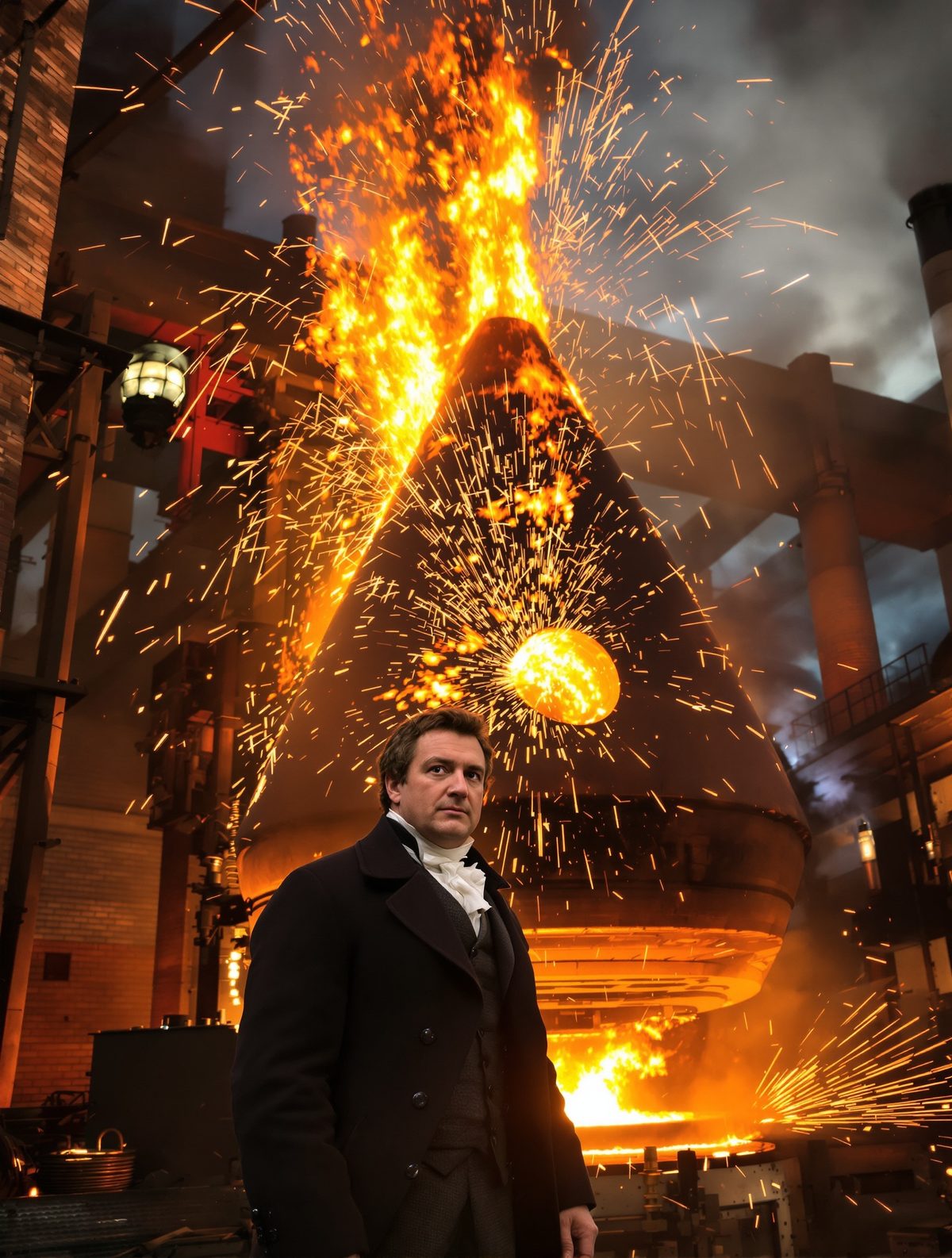
The furnace roared like a dragon in the depths of Baxter House foundry, its flames licking hungrily at the Sheffield sky. Henry Bessemer wiped the sweat from his brow as he approached the converter—a massive pear-shaped vessel that would either revolutionize the world or kill him in the next few minutes. It was August 11th, 1856, and the 43-year-old inventor was about to conduct the most dangerous experiment of his life. Nobody in that sweltering foundry could have imagined that within moments, an explosion of molten metal and compressed air would accidentally birth the modern world.
The Desperate Gamble That Started It All
Henry Bessemer wasn't supposed to be playing with molten iron. The son of a French engineer who had fled to England during the Revolution, Bessemer had made his fortune from more genteel pursuits—bronze powder for gold paint, a revolutionary sugar press, and even an early form of embossed stamps. But by 1854, Britain was embroiled in the Crimean War, and Bessemer had designed a new artillery shell that promised to give British forces a devastating advantage.
There was just one problem: the cannons kept exploding.
Cast iron, the backbone of British industry, simply couldn't handle the pressure of Bessemer's innovative shells. The brittle metal would shatter catastrophically, often killing the very soldiers it was meant to protect. Steel existed, but it was hideously expensive—produced painstakingly in small batches using ancient methods that hadn't changed since medieval times. A ton of steel cost roughly forty pounds, equivalent to nearly £5,000 today. At those prices, steel cannons were a luxury Britain's war chest couldn't afford.
Read next: The Day a Mill Owner Walked Into Parliament for His Children
Bessemer became obsessed. If he could find a way to mass-produce cheap steel, he wouldn't just solve the artillery problem—he'd transform civilization itself. But first, he had to survive what he was about to attempt in that Sheffield foundry.
Into the Inferno: The Baxter House Experiment
The workers at Baxter House thought Bessemer had lost his mind. The foundry, located in Sheffield's industrial heartland, was accustomed to the controlled violence of metalworking, but what Bessemer proposed defied all logic. He wanted to blast compressed air through molten pig iron heated to over 3,000 degrees Fahrenheit—hot enough to melt copper pennies in seconds.
The theory seemed sound, at least to Bessemer. Pig iron contained too much carbon, making it brittle. If he could burn out the excess carbon by forcing air through the molten metal, he might create something closer to pure iron. What he didn't anticipate was the sheer, terrifying violence of the chemical reaction he was about to unleash.
As the foundry workers fed pig iron into the converter—a vessel that resembled a giant teardrop standing eight feet tall—Bessemer made his final preparations. The converter had been lined with firebrick and fitted with tuyeres, small pipes that would blast compressed air up through the molten metal from below. It was elegant in its simplicity, and absolutely terrifying in its implications.
At precisely 2:30 PM, Bessemer gave the signal. The air blast engaged with a thunderous roar.
When Hell Broke Loose
What happened next defied every expectation. Instead of a controlled burn, the converter erupted like a volcano. A tower of white-hot sparks and flame shot thirty feet into the air, illuminating the foundry in an apocalyptic glow. The temperature inside the vessel skyrocketed as carbon burned away with explosive intensity, creating a maelstrom of molten metal that seemed to have a malevolent life of its own.
Workers dove for cover as sparks the size of sovereigns rained down around them. The noise was indescribable—part freight train, part thunderclap, part screaming banshee. Bessemer himself stood transfixed, mesmerized by the infernal display he had unleashed. Years later, he would write: "The sparks rose in such dense clouds that they completely filled the large building. They came pouring out of the doors and windows, forming a glowing canopy overhead."
For twenty agonizing minutes, the converter raged. Then, as suddenly as it had begun, the fireworks stopped. The sudden silence was almost more unsettling than the chaos that had preceded it. Smoke hung thick in the air, and the smell of burned metal and singed hair filled the foundry. Several workers had suffered minor burns, and everyone's eyebrows had been considerably shortened.
But Bessemer had noticed something extraordinary. During the violent reaction, the flames had changed color—from the dull red of pig iron to a brilliant white, then gradually back to red. This wasn't random destruction; it was a precisely choreographed chemical ballet.
The Miracle in the Crucible
When the converter finally cooled enough to examine, Bessemer made a discovery that would echo through history. The molten iron hadn't been destroyed by the violent process—it had been transformed. What emerged was a metal unlike anything that had existed before: steel of extraordinary purity and strength, produced in minutes rather than days.
The carbon content had dropped from roughly 4% to less than 1%, but that wasn't the only miracle. The violent oxidation process had also burned away silicon, sulfur, and phosphorus—impurities that had plagued steelmakers for centuries. The result was steel so superior to anything previously manufactured that it seemed almost supernatural.
Even more remarkable was the speed. Traditional steel production using the crucible method took days and produced only small quantities. Bessemer had just created several tons of high-quality steel in under half an hour. The economic implications were staggering—if this process could be refined and controlled, steel prices could plummet by 80% or more.
But perhaps the most astonishing discovery came when Bessemer tested the strength of his accidental creation. The steel could withstand pressures that would shatter cast iron like glass. It was flexible yet incredibly strong, perfect for everything from railway rails to ship hulls to the skyscrapers that would soon pierce the skylines of growing cities.
The Birth of the Modern World
Word of Bessemer's breakthrough spread through Britain's industrial circles like wildfire. Within months, he had filed patents and began licensing his process to foundries across the nation. The first Bessemer steel rails were laid on the London and North Western Railway in 1862, lasting far longer than their iron predecessors.
But it was in America where the Bessemer process truly came of age. Andrew Carnegie, a young Scottish immigrant with an eye for revolutionary technology, embraced the process wholeheartedly. His Edgar Thomson Steel Works in Pennsylvania became a temple to Bessemer's vision, producing steel on an unprecedented scale. Carnegie would later write: "Two pounds of ironstone purchased on the shores of Lake Superior and transported to Pittsburgh, one pound and one-half of coal mined in Connellsville and manufactured into coke and transported to Pittsburgh, one-half pound of limestone mined east of the Alleghenies and transported to Pittsburgh, and then a small amount of manganese ore imported, these four and one-half pounds of raw materials can be manufactured into one pound of steel."
The statistics were breathtaking. In 1856, Britain produced just 60,000 tons of steel annually. By 1870, that figure had exploded to over 200,000 tons. Global steel production increased fifty-fold in the three decades following Bessemer's explosion at Baxter House.
The Legacy of an Accident
Today, as we live surrounded by steel—in our cars, our buildings, our bridges—it's almost impossible to imagine how different the world might have been if Henry Bessemer hadn't risked everything in that Sheffield foundry. The skyscrapers of Manhattan, the Golden Gate Bridge, the railways that opened up continents—none of it would have been possible without that terrifying moment when compressed air met molten iron and nearly killed everyone in the room.
Perhaps most remarkably, Bessemer's process, refined over the decades, still forms the foundation of modern steelmaking. Every time you drive across a bridge, ride in an elevator, or admire a city skyline, you're witnessing the legacy of a Victorian inventor who turned an industrial accident into the backbone of civilization itself.
The next time you see sparks flying from a construction site, remember Henry Bessemer standing in that smoke-filled foundry in 1856, watching his controlled explosion reshape the world. Sometimes the most important discoveries come not from careful planning, but from the courage to ignite something dangerous and see what emerges from the flames.