In the grimy, coal-soaked air of 1829 London, where even the hardiest weeds struggled to survive, Dr. Nathaniel Bagshaw Ward made a discovery that would quite literally reshape the face of the Earth. It began with a moth cocoon, a jam jar, and what he would later call "a happy accident." What emerged from that humble glass container would break China's millennia-old monopoly on tea, transform barren hillsides into coffee plantations, and give the British Empire the power to move entire ecosystems across oceans like pieces on a global chessboard.
The doctor had no idea that his forgotten specimen jar would become the weapon that won the botanical Cold War.
The Accidental Garden in a Jar
Dr. Ward was hardly the kind of man you'd expect to revolutionize global agriculture. A physician by trade and amateur botanist by passion, he spent his days treating patients in London's grimy East End and his evenings desperately trying to cultivate ferns in his Wellclose Square garden. The problem was London itself—the air was so thick with industrial pollution that even the most resilient plants withered and died. Ward's botanical dreams seemed doomed to failure in a city where soot fell like black snow.
One summer evening in 1829, Ward sealed a hawk moth chrysalis in a wide-mouthed glass jar, adding a bit of moist earth for good measure. He wanted to observe the creature's emergence, then promptly forgot about the jar entirely. Weeks passed. When he finally remembered his abandoned experiment, Ward expected to find nothing but a dead moth and dried soil.
Read next: The Day a Devon Captain Mapped the World's Last Shore
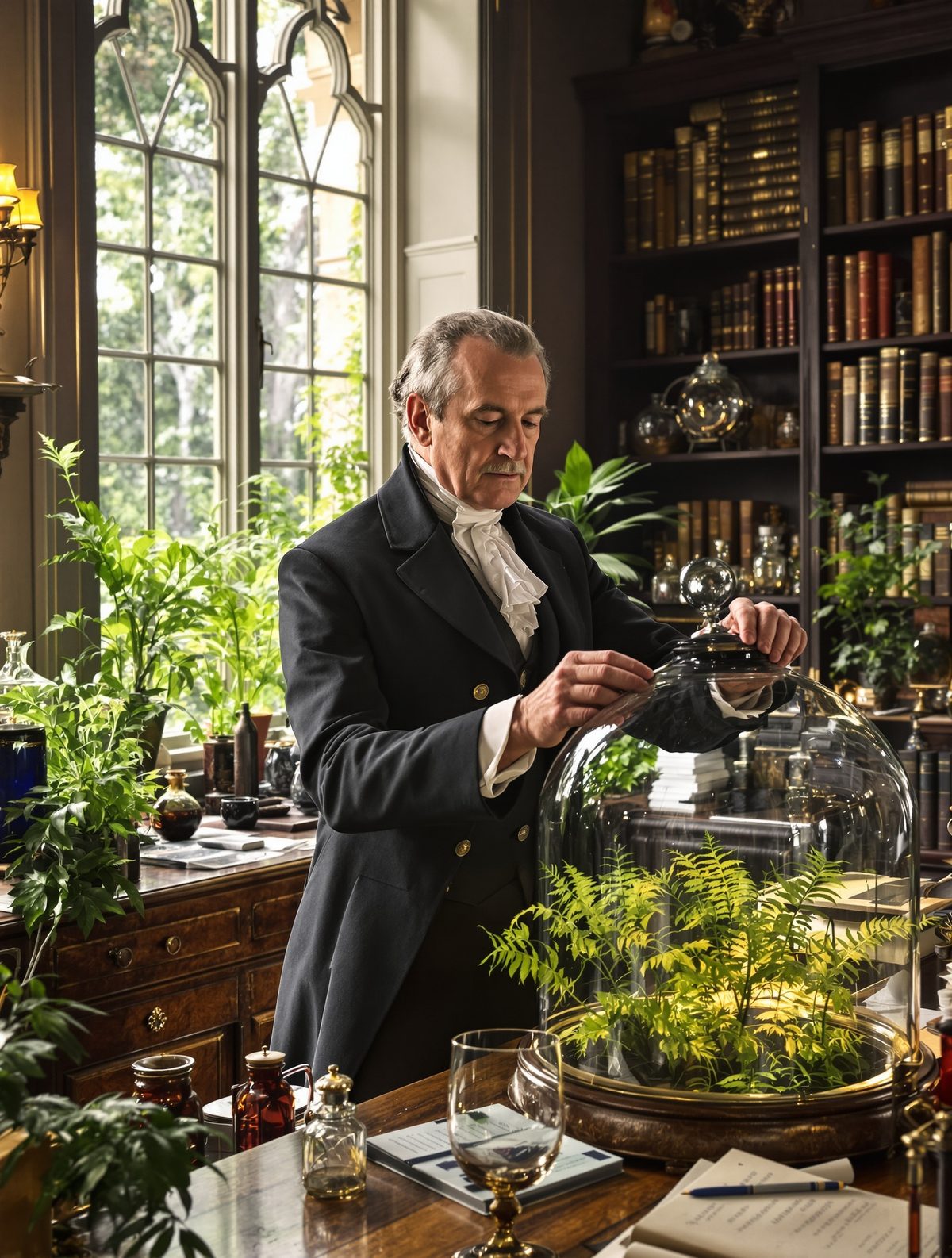
Instead, he discovered something miraculous. There, thriving in the sealed container, was a tiny fern and some grass seedlings—apparently grown from spores and seeds that had been dormant in the soil. The plants were not merely surviving; they were flourishing in their glass prison, fed by their own recycled moisture and protected from London's toxic air. Ward had stumbled upon what would become known as the "Wardian case"—a sealed glass container that created its own perfect microclimate.
For four years, Ward watched in fascination as his accidental garden thrived without a single drop of added water. The fern grew larger and lusher than any he had managed to cultivate in his outdoor garden. He had, quite by accident, solved one of botany's greatest challenges: how to keep delicate plants alive during long journeys across hostile environments.
The Great Tea Heist
While Dr. Ward marveled at his ferns, British merchants were grappling with a crisis that threatened the very foundations of their empire. For over a thousand years, China had held an absolute monopoly on tea cultivation. The Chinese guarded their tea-growing secrets jealously, forbidding foreigners from entering tea-producing regions and maintaining strict control over the entire trade. Britain was hemorrhaging silver—an estimated £3.3 million annually by the 1830s—to feed its insatiable appetite for tea.
The East India Company had tried repeatedly to establish tea plantations in British-controlled territories, particularly in the hills of Assam and Darjeeling in India. The problem wasn't finding suitable land or climate—it was getting live tea plants to survive the months-long sea voyage from China. Traditional methods of transport killed virtually every specimen. Seeds rarely germinated after exposure to salt air and extreme temperature variations. The Chinese seemed to hold an unbreakable lock on the world's tea supply.
Then someone at the East India Company learned about Dr. Ward's miraculous glass boxes.
In 1834, the Company commissioned Ward to design portable versions of his cases for botanical transport. These weren't the small jam jars of Ward's original experiment—they were substantial glass and iron structures, some weighing over 200 pounds when fully loaded. The largest could house dozens of plants in carefully partitioned sections, each creating its own sustainable ecosystem.
The first test came in 1835, when Wardian cases successfully transported delicate British ferns to Australia—a journey that typically killed 90% of plant specimens. The ferns arrived in Sydney Harbor as fresh and green as the day they left London. The botanical world was stunned. Ward had solved transportation; now came the real challenge—corporate espionage on an international scale.
The Botanical Spy Who Stole an Empire
Enter Robert Fortune, perhaps history's most successful agricultural spy. A Scottish botanist with a talent for disguise and a complete disregard for Chinese law, Fortune was tasked by the East India Company with the impossible: infiltrate China's tea regions and steal the secrets of tea cultivation. His weapon of choice? Wardian cases.
In 1843, disguised as a Chinese merchant with a shaved head and fake queue, Fortune embarked on a series of daring expeditions into the forbidden tea districts of Fujian and Zhejiang provinces. He bribed local farmers, learned closely guarded processing techniques, and most importantly, collected thousands of tea seeds and saplings. But his real breakthrough came when he convinced several Chinese tea workers to defect to British India, bringing with them generations of accumulated knowledge about cultivation and processing.
Fortune's stolen tea plants made their journey to India sealed safely within Wardian cases. What had once been impossible—keeping delicate tea plants alive during a months-long sea voyage through tropical heat and monsoon storms—became routine. The cases maintained perfect humidity, protected against salt spray, and created stable microclimates that mimicked the plants' native environment.
The results were spectacular. By the 1870s, British India had become one of the world's largest tea producers. China's ancient monopoly lay in ruins, shattered by a Scottish spy and a London doctor's accidental discovery. The economic implications were staggering—Britain had essentially stolen and relocated an entire industry worth millions of pounds annually.
Coffee, Rubber, and the Great Green Redistribution
Tea was only the beginning. Once the British realized the revolutionary potential of Wardian cases, they embarked on what can only be described as the world's first systematic program of biological imperialism. If valuable plants could be safely transported across oceans, then the entire global map of agricultural production could be redrawn to suit British interests.
Coffee became the next target. Brazil jealously guarded its coffee plantations, but in 1870, British agents used Wardian cases to successfully transport coffee plants from Brazil to Ceylon (modern-day Sri Lanka). Within decades, Ceylon coffee was competing directly with Brazilian exports. Similar operations saw South American chinchona trees (source of the malaria-fighting drug quinine) relocated to British India and Java.
Perhaps the most audacious heist involved rubber. In 1876, Henry Wickham smuggled 70,000 rubber seeds out of Brazil in what he claimed were "botanical specimens for Her Majesty's government." Safely transported in Wardian cases to Kew Gardens, these seeds became the foundation of British rubber plantations in Malaysia and Ceylon. By the early 20th century, British-controlled territories dominated global rubber production—all thanks to Wickham's smuggling operation and Ward's glass boxes.
The environmental and economic consequences were profound. Entire ecosystems were relocated across continents. Traditional agricultural regions found themselves competing with distant colonies growing the same crops more efficiently. The Wardian case had become an instrument of empire, allowing Britain to literally transplant economic power from one continent to another.
The Glass Box That Changed Everything
Ward's innovation sparked what we might now recognize as the first wave of biological globalization. Between 1830 and 1900, Wardian cases transported an estimated 100,000 different plant species across the world's oceans. The Royal Botanic Gardens at Kew became the nerve center of this operation, coordinating the movement of plants across the British Empire like a botanical stock exchange.
But the cases didn't just serve British interests. They democratized botanical transport in ways Ward never intended. Missionaries used them to establish food crops in remote regions. Settlers carried familiar plants to new homes. Scientific institutions exchanged specimens for research. The case that began as an accident in a London doctor's study had become the universal tool for moving life itself across the planet.
Some transfers proved beneficial—food crops that saved lives in famine-prone regions, medicinal plants that treated tropical diseases. Others created ecological disasters that persist today. Many of the world's most destructive invasive species arrived courtesy of Wardian cases, transported by enthusiastic botanists who had no understanding of ecological consequences.
Dr. Ward died in 1868, having lived to see his accidental invention reshape global commerce and agriculture. He remained fascinated by ferns until the end, never fully grasping that his simple glass box had become one of the most powerful tools of empire in human history.
The Legacy of an Accident
Today, as we grapple with climate change and food security, Ward's story feels remarkably contemporary. His Wardian cases were essentially the Victorian equivalent of controlled environment agriculture—the same principle behind modern hydroponic farms and space-age growing systems. The quest to grow plants in hostile environments, whether 19th-century London or 21st-century Mars, remains fundamentally the same challenge Ward solved with his forgotten jar.
The economic reshuffling Ward's invention enabled also sounds familiar. Just as Wardian cases allowed the British Empire to relocate entire industries across continents, modern globalization continues to redistribute economic power based on technological advantages and resource access. Ward's glass box was perhaps the first tool to make biological resources truly portable—a precursor to today's debates about genetic modification, seed patents, and agricultural sovereignty.
Most intriguingly, Ward's accident reminds us how often world-changing innovations emerge from the most unexpected places. A London doctor watching a forgotten moth cocoon accidentally discovered a technology that would break ancient monopolies, reshape global agriculture, and demonstrate humanity's power to redesign the natural world. Sometimes the future arrives not through grand design, but through happy accidents and forgotten jam jars—waiting quietly on a shelf for someone curious enough to take a second look.