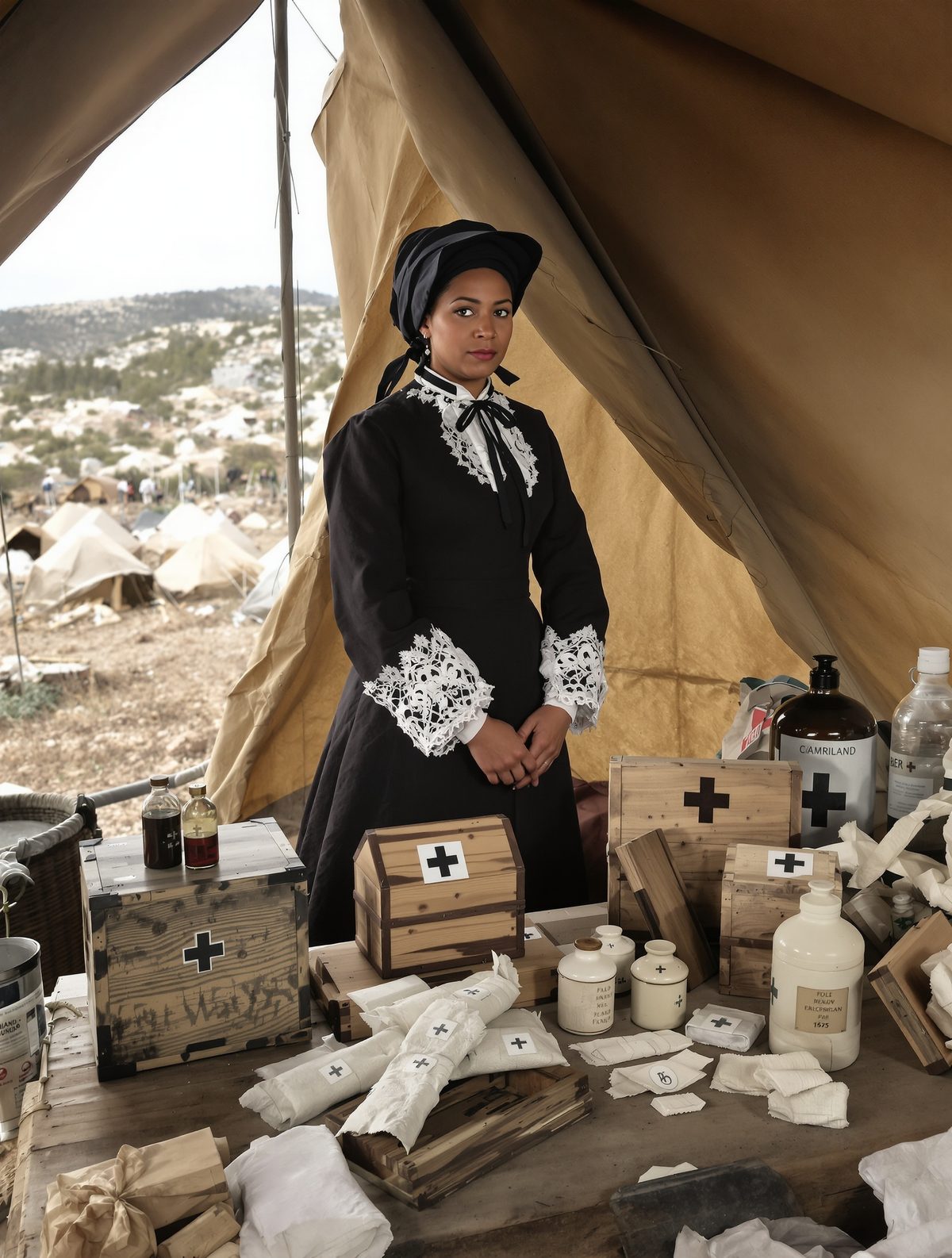
Picture this: a 50-year-old woman of mixed Jamaican-Scottish heritage stands on the docks of London in January 1855, clutching a one-way ticket to Constantinople. Her purse contains her entire life savings—every penny scraped together from selling her possessions. The War Office has just slammed its doors in her face, rejecting her application to serve as a nurse in the Crimean War. Any sensible person would have gone home.
Mary Seacole was not a sensible person.
While Florence Nightingale was becoming the darling of the British press for her work in military hospitals, another woman was quietly embarking on a journey that would make her one of the most beloved figures among frontline soldiers. But Mary's path to the battlefield would be paved entirely with her own determination—and her own money.
The Rejection That Changed Everything
The letter from the War Office was brief and brutal. In late 1854, Mary Jane Seacole—already a seasoned doctress with decades of experience treating cholera, yellow fever, and tropical diseases across the Caribbean—had applied to join the nursing expedition to the Crimean Peninsula. Her credentials were impressive: she had learned herbal medicine from her mother, a respected healer in Kingston, Jamaica, and had successfully treated British soldiers and colonial officials throughout the West Indies.
Read next: The Day a London Printer Stood Trial and Freed the Press
But when she presented herself at the offices of the newly formed nursing corps, the response was swift and cold. No explanation was given, though the reason was painfully clear to Mary. As she later wrote in her autobiography, "Was it possible that American prejudices against colour had some root here? Did these ladies shrink from accepting my aid because my blood flowed beneath a somewhat duskier skin than theirs?"
The rejection stung, but it didn't deter her. Mary had read the newspaper reports of soldiers dying not just from Russian bullets, but from exposure, disease, and lack of proper medical care. She knew she could help. If the British government wouldn't pay her passage, she would pay her own.
Selling Everything for a Dream of Service
What happened next reveals the extraordinary character of this remarkable woman. Mary Seacole systematically dismantled her comfortable life in Jamaica. She sold her boarding house in Kingston—a thriving business that had supported her for years. Her furniture, her clothes, her jewelry, even her late husband Edwin's belongings—everything went under the hammer.
The sum she raised was substantial for the time: approximately £800, equivalent to roughly £80,000 today. But Mary wasn't investing in property or starting a new business. She was buying herself a ticket to one of the most dangerous war zones in the world.
In January 1855, she boarded a ship bound for Constantinople, accompanied by her business partner and distant relative, Thomas Day. The journey would take several weeks, crossing the Atlantic and then the Mediterranean, with no guarantee of success at the end. Mary was essentially gambling her entire fortune on her ability to make herself useful in a war zone where she knew no one and had no official status.
Building a Hospital with Her Own Hands
When Mary arrived in the Crimea in the spring of 1855, what she found was chaos. The port of Balaclava, the main British supply base, was a nightmare of mud, disease, and desperate men. Ships clogged the tiny harbor, their precious cargo rotting on the docks. Soldiers stumbled through the streets, many bearing wounds that had received only the most basic treatment.
While other civilians might have been overwhelmed, Mary saw opportunity. She identified a spot near the British camp, close enough to the front lines to serve wounded soldiers quickly, but far enough back to avoid the worst of the shelling. Here, she decided, she would build the "British Hotel."
The name was somewhat misleading—this wasn't a luxury establishment, but rather a combination field hospital, supply store, and canteen. Using her remaining funds and some inspired scrounging, Mary purchased materials and literally built the structure with her own hands. The building was a ramshackle affair of wood and iron sheets, but it would become a beacon of hope for thousands of British soldiers.
What made the British Hotel unique was Mary's approach to healing. She combined traditional European medicine with herbal remedies learned from her Jamaican mother, creating treatments that often proved more effective than the harsh methods used in official military hospitals. Her secret weapon was a concoction she called "yellow dock," a herbal preparation that seemed to work wonders on dysentery and other digestive ailments that plagued the troops.
Mother Seacole: The Angel of Balaclava
But Mary didn't just treat soldiers who made it to her hotel. In an act of extraordinary bravery, she regularly ventured onto the battlefields themselves, carrying supplies and medical equipment in a makeshift knapsack. Soldiers began to call her "Mother Seacole," and the sight of her distinctive yellow dress and red ribbon became a symbol of hope amid the carnage.
During the siege of Sebastopol, Mary was often seen crawling between trenches under enemy fire, offering water to the wounded and applying emergency treatment to those who couldn't be moved. She was likely the first woman to witness active combat in the Crimean War, arriving at battle sites sometimes before the official medical corps.
The soldiers adored her. Unlike the nurses in the rear hospitals, who maintained strict military hierarchy and often seemed remote from the men's daily struggles, Mary treated everyone the same—from generals to privates. She extended credit to soldiers who couldn't pay, sent letters home for the illiterate, and provided a maternal presence for young men far from home.
Her reputation spread throughout the British forces. Officers' wives visited the British Hotel and wrote glowing letters home about the extraordinary woman who had funded her own mission of mercy. Even war correspondents began to take notice, though their dispatches about Mary never received the same prominence as stories about Florence Nightingale.
The Price of Compassion
Mary's generosity came at a tremendous personal cost. By the time the war ended in 1856, she was financially ruined. The combination of extending credit to impoverished soldiers, giving away free medical treatment, and the general chaos of wartime commerce had consumed her entire fortune. The woman who had arrived in the Crimea with £800 left with virtually nothing.
When she returned to London, Mary faced not only poverty but also obscurity. While Florence Nightingale was hailed as a national hero and received official recognition for her services, Mary Seacole found herself forgotten by the government she had served so loyally. No pension was offered, no official thanks extended.
It was the soldiers themselves who ultimately saved her. When word spread that "Mother Seacole" was destitute, a group of Crimean veterans organized a fundraising campaign. In 1857, they held a benefit concert at the Royal Surrey Gardens that attracted over 80,000 people—one of the largest gatherings in Victorian London. The event raised enough money to secure Mary's modest comfort for the rest of her life.
A Legacy Written in Courage
Mary Seacole's story forces us to confront uncomfortable truths about whose heroism gets remembered and whose gets forgotten. Here was a woman who risked everything—her fortune, her safety, her life—to serve others, yet for over a century, her story was largely absent from British history books.
Her decision to fund her own passage to the Crimea represents something profound about the nature of service and sacrifice. In an age when empire and duty were watchwords of British society, Mary embodied these values more completely than many who proclaimed them loudly. She served not because she was ordered to, or because she was paid to, but because she believed it was right.
Today, as we grapple with questions about healthcare access, racial equality, and the true meaning of patriotism, Mary Seacole's story offers a powerful reminder that heroism often comes from the most unexpected places. Sometimes the greatest service comes not from those who are invited to serve, but from those who refuse to take no for an answer—and are willing to pay any price to make a difference.