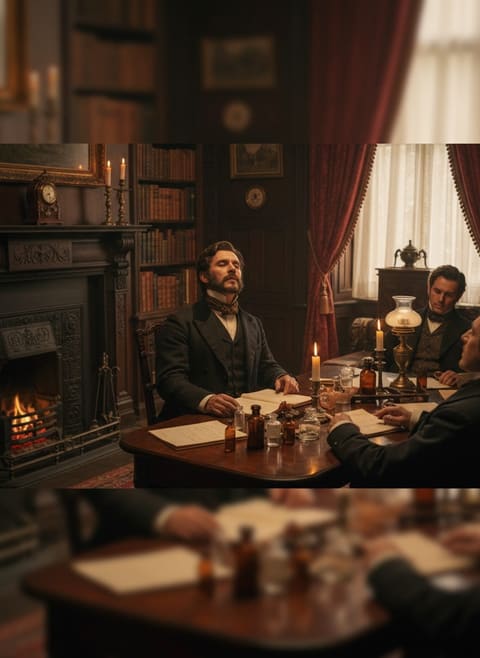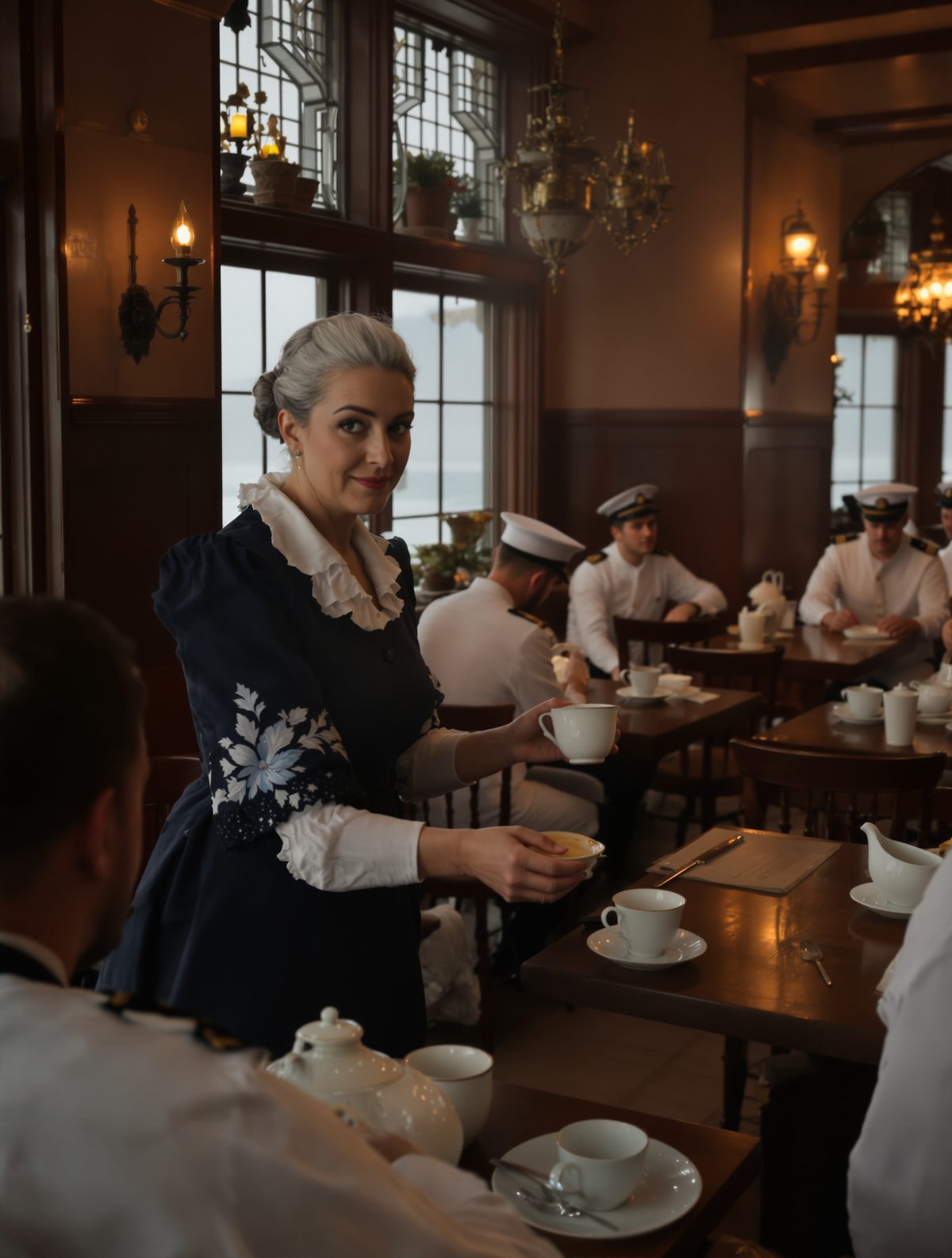
The fog rolled thick across Portsmouth harbour on a bitter February morning in 1876 when Agnes Weston unlocked the door to what would become the most revolutionary establishment the Royal Navy had ever seen. It wasn't a weapons factory or a naval college—it was a tea room. And with that simple brass key, this 43-year-old spinster from Bath would go on to save more British naval lives than Nelson, Drake, and every admiral who ever lived.
The scene that greeted sailors stumbling back from shore leave in Victorian Portsmouth was as predictable as the tide: broken men scattered across the cobblestones, pockets emptied by publicans and pickpockets, marriages destroyed by drink, and careers ended before they'd truly begun. But Agnes Weston was about to change all of that with the most unlikely weapon imaginable—a proper cup of tea.
The Battle Against Grog and Ruin
To understand why Agnes Weston's tea room was so revolutionary, you need to picture the Royal Navy in 1876. Every sailor received a daily ration of half a pint of rum—a tradition dating back to 1655 when the Navy captured Jamaica and discovered that rum lasted longer than beer in tropical climates. This daily "tot" of grog was sacred to sailors, but it was also slowly destroying them.
The statistics were staggering: in 1875 alone, over 12,000 naval personnel were punished for drunkenness. Sailors would often save up their rations and trade them for money on shore leave, leading to spectacular binges that lasted for days. Portsmouth's notorious "The Hard" district near the dockyard was packed with over 200 pubs and gin palaces, all competing to separate sailors from their wages as quickly as possible.
Read next: The Day a Surgeon's Son Chose Death Over Silence
Agnes Weston had witnessed this carnage firsthand during her charity work in the naval town. Born into a comfortable Bath family in 1833, she had devoted her life to evangelical Christianity and social reform after rejecting several marriage proposals. But unlike other Victorian do-gooders who preached from a distance, Agnes rolled up her sleeves and waded into the chaos of Portsmouth's seediest streets.
What she found broke her heart. Sailors barely out of their teens, drunk and broken before they'd seen their twentieth birthday. Families destroyed by men who couldn't resist the bottle. And a naval system that seemed designed to encourage the very behaviour it then punished.
The Radical Idea That Changed Everything
On February 1st, 1876, Agnes Weston opened the doors to her "Sailors' Rest" at 16 Queen Street, just a stone's throw from Portsmouth dockyard. The concept was beautifully simple: provide sailors with somewhere warm, clean, and alcohol-free to spend their shore leave. But the execution was pure genius.
Walking into Agnes's establishment was like stepping into a different world. Gas lamps cast a warm glow over comfortable chairs and tables spread with newspapers from across the Empire. The walls were decorated with nautical charts and pictures of famous naval victories. But most importantly, behind the polished counter sat a gleaming tea urn that never seemed to empty.
For sixpence—less than a pint of ale—a sailor could get a pot of tea, a hearty meal, and somewhere safe to sleep off the exhaustion of months at sea. Agnes provided writing paper so men could send letters home, reading rooms stocked with books and periodicals, and even primitive shower facilities—a luxury most sailors had never experienced.
The response was immediate and overwhelming. Within weeks, word had spread throughout the fleet that "Mother Weston"—as the sailors christened her—had created something unprecedented. Here was someone who treated them not as potential criminals or sources of profit, but as human beings deserving of dignity and respect.
Building an Empire of Tea and Temperance
Agnes Weston possessed something that would make modern business leaders weep with envy: she understood her market completely. She knew that sailors weren't just looking for a place to get drunk—they were looking for home. And that's exactly what she gave them.
The Portsmouth Sailors' Rest was so successful that by 1881, Agnes had opened a second location in nearby Devonport. But she was just getting started. Working with her partner Sophia Wintz—another evangelical spinster who shared her vision—Agnes began expanding across the Empire with the precision of a military campaign.
Malta in 1885, Gibraltar in 1887, Hong Kong in 1890, Bombay in 1891. Wherever the Royal Navy had a significant presence, a Sailors' Rest would soon follow. Each one was tailored to local conditions but maintained Agnes's core principles: no alcohol, decent food, comfortable accommodation, and genuine care for the men who served the Empire.
The numbers were staggering. By 1900, Agnes Weston's network of Sailors' Rests was providing over 500,000 meals per year and accommodating more than 250,000 overnight stays. Her establishments had become the unofficial welfare system of the Royal Navy, filling a gap that the Admiralty had never even acknowledged existed.
But perhaps most remarkably, she achieved all this while remaining completely independent of official support. The Admiralty was initially suspicious of her motives—after all, what respectable Victorian lady would choose to work among rough sailors? However, they couldn't argue with her results. Disciplinary cases for drunkenness plummeted wherever her Sailors' Rests opened.
More Than Just Tea and Sympathy
Agnes Weston's genius lay in understanding that saving sailors from drink was about much more than temperance—it was about treating them as complete human beings. Her Sailors' Rests offered services that wouldn't look out of place in a modern community centre.
She organised educational classes for sailors who couldn't read or write—a shocking number in an era when literacy wasn't guaranteed. Her establishments featured some of the first lending libraries specifically designed for working-class men, stocked with adventure stories, technical manuals, and improving literature.
Most revolutionary of all, she provided banking services decades before official naval banking became available. Sailors could deposit their wages at a Sailors' Rest and withdraw money at any other location in the network. This simple innovation saved thousands of men from the "crimps" and con artists who preyed on sailors carrying large amounts of cash.
Read next: The Day a Chimney Sweep's Son Shamed a Whole Parliament
Agnes also pioneered what we'd now recognise as counselling services. She and her staff would sit with homesick sailors, help them write letters to sweethearts back home, and provide a sympathetic ear for men struggling with the isolation and hardship of naval life. In an era when mental health was barely acknowledged, Agnes Weston was providing practical psychological support.
The impact on naval efficiency was immediate and measurable. Ships whose crews used Sailors' Rests reported significantly fewer disciplinary problems, lower desertion rates, and improved morale. Agnes Weston had done what generations of naval reformers had failed to achieve—she'd made the service more attractive to decent men while weeding out the worst elements.
The Woman Who Defeated the Royal Navy's Greatest Enemy
By the time Agnes Weston died in 1918 at the age of 85, she had fundamentally transformed the culture of the Royal Navy. Her network of Sailors' Rests spanned the globe, and her influence extended far beyond the men who used her facilities. She had proven that treating sailors with dignity and respect wasn't just morally right—it was strategically essential.
The Admiralty finally abolished the daily rum ration in 1970—nearly a century after Agnes had begun her campaign. July 31st, 1970, was officially designated "Black Tot Day" as the Royal Navy's last official rum was served. But Agnes Weston had been winning the war against alcohol's grip on naval life since the 1870s, one cup of tea at a time.
Her methods influenced naval welfare policies across the world. The U.S. Navy studied her techniques, and similar establishments sprang up in ports from Australia to Canada. Agnes Weston had essentially invented the modern concept of military welfare services, decades before any government thought to provide them officially.
The statistics speak for themselves: during the peak years of her operation, naval disciplinary cases related to alcohol dropped by over 60% in ports where Sailors' Rests operated. Conservative estimates suggest that she directly helped over 400,000 individual sailors during her 40-year career—and her indirect influence touched countless more.
Today, Agnes Weston's name lives on in the Royal Naval Benevolent Trust, which continues to provide support to naval personnel and their families. But her real legacy lies in something more fundamental: she proved that caring for the human needs of military personnel isn't a luxury—it's a strategic necessity.
In an age when we're rediscovering the importance of mental health and community support, Agnes Weston's story offers profound lessons. She understood that real change happens not through grand gestures or official policies, but through simple acts of human kindness repeated day after day. Sometimes the most powerful weapon against society's greatest problems isn't a sword—it's a cup of tea served with genuine compassion.