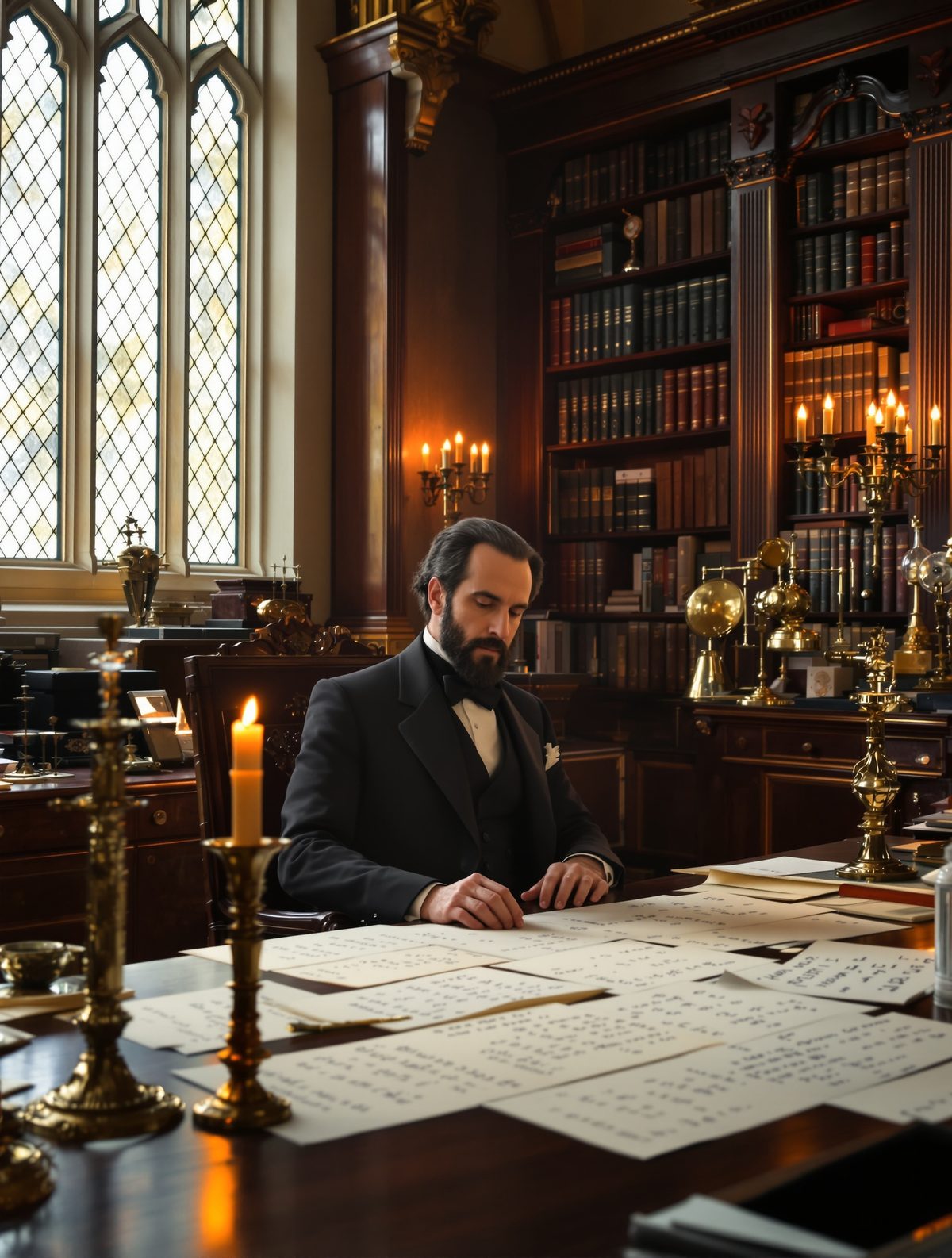
The Cambridge lecture hall fell silent as Professor James Clerk Maxwell set down his chalk, his hand trembling slightly. It was a crisp autumn day in 1865, and scattered across the blackboard behind him were four deceptively simple equations—mere symbols and Greek letters that would soon rewrite humanity's understanding of reality itself. But it wasn't the equations that had stopped Maxwell in his tracks. It was a single number that had just emerged from his calculations: 299,792,458 meters per second.
Maxwell knew that number. Every physicist of his era knew it. It was the speed of light.
What sent a chill down the Scottish professor's spine wasn't just that his electromagnetic waves traveled at light speed—it was the earth-shattering realization that light was an electromagnetic wave. In that moment, electricity, magnetism, and light revealed themselves to be three faces of the same cosmic phenomenon, dancing together in an eternal electromagnetic waltz across the universe.
The Reluctant Revolutionary
James Clerk Maxwell was an unlikely candidate to revolutionize physics. Born in 1831 to a comfortable Edinburgh family, he was a shy, stammering boy who spoke with such a thick Scottish brogue that his Cambridge classmates initially dismissed him as a country bumpkin. They called him "Daft Jamie" behind his back, mocking his habit of walking the college grounds at 6 AM sharp every morning, regardless of weather.
Read next: The Day a Weaver's Son Mapped the Invisible World
But behind that awkward exterior burned one of history's most brilliant minds. Maxwell possessed an almost supernatural ability to see mathematical patterns where others saw only chaos. At age 14, he had already published a paper on oval curves that impressed the Edinburgh Royal Society. By 25, he had become the youngest professor at Marischal College in Aberdeen.
What made Maxwell truly dangerous to the established order of Victorian science was his refusal to accept that the universe's mysteries should remain forever separate. While his contemporaries were content to study electricity in one laboratory and magnetism in another, Maxwell dreamed of finding the hidden connections that bound all of nature's forces together.
Standing on the Shoulders of Giants
Maxwell didn't work in a vacuum. Two titans of experimental physics had already laid the groundwork for his breakthrough, though neither fully grasped the implications of their discoveries.
Michael Faraday, the self-taught son of a blacksmith, had spent decades in his basement laboratory at the Royal Institution, discovering that moving magnets could generate electricity and that electric currents could create magnetic fields. Faraday spoke of mysterious "lines of force" that seemed to connect electrical and magnetic phenomena, but he lacked the mathematical tools to describe them precisely.
Meanwhile, André-Marie Ampère in France had been quantifying the relationship between electricity and magnetism with mathematical precision, showing that electric currents always produced magnetic effects in predictable patterns.
But it was Maxwell's genius to realize that Faraday's intuitive insights about field lines could be translated into the language of mathematics, and that Ampère's precise measurements were pieces of a much larger puzzle. Where others saw separate phenomena, Maxwell began to perceive a single, unified field that pervaded all of space.
The Equations That Changed Everything
Working in his study at Cambridge throughout 1864 and 1865, Maxwell embarked on perhaps the most ambitious mathematical project in the history of physics. Using advanced calculus techniques that most of his contemporaries couldn't even follow, he began to construct a complete mathematical description of electromagnetic phenomena.
The work was grueling. Page after page of complex calculations, each building on the last. Maxwell had to invent new mathematical techniques as he went, creating tools that wouldn't be fully appreciated until decades later. His wife Katherine would often find him at his desk at dawn, having worked through the entire night, surrounded by crumpled papers covered in equations.
Gradually, four fundamental relationships emerged—equations that described how electric and magnetic fields created each other in an endless cycle. The first two described how electric charges create electric fields and how magnetic monopoles (which don't actually exist) would create magnetic fields. The third captured Faraday's insight that changing magnetic fields generate electric fields. The fourth embodied Ampère's discovery that electric currents create magnetic fields.
But Maxwell added something revolutionary to Ampère's equation—a term he called the "displacement current." Even in empty space, with no actual electric current flowing, a changing electric field could still generate magnetism. This seemingly abstract mathematical correction would prove to be the key that unlocked light's deepest secret.
The Moment of Revelation
The breakthrough came when Maxwell combined his four equations to ask a simple question: what would happen if you had electromagnetic fields with no charges or currents around—just pure fields propagating through empty space?
The mathematics led him to what physicists call a wave equation. His electric and magnetic fields could travel through space as waves, with the electric field creating the magnetic field, which in turn recreated the electric field, in an endless, self-sustaining dance.
But waves of what speed? Maxwell's equations gave him a precise answer: the speed would depend on two fundamental constants of nature—the electric permittivity and magnetic permeability of free space. When he plugged in the measured values of these constants, the calculation yielded approximately 300,000 kilometers per second.
Maxwell's heart must have skipped a beat. French physicist Hippolyte Fizeau had measured the speed of light just fifteen years earlier using ingenious experiments with rotating mirrors, arriving at almost exactly the same number.
Read next: The Day a Clockmaker's Son Rewired How We See the Stars
The conclusion was inescapable: light was an electromagnetic wave.
The Invisible Spectrum Revealed
Maxwell's revelation went far beyond explaining the nature of visible light. His equations predicted that electromagnetic waves could exist at any frequency—not just the narrow band that human eyes happened to detect. The universe, Maxwell realized, must be filled with invisible forms of light, stretching across an entire electromagnetic spectrum.
Radio waves, microwaves, infrared radiation, ultraviolet light, X-rays, gamma rays—Maxwell's equations predicted them all, decades before experimental physicists would learn to detect and generate them. In 1865, Maxwell was essentially describing technologies that wouldn't be invented until the 20th century.
He even made a startling prediction: it should be possible to generate these electromagnetic waves artificially and use them to transmit information across vast distances without wires. Twenty-two years later, a young German physicist named Heinrich Hertz would prove Maxwell right, setting the stage for Marconi's radio and the entire telecommunications revolution.
A Legacy That Illuminates the Modern World
Maxwell died tragically young at 48, just fourteen years after his electromagnetic breakthrough, never living to see how completely his equations would transform human civilization. But his mathematical legacy proved more durable than any monument.
Every time you use a cell phone, watch television, heat food in a microwave, or undergo an MRI scan, you're experiencing Maxwell's equations in action. The entire information age—from radio broadcasting to satellite navigation to wireless internet—rests on the foundation of electromagnetic theory that Maxwell constructed in his Cambridge study.
Einstein called Maxwell's work "the most profound and most fruitful that physics has experienced since the time of Newton." Those four elegant equations didn't just reveal light's secret—they opened humanity's eyes to the invisible forces that surround and connect us all. In showing that light, electricity, and magnetism were one phenomenon, Maxwell revealed something profound about the universe: that beneath its apparent complexity lies a beautiful, underlying unity, waiting to be discovered by those brave enough to look.
The next time you flip a light switch or send a text message, remember that stammering Scottish professor who saw connections where others saw only separation, and who discovered that light itself is nothing more—and nothing less—than the universe's own electromagnetic heartbeat, pulsing through space at 300 million meters per second.