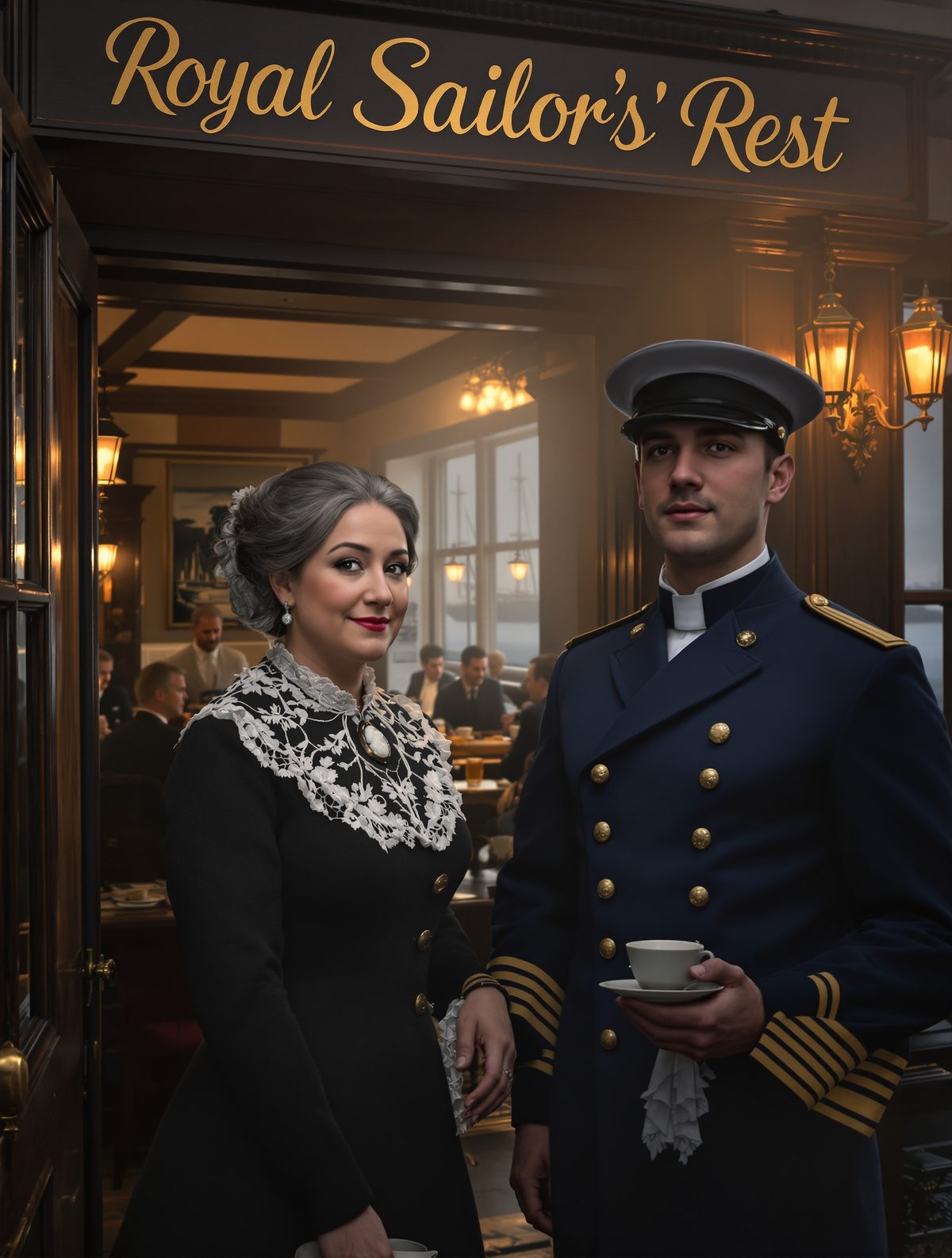
The fog rolled in thick from Portsmouth Harbour on a bitter November evening in 1876, but the real darkness lay in the narrow streets behind the naval dockyard. Here, in a maze of gin shops, pawn brokers, and lodging houses that charged by the hour, Royal Navy sailors stumbled between establishments that existed solely to separate them from their wages. Into this moral battleground stepped a most unlikely warrior: a 44-year-old spinster from Bath named Agnes Weston, armed with nothing more than a fierce determination and an unshakeable belief that every sailor deserved better than a choice between destitution and damnation.
What happened next would transform not just Portsmouth's docklands, but the very soul of the Royal Navy itself.
Hell's Half Acre: Victorian Portsmouth's Darkest Streets
To understand Agnes Weston's achievement, you must first picture Victorian Portsmouth's dockside district – a place naval officials euphemistically called "the recreational area" but sailors knew by grimmer names. The Portsea side of the harbour had earned the nickname "Hell's Half Acre," and for good reason.
When a warship docked after months at sea, her crew would pour ashore with months of accumulated pay burning holes in their pockets. Within hours – sometimes minutes – local entrepreneurs would relieve them of every penny. The system was brutally efficient: gin palaces offered immediate oblivion at threepence a glass, while lodging house keepers charged sailors ten shillings for beds that cost locals two. Pawn shops bought naval uniforms and kit that desperate men would need to buy back before their ships sailed, often at triple the price.
Read next: The Day a Victorian Nurse Walked Into a Fever Ward Alone
The human cost was staggering. Naval records show that in 1875 alone, over 3,000 sailors were admitted to Royal Naval Hospital Portsmouth for alcohol-related injuries or illnesses. Court records reveal hundreds more prosecuted for desertion – men who simply couldn't face returning to ships after losing everything ashore. Most shocking of all, the mortality rate among sailors on shore leave was actually higher than those serving in active combat zones.
The Admiralty knew about the problem but seemed powerless to solve it. After all, sailors needed somewhere to go when on leave, and the dockside establishments, however predatory, were legal businesses. It would take an outsider – and a woman, no less – to see a solution the Navy's finest minds had missed.
Enter Mother Weston: The Unlikely Crusader
Agnes Elizabeth Weston was an improbable revolutionary. Born in 1840 to comfortable middle-class parents in Bath, she had received the typical education of a Victorian lady: piano, French, watercolours, and needlework. She was expected to marry well and manage a household. Instead, she chose a path that horrified her social circle.
Weston's transformation began in the 1860s when she started visiting sailors in naval hospitals. What she saw there – young men broken not by enemy action but by the very establishments meant to serve them – ignited a fury that would drive her for the rest of her life. She began writing letters to naval magazines, describing conditions ashore with a bluntness that shocked polite society but resonated powerfully with serving sailors.
Her breakthrough came when she realized the fundamental flaw in existing charitable efforts. Religious missions preached at sailors from a safe distance; welfare societies offered stern lectures about temperance. But nobody was providing what these men actually needed: decent accommodation, wholesome food, and most importantly, respect for their service and dignity as human beings.
In 1876, using £500 of her own inheritance (equivalent to about £60,000 today), Weston rented a building at 12 Queen Street, Portsmouth. Her plan was revolutionary in its simplicity: create an establishment that could compete directly with gin palaces and boarding houses, but offer tea instead of alcohol, genuine hospitality instead of exploitation, and beds charged at cost rather than premium rates.
The Royal Sailors' Rest: Revolution in a Teacup
When the Royal Sailors' Rest opened its doors on October 2nd, 1876, local publicans and lodging house keepers initially dismissed it as the fantasy of a naive do-gooder. They were spectacularly wrong.
Weston had studied her enemy carefully. The gin palaces succeeded because they understood what sailors craved: warmth, light, company, and the feeling of being welcome somewhere. The Royal Sailors' Rest provided all of this, but without the devastating morning-after consequences. The main hall blazed with gas lighting and featured comfortable chairs, writing desks, newspapers, and games. The tea room served hearty meals at cost price – a full dinner for sixpence when local establishments charged two shillings for inferior fare.
But Weston's masterstroke was the accommodation. Clean beds with fresh linen cost one shilling per night – half the usual rate – while dormitory beds were available for just fourpence. More importantly, she treated her guests like the naval heroes they were, not like potential criminals to be watched and controlled.
The response was immediate and overwhelming. Within a week, the Rest was serving over 200 meals daily. Within a month, every bed was booked solid. Local publicans watched in dismay as their most reliable customers increasingly chose Agnes Weston's establishment over their own.
Word spread through the fleet with the speed of naval gossip. Sailors began writing home about the extraordinary woman in Portsmouth who treated them like sons rather than customers. They nicknamed her "Mother Weston" – a title that would follow her for the rest of her life and appear on her tombstone.
The Navy's Blessed Interference
The transformation in Portsmouth's dockside district was remarkable, but the real revolution lay in what happened next. As ships' companies returned from leave healthier, wealthier, and more disciplined, naval commanders began to take notice. Captain John Fisher (later Admiral of the Fleet Lord Fisher) became one of Weston's most powerful supporters, arguing that her work was worth "a dozen sermons and a regiment of naval police."
The statistics spoke for themselves. Hospital admissions for alcohol-related incidents dropped by 40% in the Rest's first year. Desertion rates plummeted. Most remarkably, savings bank deposits from sailors increased six-fold as men began keeping their pay rather than drinking it away.
By 1880, the Royal Sailors' Rest was accommodating over 1,000 men nightly and serving 300,000 meals annually. The Admiralty, initially suspicious of civilian interference in naval affairs, now actively promoted Weston's work. She received the unprecedented honour of an official tour of the Mediterranean Fleet, where she established similar facilities at Malta and Gibraltar.
But perhaps the most telling endorsement came from the sailors themselves. In 1884, the crew of HMS Alexandra presented Weston with a silver tea service, inscribed: "To Mother Weston, from her grateful sons." The presentation ceremony had to be held in Portsmouth Guildhall – the Royal Sailors' Rest couldn't accommodate the 2,000 sailors who turned up to honour her.
Beyond Portsmouth: An Empire of Hope
Success bred expansion. By 1890, Weston had established Sailors' Rests in Devonport, Chatham, and sixteen other naval ports across the British Empire. Each followed her original template: dignity, respect, and practical help rather than pious lectures.
The financial model was as revolutionary as the social one. Rather than relying entirely on charity, Weston made her establishments largely self-supporting through their commercial operations. Sailors paid fair prices for good service, which gave them dignity as customers rather than supplicants. Surplus profits funded expansion to new ports.
Her influence extended far beyond accommodation and meals. The Royal Sailors' Rest became unofficial naval welfare headquarters, helping sailors send money home to families, providing legal advice, and even offering basic banking services. Weston pioneered naval education programs, setting up libraries and evening classes that helped thousands of sailors improve their literacy and numeracy.
By the time of her death in 1918, "Mother Weston" had directly served over two million sailors. Her network of Sailors' Rests had become so integral to naval operations that the Admiralty formally incorporated them into official shore facilities – a recognition that would have seemed impossible when she first rented that modest building in Queen Street.
The Revolutionary in Respectability's Clothing
Agnes Weston's story matters today not just as a tale of Victorian philanthropy, but as a masterclass in effective social intervention. She succeeded where others failed because she understood that lasting change comes not from condemning people's choices, but from providing better alternatives.
Her approach anticipated modern understanding of addiction and social problems by a century. Rather than moralizing about the evils of drink, she created environments where drinking became unnecessary. Instead of lecturing about financial responsibility, she provided practical banking services. Rather than demanding that sailors change their behaviour, she changed their circumstances.
In an age when social reform was often the hobby of the comfortable, Weston's work had real, measurable impact on real lives. She turned Portsmouth from a byword for naval vice into a model of service welfare that other nations copied. Most importantly, she proved that one determined individual, armed with practical compassion and refusing to accept that "things have always been this way," could transform an entire institution.
The next time you pass a servicemen's club or see military welfare services in action, remember the Victorian spinster who declared war on exploitation with nothing but tea, beds, and an unshakeable belief in human dignity. Mother Weston's revolution reminds us that the most powerful changes often begin with someone simply deciding that people deserve better – and then doing something about it.