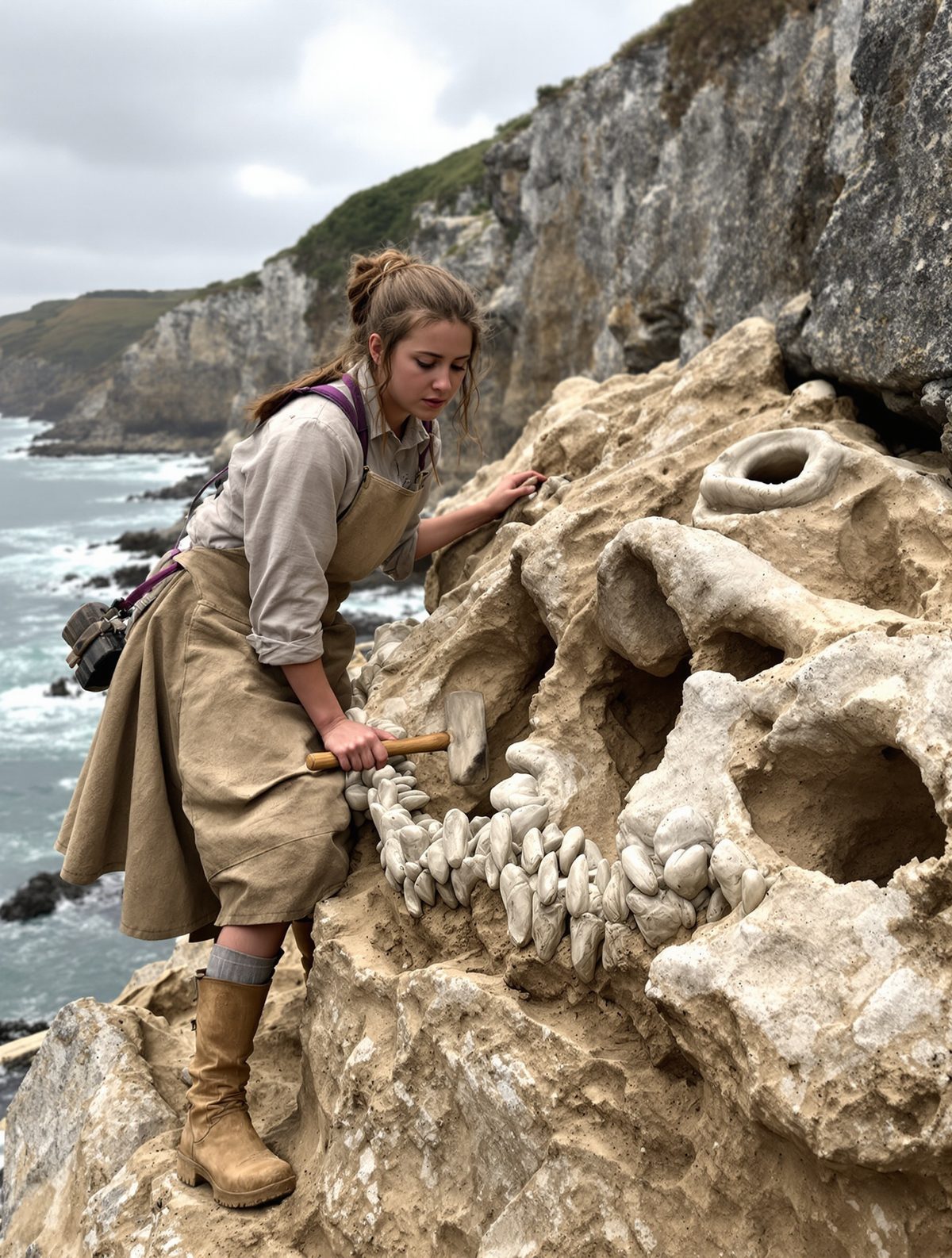
The hammer struck the limestone with a sharp crack that echoed across the grey waters of Lyme Bay. Twelve-year-old Mary Anning wiped the salt spray from her eyes and peered closer at the cliff face before her. It was December 1811, and while other children her age were safely tucked indoors away from the brutal Dorset winter, Mary was doing what she'd done almost every day since she could walk—hunting for "curiosities" in the ancient rocks that tumbled from the unstable cliffs of Lyme Regis.
What she was about to uncover would not just change her life, but challenge everything humanity thought it knew about the natural world. Embedded in that 200-million-year-old stone lay a creature so alien, so impossibly ancient, that its discovery would force scientists to confront a terrifying possibility: that God's creations were not eternal, and that entire species could simply vanish from the Earth forever.
The Girl Who Talked to Stones
Mary Anning was born into a world where fossil hunting wasn't a romantic hobby—it was survival. Her father, Richard Anning, was a carpenter and fossil collector who sold "curiosities" to tourists visiting the fashionable seaside resort of Lyme Regis. When he died in 1810, leaving the family drowning in debt, eleven-year-old Mary and her older brother Joseph became the primary breadwinners, armed with nothing but hammers, chisels, and an almost supernatural ability to read the stories written in stone.
The Dorset coast where Mary worked was a paleontologist's paradise and a fossil hunter's nightmare. The unstable Blue Lias cliffs regularly shed their ancient secrets onto the beach below, but they also claimed lives with terrifying regularity. Winter storms would undercut the cliff face, sending tons of rock crashing down without warning. Mary learned to read the moods of the cliffs like a sailor reads the sea—one misinterpreted sign could mean death.
Read next: The Day a Surgeon Walked Into a Prison and Freed a Madman
But Mary possessed something that set her apart from other fossil hunters: an intuitive understanding of anatomy that bordered on the mystical. With no formal education, she could examine a single vertebra and visualize the entire creature it came from. Local geologists soon learned that if Mary Anning said there was more fossil to be found, they should keep digging.
The Monster Emerges
The discovery that would make Mary famous actually began a year earlier, when her brother Joseph spotted something extraordinary: a four-foot-long skull with massive eye sockets and rows of sharp teeth embedded in the cliff face. But it was Mary who recognized that this was just the beginning. Through the harsh winter of 1811, she returned again and again to the same spot, carefully excavating around the skull with a dedication that amazed even the seasoned fossil hunters of Lyme Regis.
What emerged from the rock defied comprehension. The creature was seventeen feet long, with a body like a dolphin but the head of a crocodile. Its eyes were enormous—nearly eight inches across—and its jaws bristled with more than sixty razor-sharp teeth. Most bizarre of all were its paddles: four powerful flippers that looked nothing like the limbs of any living creature.
Word spread quickly through the small coastal town. Here was a "sea dragon" unlike anything in the Bible or in the cabinets of natural philosophers. The local gentry flocked to see Mary's monster, and soon news reached London's scientific circles. But what should they call it? The creature seemed to be part fish, part reptile, and wholly impossible.
When Science Met the Impossible
In 1811, the scientific establishment was not prepared for Mary Anning's monster. The prevailing wisdom, backed by centuries of religious doctrine, held that God had created all species in their perfect form, and that nothing created by divine hand could ever become extinct. The discovery of strange fossils was explained away with theories that these creatures still lived in unexplored parts of the ocean, or that they were simply varieties of known animals distorted by the fossilization process.
But Mary's creature—eventually named Ichthyosaurus or "fish lizard"—was too complete, too clearly different, to dismiss. When the fossil reached the hands of prominent naturalists like Everard Home and Charles König, they faced an uncomfortable truth: this animal had no living relatives. It was utterly extinct, vanished from the Earth for millions of years.
The implications were staggering. If God's creations could disappear forever, what did that say about the permanence of creation itself? Some scientists tried to maintain that these were merely victims of Noah's flood, but the evidence was mounting that the Earth was far older—and far more changeable—than anyone had imagined.
Perhaps most remarkably, the scientific establishment was forced to take seriously the opinions of an uneducated twelve-year-old girl from Dorset. Mary's insights into the anatomy and lifestyle of her ichthyosaur proved more accurate than those of university-trained naturalists. She correctly identified preserved skin, recognized that the large eyes indicated deep-water hunting, and even discovered fossilized stomach contents that revealed the creature's diet.
The Fossil Queen's Kingdom
Mary's ichthyosaur was just the beginning. Over the next two decades, she would uncover a menagerie of prehistoric monsters that transformed our understanding of ancient life. In 1823, she discovered the first complete plesiosaur—a long-necked marine reptile so bizarre that scientists initially declared it a fake. The great anatomist Georges Cuvier, who had dismissed earlier plesiosaur finds, was forced to publicly apologize when Mary's specimen proved genuine.
Her most spectacular find came in 1828: the first British pterosaur, a flying reptile with a twenty-foot wingspan. Local tourists dubbed it the "flying dragon," and its discovery proved that the ancient world had been populated by creatures that made modern animals seem mundane by comparison.
Despite her growing fame, Mary remained trapped by the circumstances of her birth. As a woman, and a poor one at that, she could not join the Geological Society of London or publish scientific papers. The wealthy gentlemen who bought her fossils rarely credited her discoveries, and she watched from the sidelines as others built their careers on her finds. "The world has used me so unkindly," she wrote in one bitter letter, "I fear it has made me suspicious of everyone."
The World She Broke Open
Mary Anning died in 1847 at the age of 47, finally succumbing to breast cancer. By then, the world she had helped to create was barely recognizable from the one into which she had been born. The concept of extinction was no longer controversial but fundamental to scientific thinking. Geologists spoke confidently of "deep time"—of an Earth millions of years old that had witnessed the rise and fall of entire ecosystems.
Her ichthyosaur had been the first crack in the wall of certainty about creation and permanence. Within decades, that crack would become a chasm wide enough for Charles Darwin to step through with his theory of evolution. The monsters Mary pulled from the Dorset cliffs became the foundation stones of modern paleontology, proving that life on Earth had a history far stranger and more wonderful than anyone had dared to imagine.
Today, as we face our own extinction crisis—with species disappearing at rates not seen since the age of Mary's sea dragons—her discoveries carry a different kind of urgency. The twelve-year-old girl who chiseled truth from stone showed us that our planet is not a museum of unchanging perfection, but a dynamic world where nothing is guaranteed to last forever. In our age of climate change and biodiversity loss, Mary Anning's monsters whisper a warning from deep time: even giants can fall, and extinction is always forever.