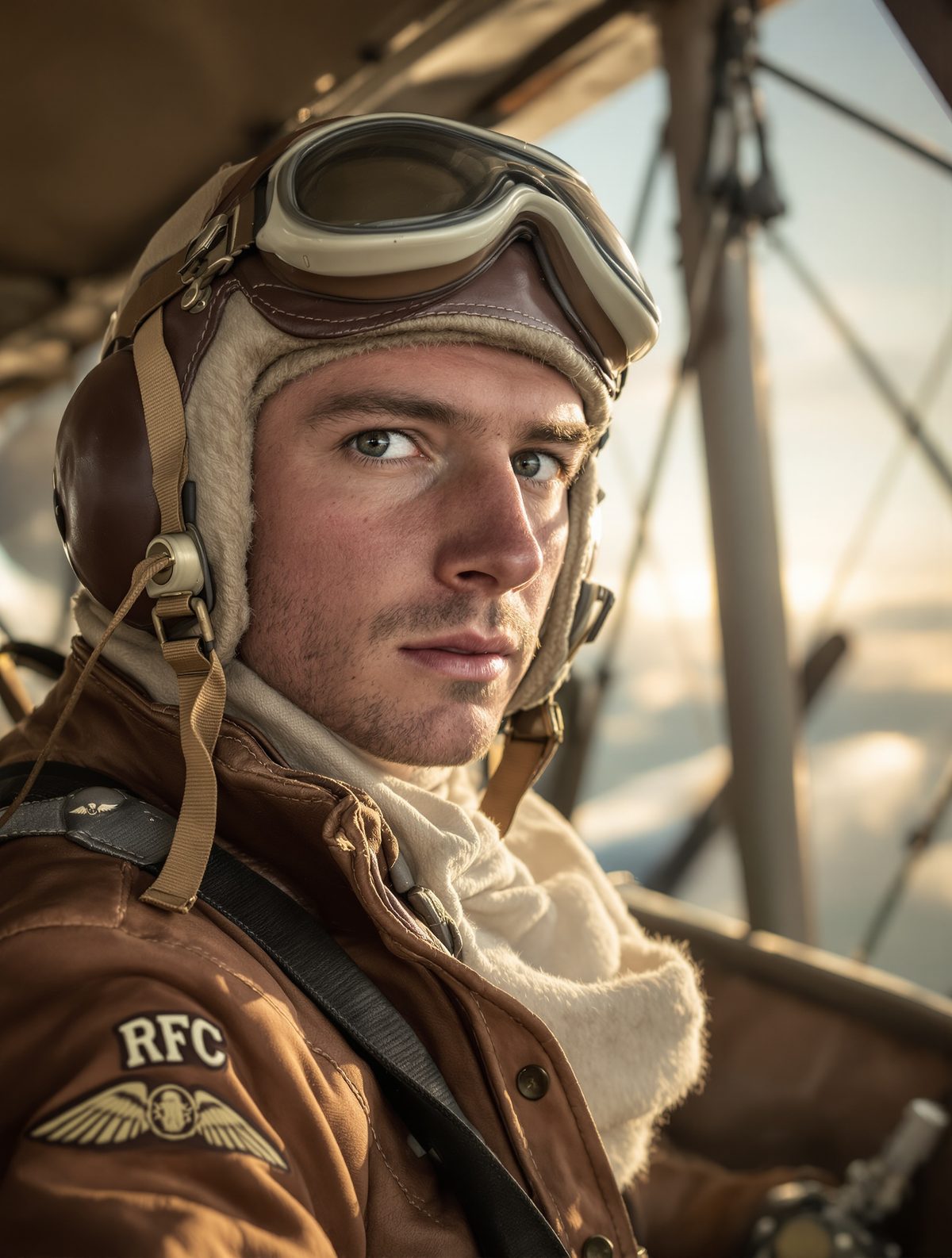
At dawn on May 7, 1917, a blood-red Nieuport 17 fighter climbed into the grey skies above Arras, France. Its pilot was barely old enough to vote, yet he was already the most feared aerial hunter in the Royal Flying Corps. Captain Albert Ball pulled his leather helmet tight, checked his twin Lewis guns, and did something that would have terrified any sensible airman: he went looking for trouble. Alone.
What happened next would cement Ball's legend as Britain's deadliest flying ace. But it would also be the last time anyone saw him alive.
The Unlikely Knight of Nottingham
Albert Ball was never supposed to be a warrior. Born in 1896 to a middle-class family in Nottingham, he was the son of a successful plumber-turned-property developer who expected his boy to follow a respectable path in engineering. Ball had other plans. When war erupted in 1914, the 18-year-old abandoned his studies and enlisted as a private in the Sherwood Foresters, driven by a patriotic fever that burned white-hot in his generation.
But trenches weren't Ball's calling. The mechanically-minded young man was fascinated by the newfangled flying machines buzzing overhead. In 1915, he transferred to the Royal Flying Corps, paying for his own flying lessons at a civilian school in Norwich. His instructors noted something unusual about the quiet Nottingham lad: he possessed an almost supernatural understanding of aircraft, combined with reflexes that seemed to slow time itself.
Read next: The Day a British Stretcher-Bearer Refused an Order to Save Lives
By May 1916, Ball was in France, flying reconnaissance missions in a lumbering Avro 504. Within weeks, he'd talked his way into a fighter squadron. What happened next defied every rule of aerial warfare.
The Red-Nosed Maverick
While other RFC pilots flew in careful formations, following textbook tactics designed to maximize survival, Ball developed his own lethal philosophy: hunt alone, strike fast, and trust no one but yourself. He painted the nose of his Nieuport 17 blood red—partly for identification, partly because it struck terror into German hearts when they spotted it diving from the sun.
Ball's preferred tactic was breathtakingly simple and absolutely suicidal. He would climb to altitude, spot a German formation, and dive straight into the center of it. No wingman. No backup. Just a 20-year-old with twin machine guns and nerves of steel. He'd learned that most pilots—friend and foe alike—hesitated in the crucial split-second of combat. Ball never hesitated.
His mechanics marveled at the bullet holes that peppered his aircraft after each mission. German pilots later wrote that encountering the red-nosed Nieuport was like meeting a demon: Ball seemed to materialize from nowhere, guns blazing, before vanishing into the clouds as quickly as he'd appeared.
Between May and October 1916, Ball shot down an astounding 31 enemy aircraft in just five months of combat. His score was climbing faster than anyone in the RFC, including the legendary Mannock and McCudden. But Ball paid a price for his lone-wolf tactics that went far beyond the physical.
Letters Home from Hell
Ball's letters to his family reveal the psychological toll of his aerial warfare. "Oh, it is too dreadful to talk about," he wrote to his father after a particularly bloody day in September 1916. "The life here is absolutely rotten. I am feeling very old just now." He was 20 years old.
Unlike the sanitized propaganda of the era, Ball's private correspondence revealed the brutal reality of aerial combat. He wrote of watching German pilots burn alive in their cockpits, of the sickening thud of bullets tearing through human bodies, of the nightmares that haunted his sleep in the ramshackle huts of French airfields.
Yet he couldn't stop hunting. Ball had discovered he possessed a terrible gift: he could kill in the air like no one else alive. Each victory brought him closer to a nervous breakdown, but also deeper into an addiction he couldn't shake. His commanding officers, recognizing the symptoms of what we'd now call combat stress, ordered him home for a rest in October 1916.
Ball spent five miserable months in England, training new pilots and attending ceremonies where he was feted as a hero. He hated every minute of it. The quiet countryside that had nurtured his youth now felt like a prison. In letters, he begged to return to France, to his red-nosed Nieuport, to the only life that now made sense to him.
The Final Hunt
Ball returned to combat in April 1917, now commanding his own flight in 56 Squadron. His reputation had grown to mythical proportions: German squadrons had standing orders to avoid the red-nosed fighter, and bounties were placed on his head. Ball seemed untouchable, invincible—until that grey morning over Arras.
On May 7, 1917, Ball led his flight into combat against Jasta 11, the elite German squadron led by Manfred von Richthofen—the Red Baron himself. Witnesses saw Ball's Nieuport diving into a formation of Albatros fighters near the village of Annoeullin. Then clouds swallowed the aerial battle.
Read next: The Day a Army Chaplain Gave His Coat to a Dying Stranger
When the sky cleared, Ball had vanished. His aircraft was found the next day, crashed in a field behind German lines. The engine was still running when German soldiers reached the wreck. Ball was slumped in his cockpit, dead from a single bullet wound. He had somehow managed to glide his damaged fighter almost to a perfect landing before succumbing to his injuries.
The Germans buried him with full military honors, a rare tribute to a feared enemy. His final score: 44 confirmed victories in just 18 months of combat flying. He was three weeks past his 21st birthday.
The Mystery That Endures
Who fired the shot that killed Albert Ball remains one of World War I's enduring mysteries. The Red Baron claimed he might have hit him, but was never certain. Some German accounts suggest Ball was shot by infantry fire from the ground. Others propose he was downed in aerial combat by Lothar von Richthofen, the Red Baron's brother.
What's remarkable is how Ball's death affected both sides of the war. RFC squadrons painted red noses on their aircraft in tribute. German pilots spoke of him with grudging respect, calling him "der rote Teufel"—the red devil. His Victoria Cross citation, published posthumously, praised not just his skill but his "most conspicuous and consistent bravery" in the face of overwhelming odds.
The Price of Genius
Albert Ball's story illuminates the terrible mathematics of early aerial warfare, where life expectancy was measured in weeks and psychological survival was almost impossible. He embodied both the best and worst of his generation: fearless, patriotic, and willing to sacrifice everything for duty, but also consumed by a violence that ultimately destroyed him.
In an age when we debate the psychological cost of warfare, Ball's letters home read like a case study in combat trauma. His insistence on fighting alone wasn't just tactical—it was the response of a young man who couldn't bear to watch friends die around him. Better to trust only himself than lose another wingman to German guns.
Perhaps most remarkably, Ball achieved his deadly success not through hatred but through a cold, mechanical precision that he both mastered and despised. His legacy reminds us that heroes aren't immune to the horrors they witness—they simply find the strength to continue despite them. In the grey skies over France, a 20-year-old from Nottingham became Britain's deadliest flying knight, proving that sometimes the most ordinary beginnings can produce the most extraordinary courage.