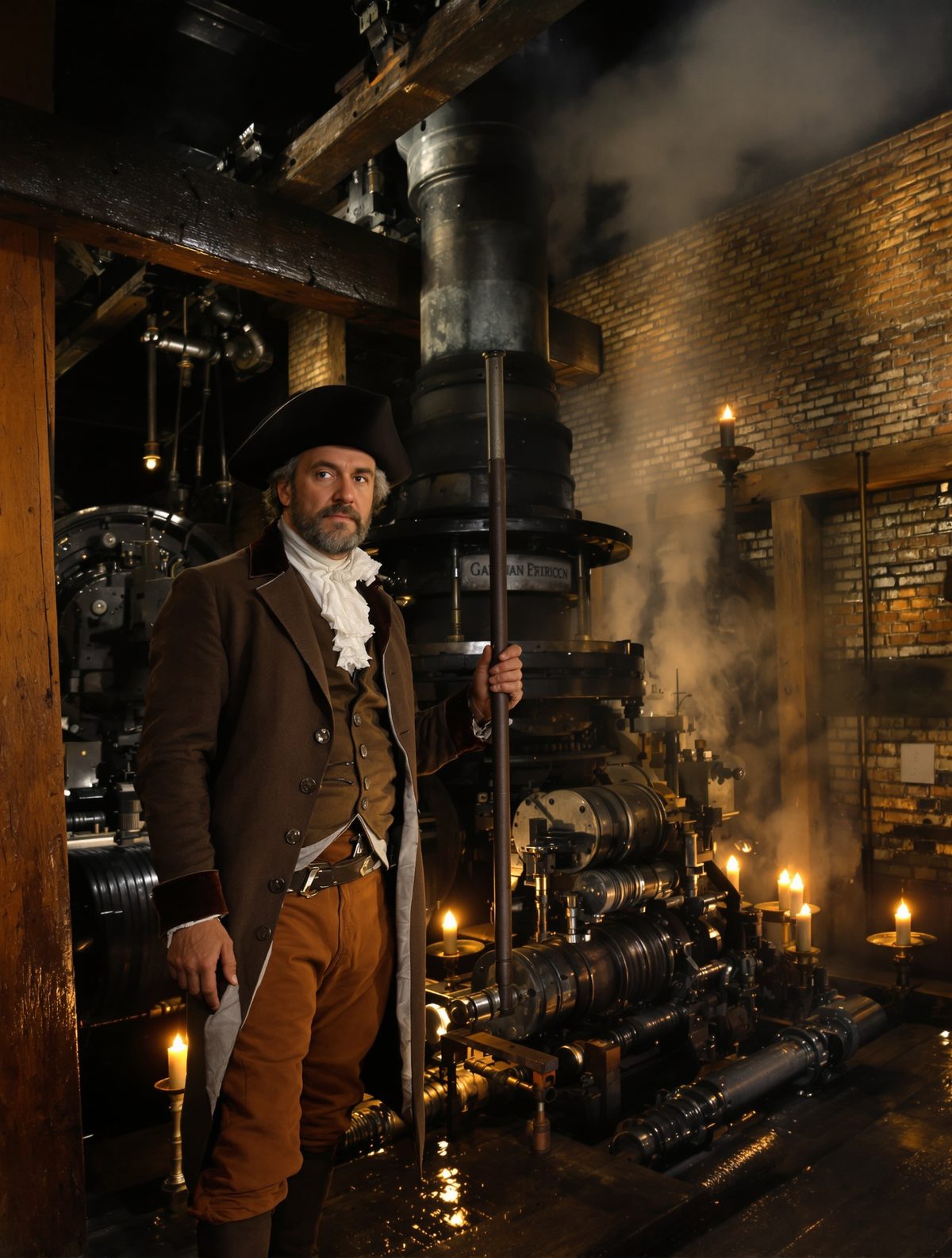
The year was 1712, and Britain was drowning from within. Not from rising seas or torrential rains, but from the relentless seepage of groundwater into the coal mines that powered the nation's growing ambitions. Deep beneath Staffordshire, men worked by flickering candlelight in a losing battle against the earth's eternal thirst to reclaim its hollowed-out chambers. Every shovelful of coal extracted seemed to invite another gallon of murky water, and the primitive pumps of the day—powered by sweating horses trudging endless circles—could barely keep pace with nature's insistence.
Then, on a crisp morning in Dudley Castle's coal mine, something extraordinary happened. A hulking contraption of iron and brass wheezed to life, its great cylinder hissing like some mechanical dragon. Thomas Newcomen, a humble blacksmith from Dartmouth, watched nervously as his "fire engine" prepared to either revolutionise the world or explode spectacularly. The machine groaned, steam billowed, and slowly—miraculously—thousands of gallons of water began rising from the depths where no horse could venture and no man could survive.
The Blacksmith Who Thought Like a Philosopher
Thomas Newcomen was an unlikely candidate to save British industry. Born around 1664 in the Devon port town of Dartmouth, he spent his days shoeing horses and mending iron tools, his hands permanently blackened by coal dust and metal filings. But Newcomen possessed something rarer than technical skill—he had the ability to see solutions where others saw only problems.
By 1700, Britain's mines were hitting a crisis point. The easy, shallow coal seams had been exhausted, forcing miners deeper underground where water accumulation became a nightmare. Traditional methods were laughably inadequate: teams of horses operating crude pump systems could only lift water from depths of about 150 feet. Beyond that, the mines simply flooded, abandoning potentially vast fortunes in coal to the darkness below.
Read next: The Day a Black Sailor Walked Into Court and Freed Himself
Newcomen had heard whispers of Denis Papin's experiments with steam pressure in France, and he knew of Thomas Savery's primitive steam pump, patented in 1698. But Savery's device was more dangerous than useful—it operated under such high pressure that explosions were common, and it could only work effectively at shallow depths. What Britain needed wasn't just any steam engine; it needed a reliable one that could handle the brutal demands of deep mining.
The Atmospheric Revolution
Newcomen's genius lay not in creating higher pressure, but in harnessing atmospheric pressure itself. His engine worked on a brilliantly simple principle that would have made ancient Greek philosophers weep with admiration. Steam from a boiler was introduced into a large cylinder, pushing up a piston connected to a massive wooden beam. Then cold water was sprayed into the cylinder, instantly condensing the steam and creating a vacuum. The atmosphere itself—bearing down with roughly 14.7 pounds per square inch—drove the piston back down with tremendous force.
This atmospheric pressure engine eliminated the explosion risk of high-pressure systems while generating enough power to operate pumps at unprecedented depths. The massive wooden beam, often weighing several tons, rocked back and forth like a giant's seesaw, each cycle lifting hundreds of gallons of water from the mine's bowels.
The first successful installation at Dudley Castle colliery in 1712 was a revelation. The engine's cylinder measured 21 inches in diameter—modest by later standards, but revolutionary for its time. It operated at the stately pace of about 12 strokes per minute, each one accompanied by dramatic hisses and clanks that announced the arrival of the machine age.
Coal, Steam, and the Hunger for Depth
The timing of Newcomen's breakthrough couldn't have been more crucial. Britain was experiencing an energy crisis that would make modern oil shortages seem trivial. The island's forests had been systematically depleted over centuries, leaving coal as the only viable fuel for the growing iron industry, salt works, and the domestic hearths of expanding cities.
But here lay the paradox: to extract more coal, mines needed to go deeper, which meant more flooding. To pump out the water, they needed more power, which required more coal. It was a vicious circle that threatened to strangle Britain's industrial ambitions in their cradle.
Newcomen's engine shattered this impasse. Within a decade of the Dudley Castle installation, his atmospheric engines were pumping water from depths of 300 feet and more. The Griff colliery in Warwickshire boasted an engine that could lift water from an astounding 373 feet below ground—deeper than a 30-story building is tall.
These machines were not delicate creatures. A typical Newcomen engine stood as tall as a three-story house, its great beam stretching up to 30 feet in length. The boiler alone consumed enormous quantities of coal—ironically, about one-third of the mine's daily output. But this seemingly wasteful arrangement made perfect economic sense: coal was free at the pithead, and without the engine, there would be no coal at all.
The Sound of Progress
Visitors to early 18th-century mining districts reported an entirely new soundscape. The rhythmic thump-hiss-clank of Newcomen engines echoed across the countryside, a mechanical heartbeat that pulsed day and night. Each engine house became a local landmark, its tall chimney visible for miles, announcing to the world that here, at least, man had bent nature to his will.
The engines required their own priesthood of operators—skilled men who understood the temperament of steam and iron. Engine-men earned premium wages, typically 30 shillings per week compared to a coal-hewer's 15 shillings. They developed an almost mystical relationship with their machines, able to diagnose problems by subtle changes in sound or rhythm.
One engine-man at a Northumberland colliery claimed he could tell if his machine needed attention simply by the way his cottage shook when he woke each morning. These men guarded their knowledge jealously, passing secrets from father to son in an early form of industrial apprenticeship.
Read next: The Day a London Clerk Walked Into Court for a Dying Slave
Beyond the Mines: An Empire of Steam
By 1725, Newcomen engines were spreading far beyond coal mines. The great London waterworks installed massive atmospheric engines to supply the capital's growing thirst for clean water. Breweries used them to pump water from deep wells, ensuring their ales remained pure in an age when surface water was often contaminated.
In the tin mines of Cornwall, where flooding had plagued miners since Roman times, Newcomen's engines opened previously inaccessible lodes. The Wheal Fortune mine near Camborne installed an engine in 1720 that could pump water from depths exceeding 400 feet. For the first time in centuries, Cornish miners could follow the rich veins of tin ore as deep as they dared to dig.
Perhaps most remarkably, these early steam engines began pumping water uphill to supply country estates and growing industrial towns. The Earl of Mar installed a Newcomen engine at his Scottish castle in 1719, creating spectacular fountains and water gardens that astonished visitors who couldn't comprehend how water could flow upward without human or animal effort.
The Mechanical Genesis of Modern Britain
When Thomas Newcomen died in 1729, more than 100 of his engines were chugging away across Britain and beginning to appear in Europe. He had lived to see his invention transform from a desperate experiment into the backbone of industrial expansion. Yet the true magnitude of his achievement would only become apparent in the decades that followed.
James Watt's later improvements to the steam engine—adding a separate condenser and making the system far more efficient—built directly on Newcomen's foundation. Without the atmospheric engine's proof that steam power could work reliably, Watt might never have received the funding and support necessary for his innovations.
The coal unlocked by Newcomen's engines powered the furnaces that forged the iron for Britain's railways. The deeper mines enabled the expansion of steel production that built the Royal Navy's dominance. The precedent of mechanical power replacing muscle and horse led inexorably to the textile factories and manufacturing centers that would make Britain the workshop of the world.
Today, as we grapple with the environmental consequences of the fossil fuel age that Newcomen helped birth, his atmospheric engine reminds us that technological revolutions often emerge from the most mundane necessities. A blacksmith trying to keep a coal mine dry ended up unleashing forces that would reshape civilization itself. In our age of artificial intelligence and renewable energy, we might ask: what simple problem, solved by an unlikely inventor, will define the next three centuries of human progress?