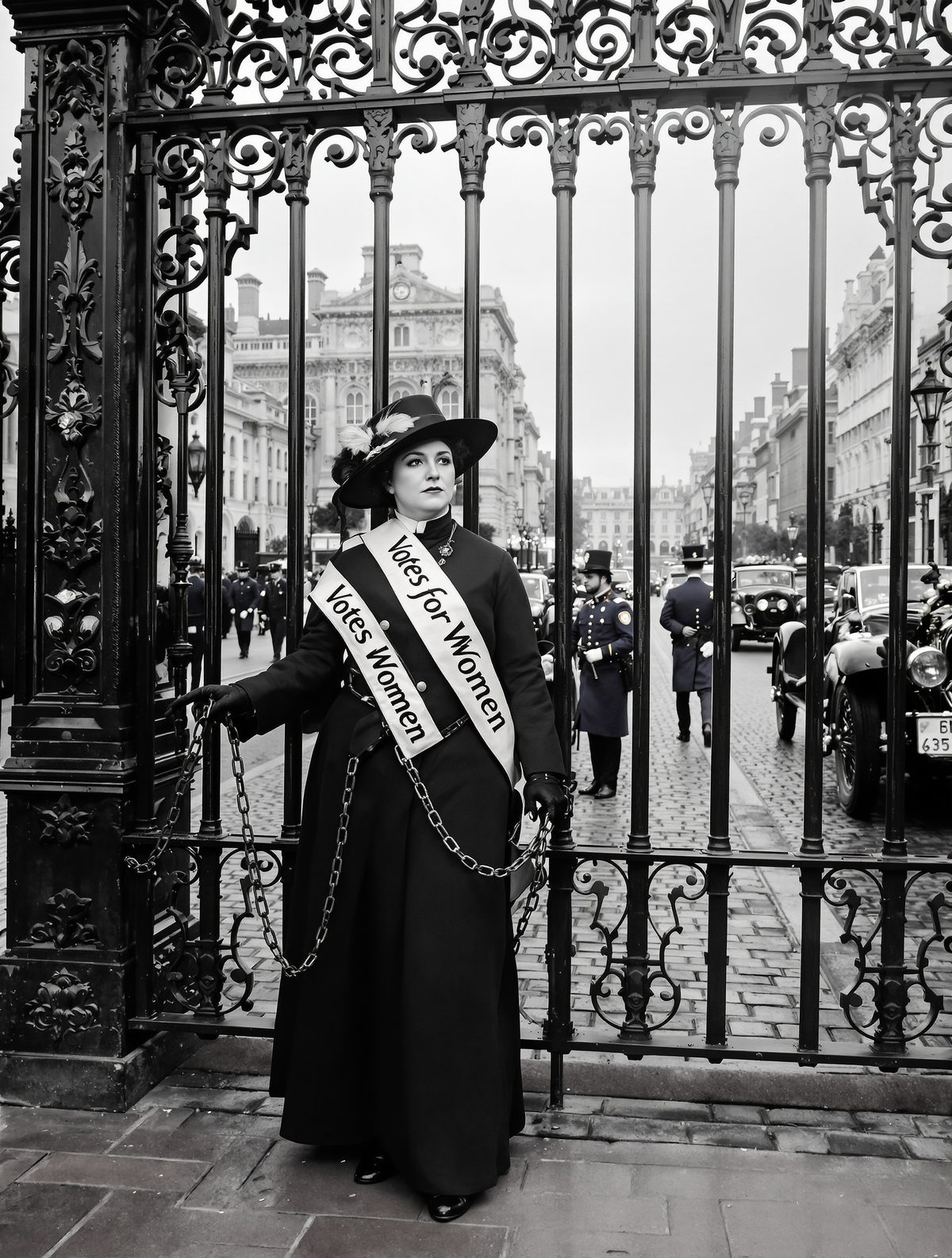
The cold iron rattled against the ornate railings as Alice Hawkins locked the final link around her wrist. It was May 21st, 1908, and the diminutive boot factory worker from Leicester had just done something that would echo through the marble halls of Buckingham Palace and into the annals of British history. Behind those imposing gates lived King Edward VII, sovereign of the greatest empire the world had ever known. Yet Alice—barely five feet tall, earning a pittance stitching boots twelve hours a day—had just declared herself his equal in the most audacious way imaginable.
Within minutes, the Metropolitan Police would arrive with bolt cutters. Within hours, she'd be dragged to Holloway Prison, beginning a journey that would see her imprisoned five times and subjected to the barbaric practice of force-feeding. But in that moment, chained to the very symbol of British power, Alice Hawkins had transformed from an anonymous factory worker into one of the most formidable suffragettes Britain would ever know.
The Making of a Revolutionary
Alice Hawkins wasn't born to revolution—she was driven to it by the grinding realities of Victorian industrial life. Born in 1863 in Stafford, she began working in Leicester's booming boot and shoe industry as a young woman, joining thousands of others in the city's grimy factories. Leicester had become the heart of Britain's footwear trade, but for workers like Alice, it meant a life of unrelenting toil for wages that barely sustained survival.
Each day, Alice would arrive at the factory before dawn and work until evening fell, her fingers flying over leather and thread in the deafening cacophony of industrial machinery. The most skilled male workers earned around 30 shillings a week—Alice, despite performing identical work with equal skill, took home just 15 shillings. This wasn't unusual; it was the law. Women had no political voice to challenge such injustices because women, regardless of their intelligence, skill, or contribution to society, were deemed unworthy of the vote.
Read next: The Day a Victorian Nurse Walked Into a Fever Ward Alone
But Alice possessed something that would prove more dangerous to the established order than any weapon: an unshakeable sense of justice. In the 1890s, she joined the Independent Labour Party and began organizing her fellow workers. Her small stature belied a voice that could command a crowd and a will that would bend to no authority. When she spoke at union meetings, men twice her size would fall silent and listen.
Awakening to the Cause
The transformation from labor organizer to suffragette came gradually, then all at once. In 1906, Alice attended a meeting addressed by Emmeline Pankhurst, the formidable founder of the Women's Social and Political Union (WSPU). Pankhurst's message was electric: polite petitions and patient waiting had failed. If women wanted the vote, they would have to fight for it with the same determination that men had shown throughout history.
For Alice, this wasn't abstract political theory—it was personal survival. Every day she witnessed how powerlessness crushed the women around her. Factory girls worked in dangerous conditions with no recourse when injured. Mothers watched their children go hungry while politicians debated policies that affected them intimately but excluded their voices entirely. The vote wasn't just about democracy; it was about dignity.
She joined the WSPU in 1907, and within months had established herself as the organization's chief organizer for Leicester and the surrounding counties. Her humble background proved to be her greatest asset. While critics dismissed the suffragette movement as the hobby of wealthy, idle women, Alice's presence at the podium demolished such arguments. Here was a woman who understood poverty, who had calluses on her hands and knew the weight of real labor. When she spoke about injustice, working-class audiences knew she had lived it.
The Palace Gates
By May 1908, Alice had already been arrested twice for suffragette activities. She had disrupted political meetings, organized demonstrations, and endured the sneers of men who considered her political awakening an unnatural rebellion against God's design. But chaining herself to Buckingham Palace represented an escalation that shocked even her fellow suffragettes.
The plan was audacious in its simplicity. On that spring morning, Alice approached the palace gates dressed in her Sunday best—a dark coat and hat that made her appear like any other middle-class woman taking a constitutional through London's royal parks. Hidden beneath her coat was a length of chain and a sturdy padlock. She had studied the railings on previous visits, identifying the perfect spot where she could secure herself before the guards could intervene.
As tourists and passersby stopped to stare, Alice produced a banner reading "Votes for Women" and began shouting slogans that echoed off the palace walls. The irony was exquisite: here was a woman who earned less in a year than the royal family spent on a single dinner party, yet she had succeeded in bringing her message to the very heart of the monarchy. For precious minutes, Alice Hawkins commanded more attention than the King himself.
The police response was swift and brutal. When bolt cutters failed to quickly remove her chains, officers began dragging her along the railings, the metal cutting into her wrists until she finally broke free. Bleeding and disheveled, she was bundled into a police wagon and driven to Holloway Prison, London's fortress for suffragettes.
The Price of Conviction
Holloway in 1908 was a Victorian monument to punishment rather than rehabilitation. The prison had become the unwilling epicenter of the suffragette movement, housing hundreds of women who had committed "crimes" like throwing stones, interrupting speeches, or—like Alice—chaining themselves to public monuments. The government, increasingly desperate to break the movement's will, had authorized prison officials to use any means necessary to end the suffragettes' weapon of choice: the hunger strike.
Alice's first imprisonment lasted six weeks, but it was her second arrest in 1909 that would test the absolute limits of her endurance. When she refused to eat in protest of being denied political prisoner status, prison officials implemented the government's most controversial weapon: force-feeding.
The procedure was medical torture disguised as healthcare. Guards would pin Alice to her cell floor while a doctor forced a rubber tube down her throat or up her nose, pumping liquid nutrition into her stomach. The process caused vomiting, internal injuries, and psychological trauma that lasted long after release. Many suffragettes described force-feeding as worse than rape—a deliberate violation designed to break their spirits and deter other women from joining the cause.
Alice endured this brutality repeatedly across five separate imprisonments. Each time she emerged thinner and more battered, but her resolve only strengthened. She had discovered something the government hadn't anticipated: working-class women like herself had already endured so much suffering that prison held fewer terrors than it did for their more privileged sisters.
The Ripple Effect
Alice's courage inspired a network of suffragettes across the Midlands who might otherwise have remained silent. Her Leicester base became a recruiting ground where factory workers, shop girls, and domestic servants found their political voices. She organized elaborate stunts that captured national headlines: suffragettes hiding in the organ pipes of local churches to interrupt services with speeches, or disguising themselves as cleaners to infiltrate political meetings.
Her most ingenious protest came in 1913 when she and several conspirators purchased tickets to a Leicester music hall, then unfurled banners and began speechmaking from their box seats. When ushers tried to remove them, they discovered the women had chained themselves to their chairs. The entire evening's entertainment was cancelled while police worked to free them, generating exactly the kind of publicity disruption the movement thrived upon.
But Alice's influence extended beyond spectacular protests. She understood that sustainable change required grassroots organizing, not just headline-grabbing stunts. She established suffragette groups in dozens of Midlands towns, training working-class women in public speaking, political organizing, and civil disobedience. Her proteges carried the movement into communities that educated, middle-class suffragettes could never have reached.
Victory and Legacy
When World War I erupted in 1914, the suffragette movement suspended its militant activities to support the war effort. Alice, now in her fifties and bearing the physical scars of her imprisonments, threw herself into war work with the same fierce dedication she had shown to the suffrage cause. She organized women workers, supported soldiers' families, and demonstrated that women's patriotism was never in question—only their political rights.
The Representation of the People Act of 1918 finally granted voting rights to women over 30 who met certain property requirements. It was a partial victory, but Alice lived to see full equality achieved in 1928 when all women over 21 gained the franchise. She cast her first legal ballot at age 55, more than four decades after she had first begun fighting for the right.
Alice Hawkins died in 1946, having witnessed two world wars and the transformation of British society. The boot factory worker who had once earned half a man's wage for equal work lived to see women enter Parliament, the professions, and every corner of public life. The chain she had wrapped around Buckingham Palace's railings had helped break the chains that bound half of Britain's population in political silence.
Today, as democracy faces new challenges around the world, Alice Hawkins's story carries fresh urgency. She understood that rights are never given freely—they must be claimed by those brave enough to risk everything for justice. In our age of comfortable activism and online outrage, her willingness to endure prison, torture, and social ostracism for her beliefs seems almost mythical. Yet Alice was no myth. She was a working-class woman who refused to accept that powerlessness was her destiny, and in refusing, she changed the destiny of millions who came after her.