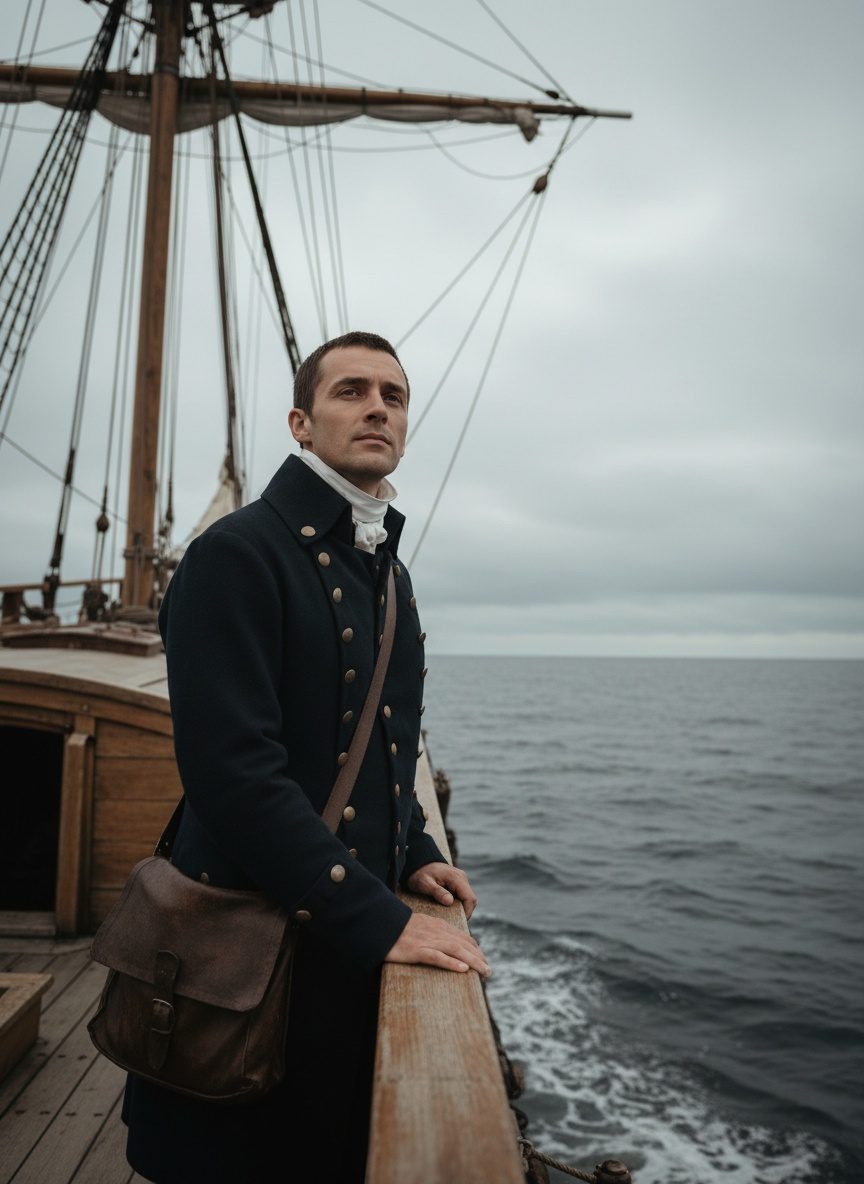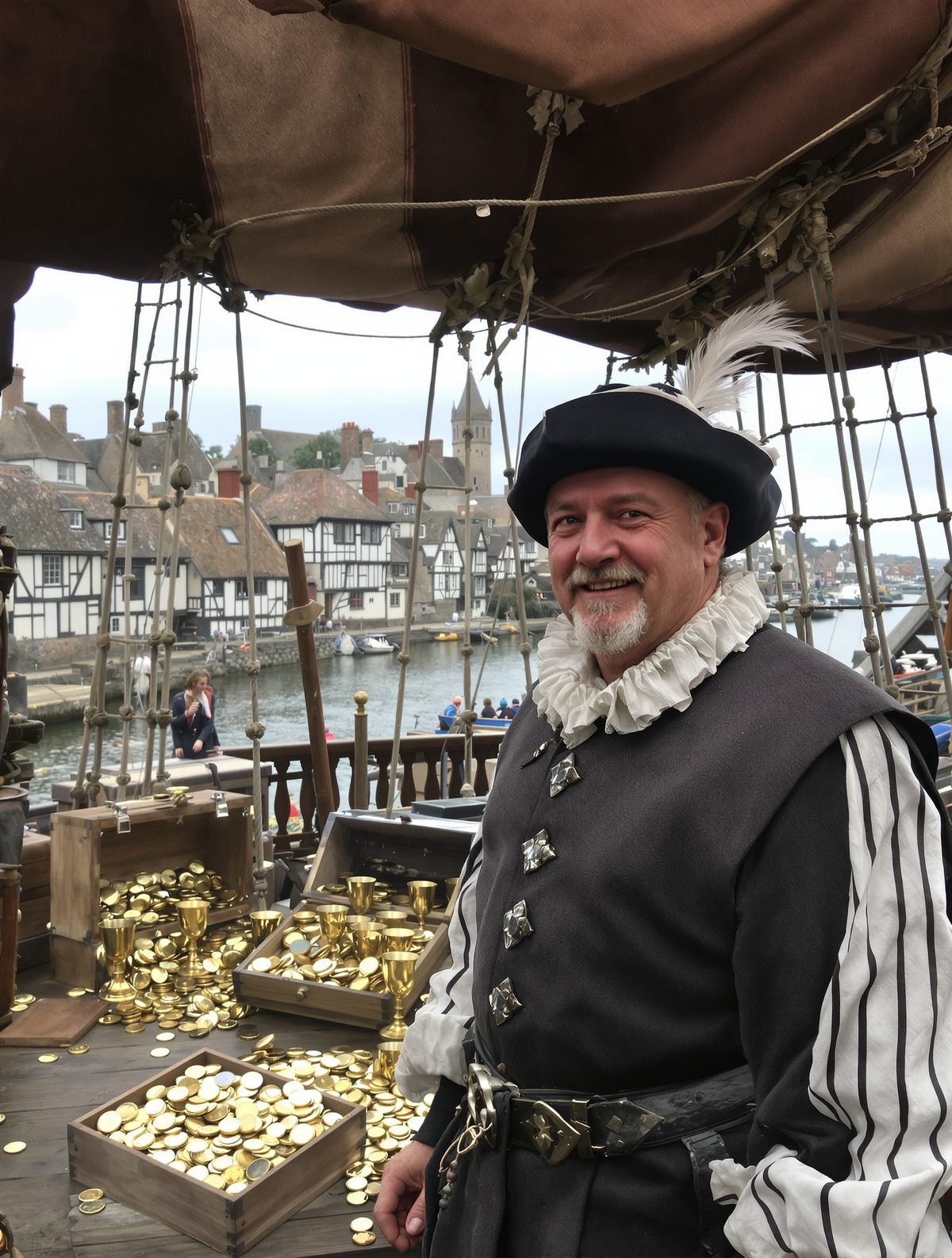
The lookout's cry echoed across Plymouth's windswept harbour on that grey September morning in 1580: "Ship approaching!" But this was no ordinary vessel limping toward the English coast. The Golden Hind, her hull scarred by three years of salt spray and battle, rode low in the water—not from damage, but from the crushing weight of silver bars, golden coins, and precious gems crammed into her hold. Francis Drake had just completed what many thought impossible: the first English voyage around the entire world. More importantly, he'd turned piracy into England's most profitable foreign policy.
What happened next would transform a rain-soaked island kingdom into the terror of the Spanish Empire.
A Pirate's Gamble on the High Seas
When Drake had slipped out of Plymouth three years earlier on December 13th, 1577, most people assumed they'd never see him again. His official mission, sanctioned by Queen Elizabeth herself, was deliberately vague—to "annoy" the King of Spain in the Pacific. In reality, Elizabeth had secretly invested £1,000 of her own money in what amounted to a state-sponsored piracy expedition. The Spanish called Drake "El Draque"—the Dragon—and they weren't being poetic.
Drake's fleet of five ships had been whittled down to just the Golden Hind by the time he rounded Cape Horn into the Pacific. But what the Spanish didn't expect was an English warship appearing in their private ocean. For decades, they'd treated the Pacific as their personal treasure highway, with lumbering galleons carrying Peruvian silver and Philippine gold back to Spain, completely undefended.
Read next: The Day a Devon Captain Mapped the World's Last Shore
Drake fell upon them like a wolf among sheep. Off the coast of Chile, he captured the Spanish ship Nuestra Señora de la Concepción—so heavy with silver that the crew nicknamed her Cacafuego (which, roughly translated, means "fire-shitter"). When Drake's men broke open her holds, they found 13 chests of silver coins, 26 tons of silver bars, 80 pounds of gold, and a fortune in precious stones. It took six days to transfer the treasure to the Golden Hind.
The Secret Passenger Who Changed History
But here's what the history books rarely mention: Drake didn't just steal treasure. Aboard the captured Spanish ships was something far more valuable—a collection of detailed charts and navigational secrets that Spain had guarded for nearly a century. These maps revealed the true locations of Spanish ports, the timing of treasure fleets, and most crucially, the exact sailing routes across the Pacific.
Drake also captured a Spanish pilot named Nuño da Silva, who possessed inside knowledge of Spanish operations along the entire Pacific coast. Under interrogation (one imagines over several bottles of wine), da Silva revealed the schedules of treasure ships, the locations of undefended ports, and the seasonal patterns of Spanish naval movements. It was like stealing the enemy's playbook.
This intelligence would prove more valuable than any chest of silver. For the first time, England possessed detailed knowledge of Spanish maritime operations—information that would be used to plan attacks for decades to come.
When Plymouth Harbour Became a Treasure Cave
By the time the Golden Hind finally appeared off the English coast on September 26th, 1580, Drake faced a diplomatic nightmare. England and Spain weren't officially at war. Technically, Drake had just committed an act of piracy that could trigger a Spanish invasion. Queen Elizabeth, ever the political strategist, initially kept Drake waiting offshore for weeks while she decided whether to execute him as a pirate or knight him as a hero.
The treasure that Drake unloaded onto Plymouth's docks defied imagination. The total haul was valued at £400,000—equivalent to roughly £400 million today. To put that in perspective, it was more than England's entire annual royal revenue. The Queen's personal share alone was £160,000, enough to pay off all of England's foreign debts and still have change left over.
Local Plymouth residents watched in amazement as chest after chest of silver was carried from the ship. Spanish coins, many of them minted in Mexico and Peru from silver extracted by forced indigenous labour, clinked through the streets of a Devon port town. One witness described the scene as "more silver than any man in England had ever seen in one place."
The Golden Hind's Secret Weapon
What made Drake's voyage truly revolutionary wasn't just the treasure—it was the ship itself. The Golden Hind represented a new type of English vessel: smaller and faster than Spanish galleons, but armed with cutting-edge bronze cannons that could outshoot anything the Spanish possessed.
Drake had essentially invented the concept of the "race-built" galleon—a ship designed for speed and manoeuvrability rather than cargo capacity. While Spanish treasure ships were floating fortresses built to intimidate, English ships were becoming floating weapons platforms built to attack and retreat before the enemy could respond.
The Golden Hind displaced only 150 tons but carried 18 cannons—a higher guns-to-tonnage ratio than any ship of its era. This innovation would become the template for English naval design for the next century, ultimately giving England the technological edge that would defeat the Spanish Armada just eight years later.
The Queen's Dilemma: Knight or Execute?
For months, Elizabeth wavered over what to do with her successful pirate. Spanish ambassadors demanded Drake's head. English merchants, suddenly wealthy from investments in Drake's voyage, demanded he be celebrated. The Queen, as usual, found a third option that was pure political genius.
On April 4th, 1581, Elizabeth boarded the Golden Hind—now permanently moored at Deptford as a tourist attraction—and knighted Drake on his own deck. But she didn't perform the ceremony herself. Instead, she handed the ceremonial sword to the French ambassador, symbolically making France complicit in what was essentially a state-sponsored theft from Spain.
It was a masterclass in diplomatic trolling. Elizabeth got to keep the treasure, honour her successful captain, and implicate France in the insult to Spain, all while maintaining plausible deniability about England's aggressive intentions.
The Treasure That Bought an Empire
The wealth that Drake dumped onto Plymouth's docks did more than fill Elizabeth's treasury—it funded England's transformation into a naval superpower. The treasure financed the construction of new warships, the training of naval officers, and the establishment of England's first permanent naval infrastructure.
Perhaps most importantly, it proved that Spain's empire was vulnerable. For decades, other European powers had assumed that Spanish dominance of the seas was unbreakable. Drake's voyage demonstrated that a single well-armed ship with a competent crew could wreak havoc on Spanish commerce and return home wealthy beyond imagination.
The psychological impact was enormous. Within years, other English captains were following Drake's example, launching their own raids on Spanish shipping. What began as one man's piratical adventure became England's unofficial naval strategy: use private enterprise to weaken Spain while enriching England.
Today, we might recognize this as an early form of economic warfare—using targeted attacks on commercial infrastructure to weaken an enemy's ability to project power. Drake had inadvertently invented a new form of conflict that would dominate maritime strategy for centuries.
When the Golden Hind finally rotted away at her Deptford mooring decades later, pieces of her timber were made into furniture and souvenirs. But her real legacy wasn't wood and nails—it was the proof that a small, determined nation could challenge a global empire and win. The silver Drake carried into Plymouth harbour had purchased something more valuable than treasure: it had bought England a future on the world's oceans.