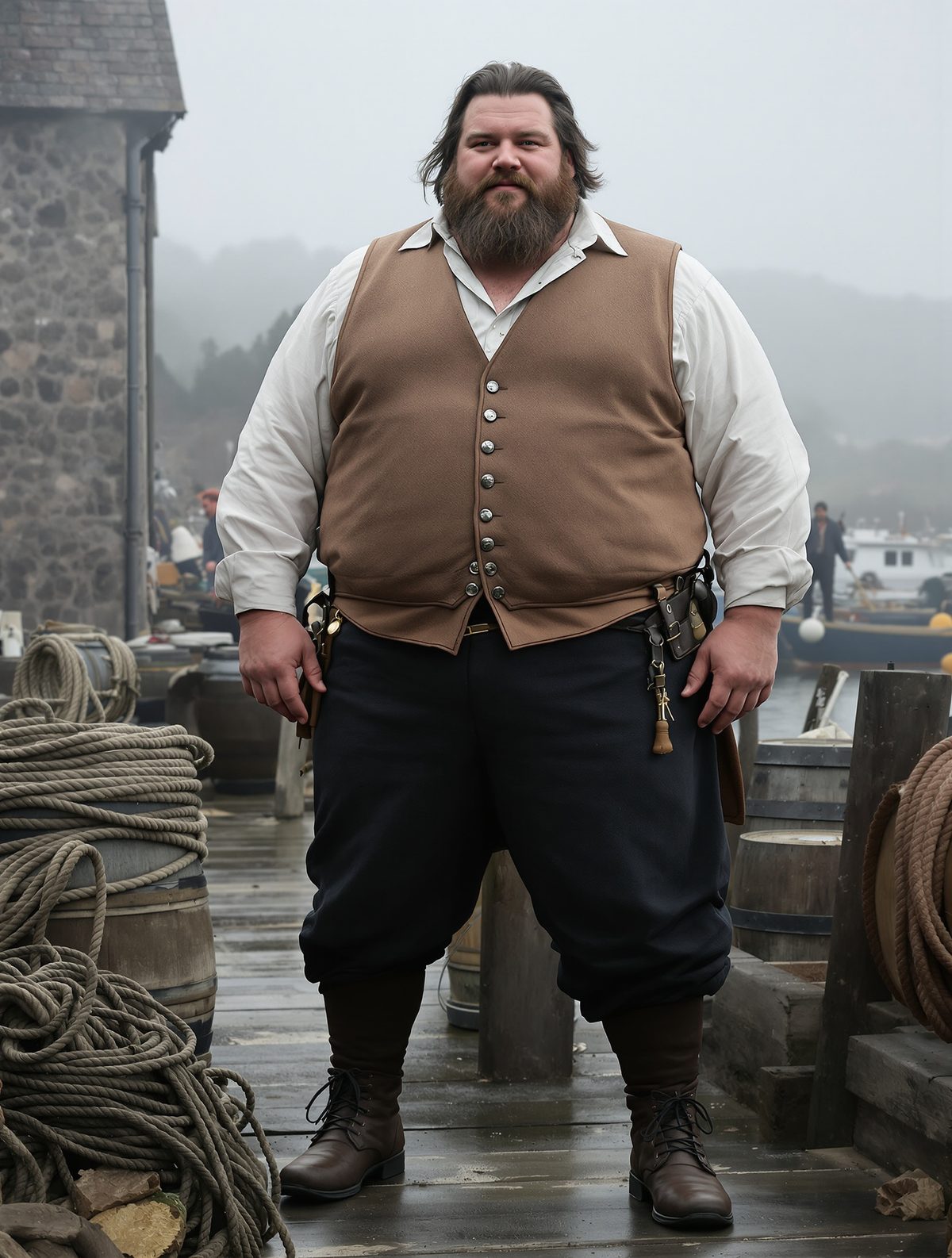
Picture this: you're standing in a crowded tavern in 1850s Nova Scotia when the door suddenly fills—completely fills—with the silhouette of a man so tall he has to duck his massive frame just to enter. At seven feet nine inches, Angus MacAskill cast a shadow that could eclipse entire families. His hands were so large they could palm a man's head like a child's toy, and his shoulders so broad they seemed to span doorways. Yet when this gentle colossus from the Scottish Highlands set down his walking stick and smiled, the room didn't tense with fear—it warmed with wonder.
This is the extraordinary tale of the man who became known as the strongest human being who ever lived, yet never once used that power to cause pain. In an age when might made right and bare-knuckle boxing drew crowds like gladiatorial combat, Angus MacAskill rewrote the rules of what it meant to be powerful.
A Giant Born Among Giants
On the windswept Isle of Berneray in Scotland's Outer Hebrides, October 1825 brought forth a child who seemed destined for an ordinary Highland life. Angus MacAskill entered the world as the fourth of thirteen children born to Norman MacAskill and Christina Campbell—both of perfectly normal stature. For the first few years, nothing marked young Angus as different from his siblings, save perhaps an unusually sunny disposition.
But then came the growth spurt that would redefine the meaning of the word "giant."
Read next: The Day a Cornish Surgeon Walked Into a Condemned Cell
When the MacAskill family emigrated to Nova Scotia's Cape Breton Island in 1831, six-year-old Angus was still of normal size. Yet somewhere in the salty air and vast landscapes of Englishtown, his body began its remarkable transformation. By age fourteen, he towered at six feet tall. By twenty, he had reached his full, astounding height of seven feet nine inches—making him officially the tallest natural giant in recorded history.
But height was only the beginning of Angus MacAskill's extraordinary proportions. His shoulders measured an incredible 44 inches across—wider than most doorframes. His hands were 12 inches long and 8 inches wide, so massive that when he shook hands with normal-sized men, their entire hand would disappear into his palm. Most remarkably, unlike many giants who suffer from weakness and poor health, Angus possessed strength that seemed to defy the very laws of physics.
The Anchor That Made a Legend
It was a crisp morning in Halifax Harbor, sometime in the late 1840s, when Angus MacAskill performed the feat that would echo through maritime history. A merchant ship had dropped anchor, and the crew was struggling with the massive iron weight—a ship's anchor that typically required multiple men and mechanical assistance to move.
Watching from the wharf, Angus stepped forward with his characteristic gentle smile. Without ceremony or fanfare, he reached down, grasped the 2,200-pound anchor by its stock, and lifted it clean out of the water with one hand, holding it aloft as easily as another man might lift a fishing net. Sailors stopped their work, their jaws agape. Word of the feat spread like wildfire through the maritime communities of the Atlantic coast.
But the anchor was merely one entry in an almost mythical catalog of strength. Angus could lift a full-grown horse clear off the ground. He once carried two men—one under each arm—for over a mile when they became too drunk to walk home. His party trick involved lifting a barrel of pork weighing 350 pounds above his head with one hand, then drinking from a mug held in the other.
Perhaps most incredibly, he could carry 250-pound flour barrels under each arm while walking up a steep gangplank—a feat that left seasoned dock workers shaking their heads in disbelief.
The Philosophy of a Gentle Giant
In an era when physical prowess was often measured by one's ability to dominate others, Angus MacAskill chose a radically different path. His philosophy was as simple as it was revolutionary: true strength lay not in causing harm, but in preventing it.
This principle was tested repeatedly as word of the Nova Scotian giant spread throughout North America. Tough men came from hundreds of miles away, eager to prove themselves against the legendary strongman. They arrived with clenched fists and aggressive postures, expecting a brutal contest of wills.
What they found instead was a soft-spoken Gaelic speaker with twinkling eyes who would listen patiently to their challenges, then—if they insisted on physical confrontation—simply reach out with those massive hands, lift them gently off the ground, and set them down again like wayward children. The gesture was so matter-of-fact, so devoid of aggression, that it drained the fight out of even the most belligerent challengers.
"There's no shame in being handled by hands the size of dinner plates," one defeated challenger was heard to mutter, "especially when they're gentler than a mother's."
The Greatest Show on Earth
Word of the gentle giant eventually reached Phineas Taylor Barnum, the greatest showman of the 19th century. In 1849, Barnum convinced Angus to join his traveling circus, promising adventures beyond the highlands of Cape Breton. For three years, Angus MacAskill became one of the most celebrated attractions in North America, performing alongside the famous "Tom Thumb"—who, at 25 inches tall, created one of history's most striking visual contrasts.
Audiences gasped as Angus demonstrated his incredible strength, lifting massive weights and performing feats that seemed to belong more to mythology than reality. But what truly captivated crowds was his demeanor. Unlike the aggressive strongmen of traveling shows, Angus radiated warmth and kindness. Children who initially cowered behind their parents' legs would end up sitting on his massive shoulders, giggling with delight.
During his time with Barnum's circus, Angus earned the modern equivalent of $500,000—a fortune that he carefully saved, planning to return to his beloved Nova Scotia and live quietly among his family and friends.
The highlight of his show career came when he performed before Queen Victoria herself at Windsor Castle in 1851. The monarch, initially apprehensive about meeting the giant, was reportedly charmed by his gentle manner and impeccable Highland courtesy. She declared him "a fine specimen of Highland manhood" and presented him with two gold rings, which he treasured for the rest of his life.
Read next: The Day a Vicar's Son Walked Into a Debtor's Cell and Freed Them All
The Price of Being Extraordinary
But fame came with unexpected costs. In 1853, while performing in New York, disaster struck during what should have been a routine demonstration. Angus was lifting a massive ship's anchor—similar to the one that had made him famous—when something went wrong. Whether from a defect in the anchor or simply the accumulation of years of superhuman exertion, he severely injured his back and shoulders.
The injury marked the beginning of the end of his performing career. Angus returned to his family's home in Englishtown, Nova Scotia, where he used his circus earnings to open a general store. Even in his reduced capacity, he remained a figure of wonder and respect in his community. Visitors came from around the world to meet the famous giant, and he received them all with the same gentle courtesy that had characterized his entire life.
The local Mi'kmaq people held him in particular reverence, calling him "the kind mountain" and often seeking his help in resolving disputes—knowing that his mere presence could calm the most heated arguments without a word being spoken.
A Legacy Measured in Kindness
Angus MacAskill died on August 8, 1863, at the age of 38, his body finally succumbing to the strain of carrying such extraordinary proportions. His funeral drew thousands of mourners from across the Maritime provinces. The Nova Scotia government declared a day of mourning, and ships in Halifax Harbor flew their flags at half-mast.
Today, more than 150 years later, Angus MacAskill's story offers a powerful alternative narrative to our culture's obsession with dominance and aggression. In an age of social media posturing and performative toughness, his example reminds us that true strength—the kind that leaves a lasting legacy—comes not from the ability to overpower others, but from the wisdom to restrain that power.
The Guinness Book of World Records still lists Angus MacAskill as the tallest non-pathological giant in recorded history, but perhaps his real record is something far more valuable: he may be the strongest human being who never used that strength to cause deliberate harm to another person.
In the Scottish Gaelic tradition of his ancestors, they might have called him Fear Mòr Caoimhneil—the Great Gentle Man. It's a title that seems far more meaningful than any measure of height or weight could ever be. After all, in a world full of people trying to prove how tough they are, perhaps the most radical act of all is choosing to be gentle.