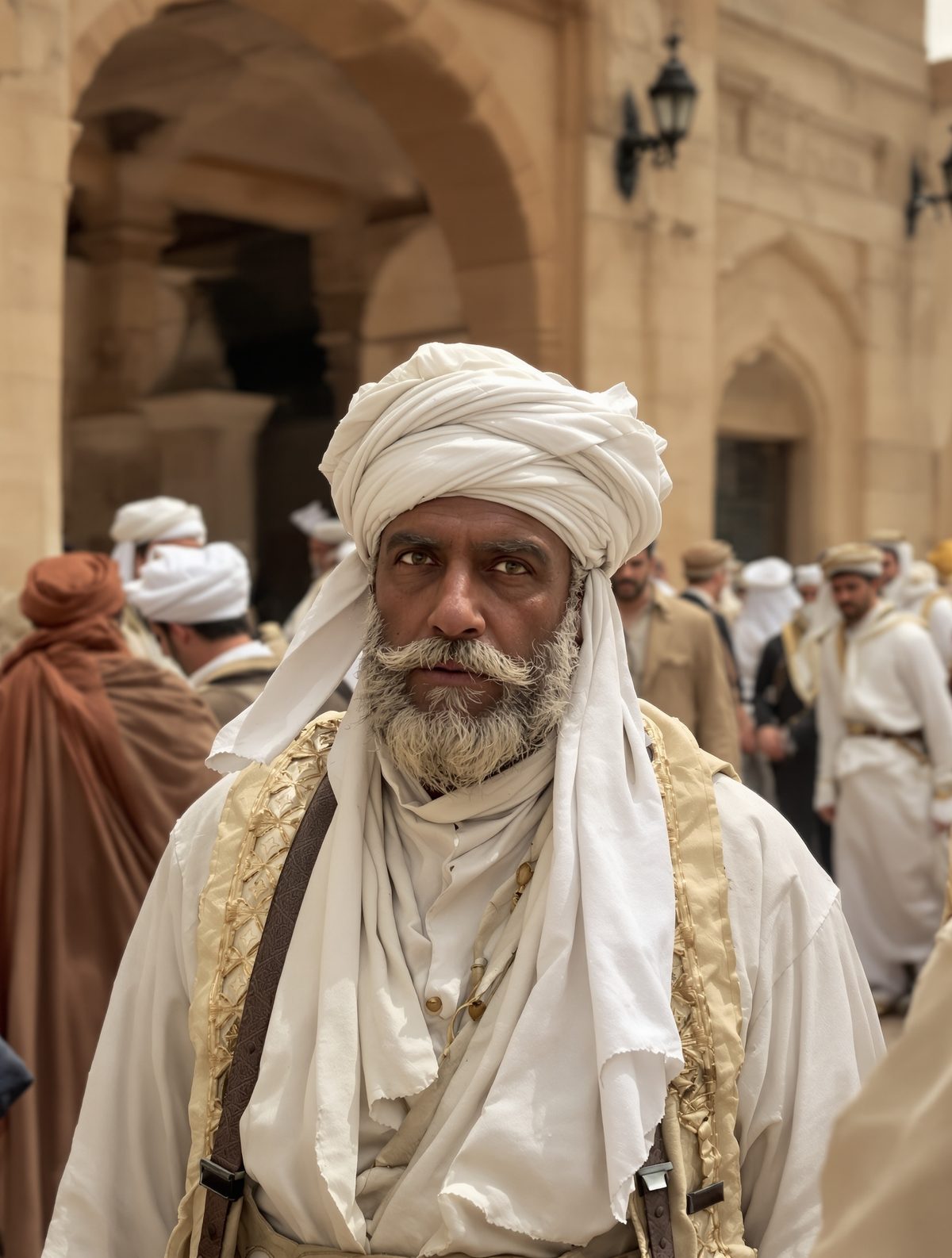
Picture this: It's dawn in Medina, 1853. Among thousands of Muslim pilgrims preparing for the sacred journey to Mecca, a bearded Afghan doctor named Abdullah adjusts his turban and checks his prayer beads. His skin is darkened with walnut juice, his Arabic flows like a native speaker's, and his knowledge of Islamic customs appears flawless. But beneath this perfect disguise beats the heart of Captain Richard Francis Burton—a pale-skinned British officer whose discovery would mean instant death by stoning or beheading.
In an age when the Royal Geographical Society's maps bore the humiliating phrase "unknown" across vast swaths of the Islamic world, Burton was about to pull off the most audacious act of Victorian espionage ever attempted: becoming the first documented European to enter Islam's holiest city.
The Forbidden City That Haunted Victorian England
Mecca in 1853 was more than just forbidden to non-Muslims—it was a geographical obsession for Victorian Britain. While the Empire's red was spreading across world maps, this single city remained an impenetrable mystery. The penalty for non-Muslim entry wasn't negotiable: death, swift and certain. The last known European to attempt the journey, Johann Ludwig Burckhardt, had died in Cairo in 1817 before completing his mission.
For Burton, this prohibition wasn't just a challenge—it was an irresistible siren call. At thirty-two, he already spoke twenty-nine languages and dialects, had mastered Indian swordsmanship, and served as an intelligence officer in the wilds of Sind (now Pakistan). But Mecca represented the ultimate test of his extraordinary abilities.
Read next: The Day a Surgeon's Son Chose Death Over Silence
The Royal Geographical Society had been quietly funding attempts to penetrate Arabia's secrets for decades. Trade routes, political alliances, and military intelligence all hung in the balance. Burton convinced them to sponsor his mission with a simple argument: if anyone could pull off this impossible deception, it was him.
Becoming Abdullah: The Art of Human Disguise
Burton's transformation into "Mirza Abdullah" began months before his journey. This wasn't mere costume—it was a complete metamorphosis of identity. He spent weeks perfecting the guttural sounds of Afghan Persian, studying the subtle differences between Sunni and Shia prayers, and memorizing the intricate genealogies of Prophet Muhammad that any educated Muslim would know by heart.
The physical transformation was equally meticulous. Walnut juice stained his skin a convincing brown, while careful application of kohl darkened his eyes. He grew his beard in the Afghan style and learned to walk with the slight limp of a man who'd spent years traveling rough mountain paths. His cover story was brilliant in its simplicity: a Persian-speaking Afghan doctor returning from medical studies in India, seeking spiritual purification through the Hajj.
Burton's attention to detail was obsessive. He practiced eating with his right hand only, mastered the five daily prayer positions until they became muscle memory, and even learned to sleep in the cramped positions common among traveling pilgrims. One slip—using his left hand for food, facing the wrong direction during prayer, or mispronouncing a single Arabic phrase—could expose him instantly.
Among the Faithful: The Journey Begins
On April 3, 1853, Burton departed from Southampton aboard the steamship Bengal, bound for Alexandria. His fellow passengers had no idea they were traveling with a man about to attempt one of the most dangerous deceptions in history. In Alexandria, he joined a caravan of Egyptian pilgrims, testing his disguise among people who had known Arabic since birth.
The journey from Cairo to the Red Sea port of Suez revealed the first cracks in Burton's confidence. Traveling in the suffocating heat while maintaining perfect character was exhausting. The cramped conditions, unfamiliar food, and constant vigilance required to maintain his cover took their toll. More than once, he caught himself about to respond in English to a fellow traveler's question.
But it was in Suez that Burton faced his first real test. Egyptian authorities, suspicious of his Afghan story, questioned him extensively about his background. Speaking perfect Arabic, Burton spun tales of his medical training in Delhi and his family's connections to prominent Afghan merchants. His performance was so convincing that the officials not only believed him but helped arrange his passage to Jeddah, the port city serving Mecca.
The Crossing: Hell on the Red Sea
The voyage from Suez to Jeddah aboard a crowded pilgrim ship tested Burton's endurance beyond anything he'd experienced. Packed with over 900 pilgrims into a space meant for 200, the ship was a floating nightmare of disease, heat, and human misery. Cholera broke out during the journey, claiming dozens of lives daily. Bodies were wrapped in shrouds and dropped overboard with heartbreaking regularity.
Burton later wrote that maintaining his disguise while seasick, sleep-deprived, and surrounded by death was "the greatest acting performance of my life." He couldn't risk the privacy of illness—every moment required perfect performance. When fellow pilgrims asked him to treat their ailments (believing him to be a doctor), he had to provide convincing medical advice while secretly having no formal training.
The ship's arrival at Jeddah on July 15, 1853, brought new dangers. Ottoman officials boarded to inspect pilgrims' papers and credentials. Burton watched nervously as several suspected imposters were dragged away—their fate unspoken but understood. When his turn came, Burton's forged documents and flawless Arabic saved him, but he later admitted his hands were shaking as he answered their questions.
The Holy City: Walking Among the Sacred
On July 16, 1853, Burton achieved what no documented European had before: he entered Mecca. Traveling in a caravan of pilgrims from Jeddah, he first glimpsed the city's minarets shimmering in the desert heat. His journal records a moment of genuine awe mixed with terror—after months of preparation, he was finally inside the forbidden city, surrounded by the most sacred sites in Islam.
The Kaaba, Islam's holiest shrine, stood before him like "a black silk-covered cube, drawing pilgrims like iron filings to a magnet." Burton joined the Tawaf—the ritual circumambulation of the Kaaba—walking counterclockwise with thousands of other pilgrims. He kissed the Black Stone, drank from the Zamzam Well, and performed every ritual with the devotion expected of a true believer.
Read next: The Day a Chimney Sweep's Son Shamed a Whole Parliament
For three days, Burton lived among Mecca's pilgrims, gathering intelligence that would fill several Royal Geographical Society reports. He sketched the city's layout from memory, noting defensive positions, trade routes, and political tensions. His observations of Ottoman rule, Bedouin tribal politics, and the complex logistics of managing hundreds of thousands of pilgrims provided British intelligence with unprecedented insights.
But perhaps most remarkably, Burton found himself genuinely moved by the experience. Despite the deception, he wrote of feeling "the genuine spiritual energy of a million prayers" and admitted that the Hajj's power transcended his role as a spy.
The Narrow Escape: When Suspicion Nearly Killed
Burton's closest call came on his final day in Mecca. A fellow pilgrim from Afghanistan began questioning him closely about mutual acquaintances in Kabul—people Burton had invented in his cover story. As the man's suspicion grew, Burton realized he was moments away from exposure. In a brilliant improvisation, he claimed to be suffering from severe fever and began reciting Quranic verses in a delirious manner, convincing the suspicious Afghan that illness was affecting his memory.
The ruse worked, but Burton knew his time was up. He completed the final Hajj rituals and departed Mecca on July 19, having spent just three days in the holy city that had obsessed him for years. The return journey to Cairo was equally perilous—Ottoman authorities were investigating reports of a possible European infiltrator among the pilgrims.
Legacy of the Impossible Journey
Burton's successful infiltration of Mecca sent shockwaves through Victorian society. His published account, "Personal Narrative of a Pilgrimage to Al-Madinah and Meccah," became an instant bestseller and established him as one of the era's greatest explorers. The Royal Geographical Society hailed it as an intelligence coup that opened new understanding of the Islamic world.
But Burton's achievement raises uncomfortable questions that echo today. Was this brilliant exploration or cultural violation? His journey occurred during an era when European powers were carving up the Islamic world, and his intelligence certainly served imperial interests. Yet Burton also showed genuine respect for Islamic culture and traditions, even as he deceived their practitioners.
In our current age of cultural sensitivity and global interconnection, Burton's Mecca journey stands as a complex legacy—a testament to extraordinary human courage and linguistic genius, shadowed by the imperial context that made such deception seem heroic rather than invasive. It remains one of history's greatest acts of espionage, achieved not through technology or violence, but through the simple, terrifying power of perfect performance under impossible stakes.