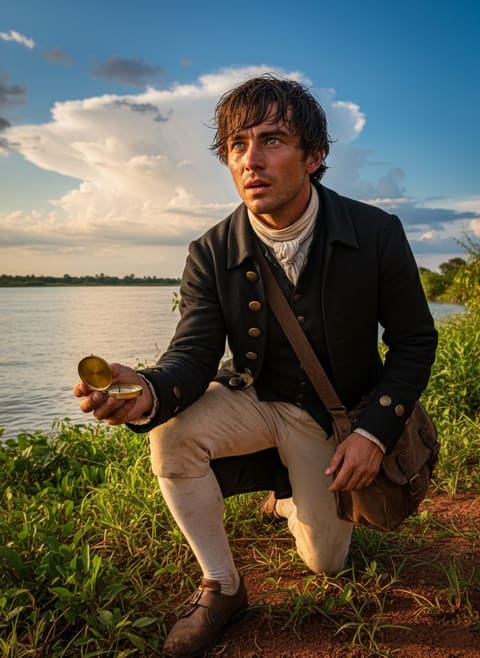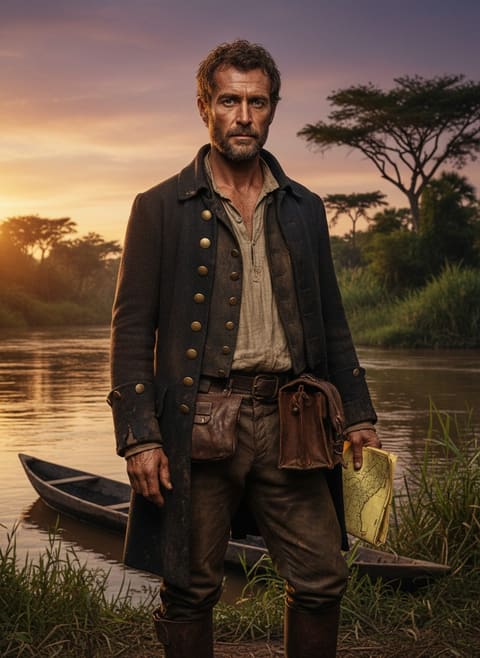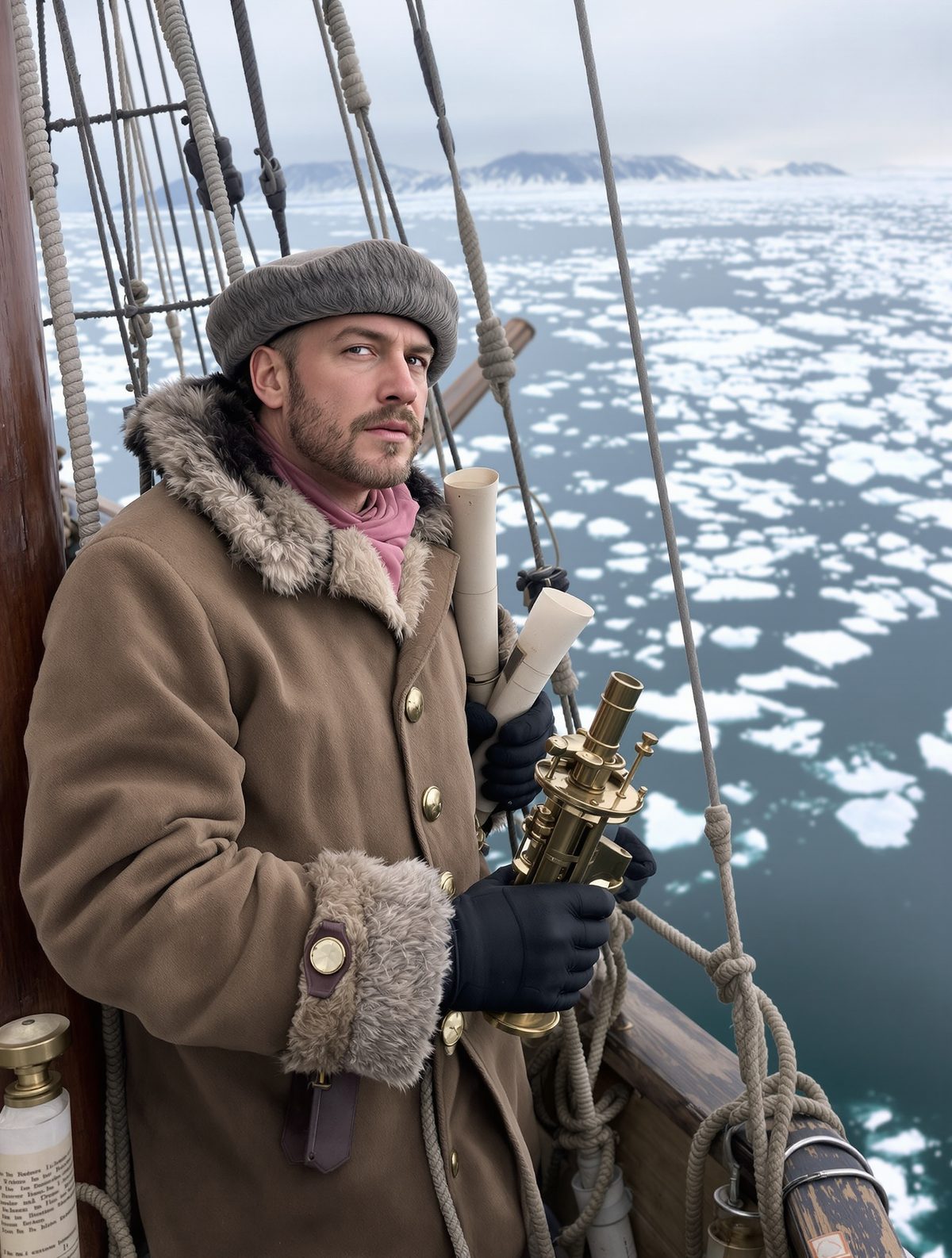
The Arctic wind howled across the deck of the Baffin as young William Scoresby secured his rope and began his precarious climb up the ship's mast. It was July 1822, and the 33-year-old carried with him a collection of instruments that would have made any naval surveyor envious: a sextant, compass, telescope, and most importantly, sheets of paper and charcoal for sketching. What happened next in that crow's nest, swaying 90 feet above the ice-choked waters off East Greenland, would rewrite the maps of the Arctic forever.
For centuries, the eastern coast of Greenland had remained one of the world's most impenetrable mysteries. The dense pack ice that guarded its shores had crushed the ships of countless explorers, and those few who glimpsed the coastline could never get close enough to chart it accurately. But Scoresby wasn't your typical explorer—he was a whaler, and whalers knew secrets about navigating ice that the Royal Navy had never learned.
The Whaler's Son Who Dreamed of Science
William Scoresby Jr. was born into a world where the line between commerce and exploration blurred like the horizon on a foggy Arctic morning. His father, Captain William Scoresby Sr., was already a legend among Whitby's whaling fleet, having pushed farther north than any whaler before him. But young William possessed something his father's generation lacked: a scientific mind trained at Edinburgh University and an obsession with precision that would have impressed the scholars at the Royal Society.
By 1822, Scoresby had already spent fifteen seasons hunting whales in Arctic waters, but this voyage aboard the Baffin was different. The ice conditions that summer were unlike anything the whalers had seen before—instead of the usual impenetrable barrier, the pack ice had shifted, creating narrow channels of open water along Greenland's coast. It was as if nature had briefly unlocked a door that had remained sealed for generations.
Read next: The Day a Devon Captain Charted the Pacific and Changed the World
Most captains would have seen this as an opportunity for whaling. Scoresby saw it as a chance to solve one of geography's greatest puzzles.
Into the Ice Cathedral
The landscape that greeted Scoresby as he climbed into his crow's nest defied description. Towering icebergs, some rising 200 feet above the waterline, drifted like frozen cathedrals through the dark waters. Behind them, the coast of East Greenland revealed itself in all its savage beauty—black volcanic peaks thrusting through glacial ice, fjords cutting deep into the landmass like ancient scars, and valleys where no human foot had ever trod.
From his perch high above the deck, Scoresby could see what no one at sea level could comprehend: the true shape of the coastline. The elevated perspective allowed him to peer over intervening ice floes and trace the land's contours for miles in each direction. But this wasn't casual sightseeing—Scoresby worked with the methodical precision of a scientist, taking bearings with his compass, measuring angles with his sextant, and constantly sketching what he observed.
What made his achievement even more remarkable was the speed at which he worked. Ships in these waters couldn't anchor safely; the ice moved constantly, and a vessel that lingered too long risked being crushed. Scoresby had to complete his observations while the Baffin remained in motion, compensating for the ship's movement and the swaying of the mast in his calculations.
The Art of Arctic Cartography
Traditional navigation relied on getting close to shore, taking multiple readings from fixed positions, and having time to double-check measurements. Scoresby had none of these luxuries. Instead, he developed techniques that were part science, part artistry, and part intuition born from decades of reading ice and weather patterns.
His sketches from the crow's nest weren't just rough drawings—they were detailed topographical studies that captured the relative heights of peaks, the depth of fjords, and the flow patterns of glaciers. He noted everything: the color of exposed rock that might indicate mineral composition, the size of ice formations that suggested how long they'd been there, and the behavior of seabirds that could reveal the location of hidden currents or feeding grounds.
Perhaps most impressive was Scoresby's ability to maintain accuracy while working under such extreme conditions. The temperature hovered near freezing even in summer, and the constant motion of the ship made precise instrument readings nearly impossible. Yet when his charts were later compared to modern satellite imagery, they proved astonishingly accurate—often within a few miles over hundreds of miles of coastline.
400 Miles of Discovery
Over the course of several weeks, Scoresby methodically charted approximately 400 miles of East Greenland's coast, from roughly 70° to 75° North latitude. He identified and named numerous geographical features, many of which still bear the names he gave them today: Scoresby Sound (the world's largest fjord system), Cape Tobin, and Milne Land among others.
But the true significance of his work went beyond mere mapping. Scoresby's detailed observations provided the first scientific data about East Greenland's geology, climate, and wildlife. He documented species of Arctic plants and animals, recorded weather patterns, and made calculations about ice thickness and movement that wouldn't be verified by other explorers for decades.
His achievement was made even more remarkable by the fact that he accomplished it while simultaneously running a successful whaling operation. The Baffin returned to Whitby that autumn with a full cargo of whale oil and blubber, proving that scientific exploration and commercial enterprise could coexist—a lesson that wouldn't be lost on future generations of Arctic explorers.
Recognition and Rivalry
When Scoresby returned to England with his charts and observations, the response was mixed. The scientific community was astounded by the quality and scope of his work, but the Admiralty was less enthusiastic. Here was a civilian whaler who had achieved more in a single season than decades of official Royal Navy expeditions. The slight stung, particularly when the Admiralty declined to provide Scoresby with a ship for further Arctic exploration, despite his proven abilities.
Read next: The Day a Devon Sailor Mapped the Roof of the World Alone
The tension between Scoresby and official exploration circles revealed a deeper conflict about who had the right to claim new territories and make scientific discoveries. The gentlemen explorers of the Royal Navy saw Arctic exploration as their domain, while practical men like Scoresby viewed such attitudes as wasteful and inefficient. This divide would influence British exploration policy for decades to come.
Despite the official snubs, Scoresby's maps became the standard reference for East Greenland. His detailed charts guided whale hunters, Arctic explorers, and eventually the first scientific expeditions to establish research stations in the region. Even today, elements of his 1822 survey remain incorporated in modern maps of the area.
Legacy of the Crow's Nest
William Scoresby's achievement from his ship's crow's nest represents more than just exceptional navigation—it embodies a uniquely practical approach to exploration that prioritized results over glory. In an age when Arctic expeditions often ended in disaster, Scoresby proved that local knowledge, scientific method, and commercial pragmatism could achieve more than heroic suffering and expensive equipment.
His success also highlights how innovation often comes from unexpected places. While the Royal Navy was launching elaborate expeditions with multiple ships and hundreds of men, a single whaler with homemade instruments and deep knowledge of ice conditions accomplished what had defeated far larger efforts.
Today, as we face new challenges in understanding and mapping our changing planet, Scoresby's story reminds us that the most valuable discoveries often come from combining scientific rigor with practical experience. Climate researchers studying Arctic ice loss, oceanographers mapping changing currents, and even modern satellite cartographers can trace their intellectual lineage back to that moment in 1822 when a young whaler climbed into his crow's nest and decided to map the unmappable.
The tools may have evolved from sextants to GPS satellites, but the essential challenge remains the same: how do we accurately observe and record a world that refuses to stand still? William Scoresby answered that question from 90 feet above the Arctic Ocean, proving that sometimes the best view comes not from the most expensive equipment, but from the willingness to climb a little higher than anyone else dared to go.