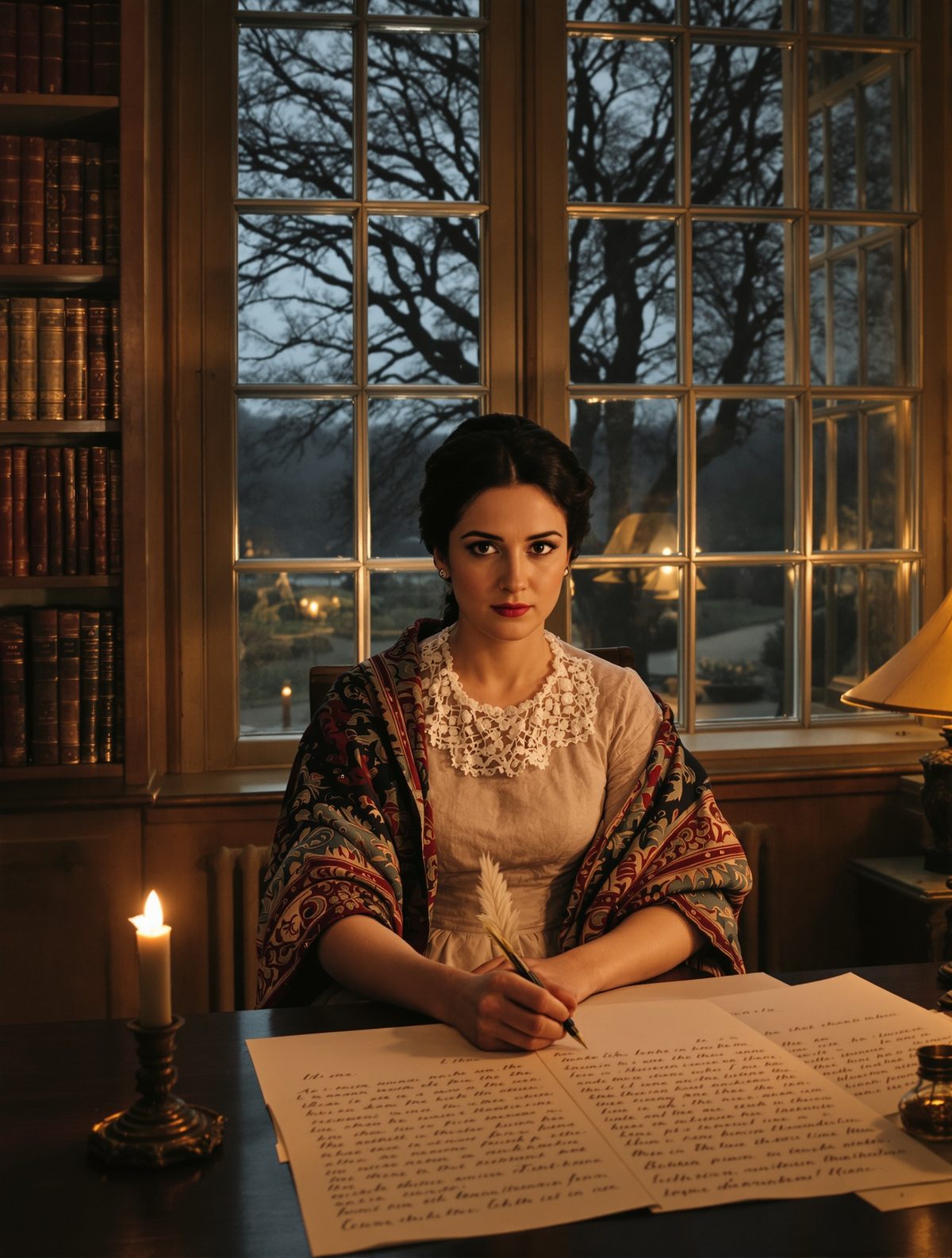
Imagine the London of the late 1790s, a city engulfed in a frenzy not over a political upheaval or a royal scandal, but a novel. As readers huddle by candlelight, they find themselves irresistibly drawn into shadowy corridors, haunted chambers, and the terrors of the unknown — all conjured from the mind of a reclusive woman who rarely ventured beyond her armchair. Ann Radcliffe, the quiet, elusive architect of Gothic horror, was captivating a nation from her London home. But who was this woman, and how did she come to terrify a generation with her tales? Let's unravel the legend of the day Ann Radcliffe terrified a nation.
The Shy Scribe and Her Spectral World
Born in 1764 in Holborn, London, Ann Radcliffe was not the typical figure one might expect to revolutionise literature. Unlike many adventurers of her time, Ann preferred the comfort of her own room, finding solace and inspiration in the written word rather than in society’s bustling gatherings. Her husband, William Radcliffe, was a journalist, and it is said he encouraged her to channel her vivid imagination onto paper. Little did the world know that behind her demure, reserved façade lay the mind of a storyteller who would redefine fear.
In 1789, she published her first novel, “The Castles of Athlin and Dunbayne,” introducing what would become her signature elements: persecuted heroines, moody landscapes, and mysterious, albeit sublime, realms. However, it was her subsequent works, including “The Mysteries of Udolpho” (1794) and “The Italian” (1797), that cemented her status as a pioneer of Gothic literature. Her storytelling struck a chord reminiscent of a haunting melody, echoing through the chambers of the national psyche and igniting an insatiable appetite for the eerie and the unexplained.
Gothic Ghosts and Enigmatic Echoes
Ann Radcliffe’s genius lay in her ability to weave suspense with the uncanny, crafting narratives that left readers teetering on the edge of their seats. Her novels frequently depicted heroines confined in dilapidated castles, confronted with threats both tangible and spectral. This was revolutionary; at a time when Europe was rife with political upheaval, Radcliffe’s tales provided an escape, a parallel universe where existential dread could be safely explored.
Read next: The Day a Baronet Stood Up in Court and Freed His Slaves
Perhaps surprisingly, it was not her characters that captured Victorian readers most — it was her bewitching settings. She painted landscapes with her words, creating environments that felt palpable, teeming with foreboding. Her adept use of atmosphere and semiotics laid the foundation for future storytelling, inspiring literary greats like Keats and Byron. Upon the publication of “The Mysteries of Udolpho,” critics lauded her ability to render the *fantastique*, the entrancing horror that she so deftly depicted.
The Heiress of Hauntings: Commercial Success
In a world dictated by social standing and financial constraint, Ann Radcliffe broke barriers, becoming England's highest-paid novelist prior to the rise of Charles Dickens. Her publisher offered her £500 for “The Mysteries of Udolpho,” an astronomical sum equivalent to more than £90,000 today. Her novels sold in days, leaving booksellers scrambling to quench the public’s thirst for her ghostly concoctions.
Her influence was profound, permeating various strata of culture. While tales of haunted castles captivated the elite, they also provided common folk with an engaging narrative escape. The widespread appeal of her books was without precedent, mesmerizing an audience eager to delve into the depths of their own fears and fascinations within the safety of a story.
The Mystery of an Author’s Silence
In what might be known as her most haunting mystery, Ann Radcliffe stopped writing. After the successful release of “The Italian” in 1797, she withdrew from the literary world altogether. The cause of her silence remains shrouded in speculation. Some attributed it to her desire for privacy; others suggested perhaps she had said all she wished to or that she simply felt overwhelmed by the specter of her own success. It was said that Radcliffe never enjoyed public attention, making her retreat as intriguing as her works themselves.
Yet her disappearance from the public eye only fueled the public’s fascination, with her novels continuing to influence long after her last penned word. Scholars and readers alike were left to ponder: Was Radcliffe herself a victim of the very gothic intrigue she so masterfully constructed?
The Legacy Beyond the Shadows
Ann Radcliffe died in 1823, leaving behind a legacy as ethereal as the spirits she wrote about. While she receded into personal obscurity, her impact on the literary world remains indelible. Her unique ability to blend terror with psychological depth laid the groundwork not only for Gothic horror but also for modern suspense. In many ways, she provided a cultural crucible — a means for society to grapple with its innermost fears without ever uttering them aloud.
Why does Ann Radcliffe’s work matter today? At its core, her writing reflects humanity's age-old fascination with the macabre, the mysterious, and the mirage of the unexplainable. Her stories echo through time, reminding us of the power of imagination and the impact of venturing into the shadows to discover truths about ourselves. In our contemporary world of rapid technological advancement and shifting paradigms, the harrowing beauty of Radcliffe’s prose offers a timeless reminder of where fear, imagination, and literature intersect. Truly, from her armchair in London, Ann Radcliffe terrified a nation — and, in the process, shaped literary history.