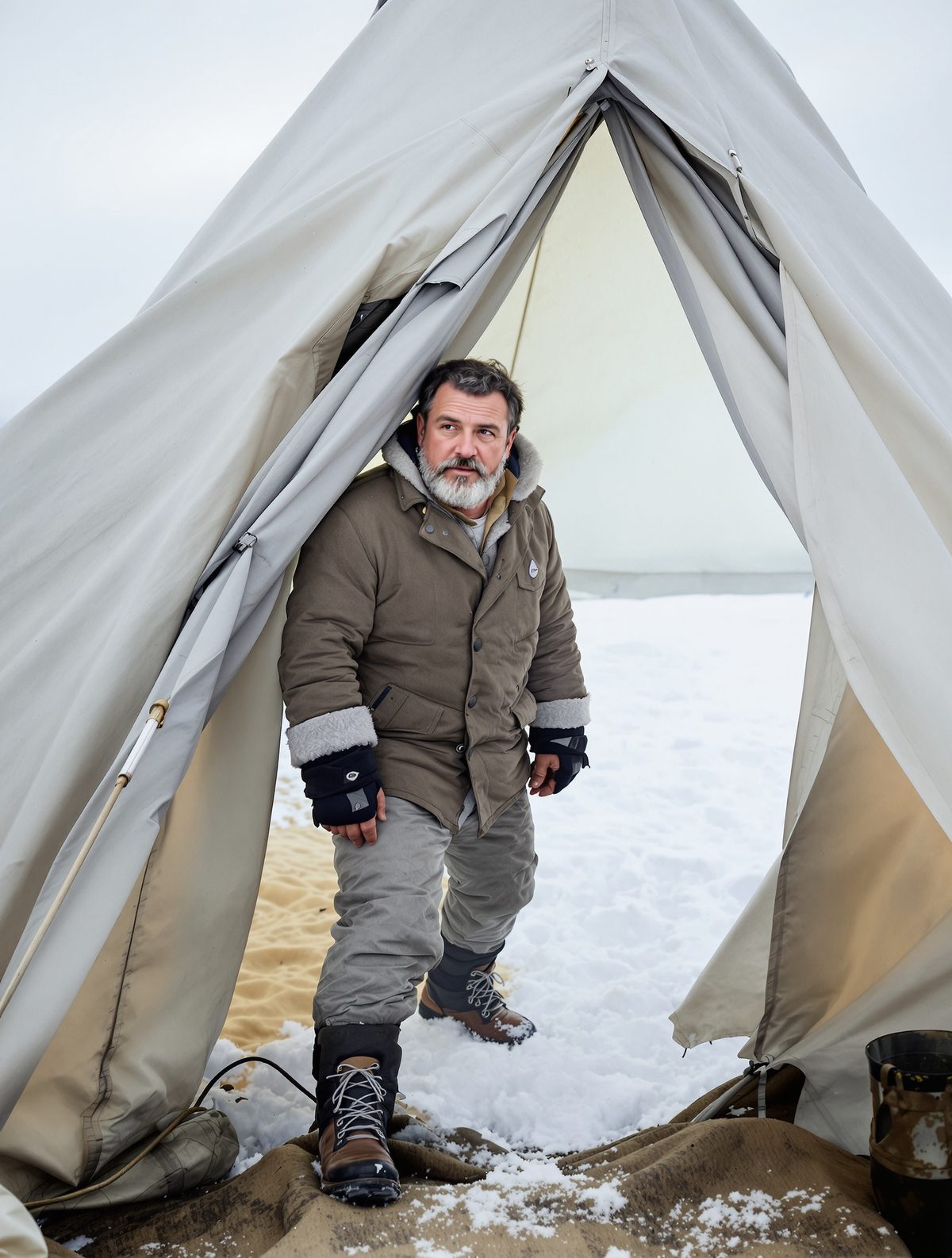
The wind howled across the Ross Ice Shelf with the fury of a thousand demons, carrying ice crystals sharp enough to strip flesh from bone. Inside a frost-covered tent, five men huddled around the dying flame of their spirit stove, their breath forming crystalline clouds in the minus-forty air. One man's feet had turned black with frostbite, gangrenous and swollen beyond recognition. He knew what he had to do.
Captain Lawrence Edward Grace "Titus" Oates was facing the most important decision of his life—and quite possibly the most heroic act of self-sacrifice in human history.
The Cavalry Officer Who Conquered Hearts Before Ice
Long before Oates became synonymous with Antarctic heroism, he was cutting his teeth in the muddy trenches of the Second Boer War. Born into wealth in 1880 at Meanwood in Leeds, Oates could have lived a life of comfortable privilege. Instead, he chose the brutal realities of military service, joining the 6th Inniskilling Dragoons at just 18 years old.
What many don't know is that Oates earned his nickname "Titus" not from classical literature, but from his resemblance to the notorious Titus Oates, the 17th-century conspirator. The irony is striking—while his namesake was remembered for treachery, Lawrence Oates would become the very definition of loyalty and sacrifice.
Read next: The Night the British Ate the President's Dinner
In South Africa, Oates demonstrated the same unflinching courage that would later define his final moments. During the Battle of Magersfontein, he was shot through the thigh, the bullet shattering his femur so severely that his left leg remained an inch shorter for the rest of his life. He would walk with a slight limp forever—a detail that makes his selection for Scott's polar expedition even more remarkable.
When Captain Robert Falcon Scott was assembling his Terra Nova expedition team in 1909, he needed men who could handle horses in the Antarctic. Oates, by then a seasoned cavalry officer, seemed perfect for the job. There was just one catch: Scott wanted £1,000 from each expedition member to help fund the venture. For context, that's roughly £120,000 in today's money. Oates paid without hesitation.
When Machines Failed, Heroes Emerged
Scott's plan for reaching the South Pole was ambitious but fatally flawed. He placed enormous faith in motor sledges—primitive tracked vehicles that were supposed to revolutionize polar exploration. The reality proved far different. The machines broke down almost immediately in the brutal Antarctic conditions, leaving the expedition dependent on ponies, dogs, and ultimately, human endurance.
Oates had been skeptical of Scott's Siberian ponies from the beginning. These animals, while strong, were utterly unsuited to Antarctic conditions. Their hooves broke through snow crusts, they sweated (which froze instantly), and they required enormous amounts of feed. Oates watched with growing frustration as his beloved animals suffered and died one by one.
By November 1911, when the polar party began their final push to the South Pole, all the ponies were dead. Scott selected five men for this ultimate journey: himself, Petty Officer Edgar Evans, Lieutenant Henry "Birdie" Bowers, Dr. Edward Wilson, and Captain Lawrence Oates. What they didn't know was that Norwegian explorer Roald Amundsen was already racing ahead of them with a perfectly organized dog-sledge operation.
The British team reached the South Pole on January 17, 1912, only to find the Norwegian flag already planted there. Amundsen had beaten them by 34 days. In his diary, Scott wrote the crushing words: "Great God! This is an awful place and terrible enough for us to have laboured to it without the reward of priority."
The 800-Mile Death March
The journey back from the South Pole became one of the most harrowing survival stories ever recorded. The weather turned viciously cold—temperatures plummeted to minus-47°F (-44°C). The men were hauling a 200-pound sledge across ice that felt like concrete, making barely ten miles a day when they needed to cover twice that distance to reach their supply depots in time.
Petty Officer Evans was the first to deteriorate seriously. The big sailor, who had been the strongest member of the party, began showing signs of severe concussion from a fall into a crevasse. He died on February 17 at the foot of the Beardmore Glacier, leaving four men to continue the nightmare journey.
By early March, Oates was in agony. His old war wound was hampering his mobility, but worse were his feet. The frostbite had set in with merciless efficiency, turning his toes black with gangrene. Every step was torture, but he never complained. His companions watched helplessly as the tough cavalry officer grew weaker by the day.
What makes Oates's situation even more tragic is that we now know frostbite was particularly devastating to him because of his previous injury. The damaged circulation in his left leg made him especially vulnerable to the cold. Modern medical knowledge might have saved him, but in 1912, there was no hope of recovery.
The Ultimate Sacrifice
By March 15, 1912, the remaining four men were camped just 11 miles from One Ton Depot, which contained food and fuel that could have saved their lives. But they were trapped by a blizzard, and Oates could barely stand. He knew the terrible mathematics of their situation: his failing strength was condemning all four men to death.
For two days, Oates endured unbearable pain while wrestling with an impossible decision. His feet were so badly frostbitten that Wilson had to help him put on his boots each morning. Scott wrote in his diary: "Poor Oates is unable to pull, sits on the sledge when we are track-searching—he is wonderfully plucky, as his feet must be giving him great pain."
Read next: The Day a One-Eyed Admiral Sailed Into the Line of Fire
On the morning of March 17, 1912—his 32nd birthday—Oates woke to another howling blizzard. The temperature was minus-40°F. He had made his decision. According to Scott's diary, Oates said simply: "I am just going outside and may be some time." He walked out of the tent and into the Antarctic wilderness, never to be seen again.
What many people don't realize is that Scott initially wanted to include Oates's actual last words in his diary, but they were far more explicit about his intentions. The polished version we know today was likely edited for public consumption. The raw truth was that Oates told his companions he was going to die, and he hoped his sacrifice would give them a chance to reach safety.
The Legend That Outlived the Man
Oates's sacrifice didn't save his remaining companions. Scott, Wilson, and Bowers died in their tent just days later, only 11 miles from salvation. Their bodies were discovered eight months later by a search party, along with Scott's meticulously kept diary that preserved Oates's final act for history.
But here's what the textbooks often miss: Oates's body has never been found. Despite numerous search expeditions over the past century, he remains somewhere in the vast Antarctic ice. Some experts believe his remains are slowly moving toward the Ross Sea, carried by the inexorable flow of the ice sheet. In a sense, Captain Lawrence Oates is still traveling, still moving forward, just as he did in his final moments.
The impact of his sacrifice resonated far beyond the Antarctic. When news reached Britain in 1913, Oates became an instant hero. His final words became a byword for British stoicism and self-sacrifice. During both World Wars, his example inspired countless servicemen facing their own impossible choices.
Today, visitors to Antarctica can see the Lawrence Oates Land, named in his honor, and the Oates Coast stretches for hundreds of miles along the continent's edge. But perhaps the most fitting memorial is the simple wooden cross erected by the search party, bearing the inscription: "Hereabouts died a very gallant gentleman."
In our modern world of GPS tracking and satellite rescue beacons, it's almost impossible to comprehend the isolation these men faced. Oates walked into that blizzard knowing there would be no miraculous rescue, no second chances. His decision reminds us that true heroism isn't about grand gestures or public recognition—it's about doing what's right when no one will ever know, when the only witness is your own conscience and the howling wind.