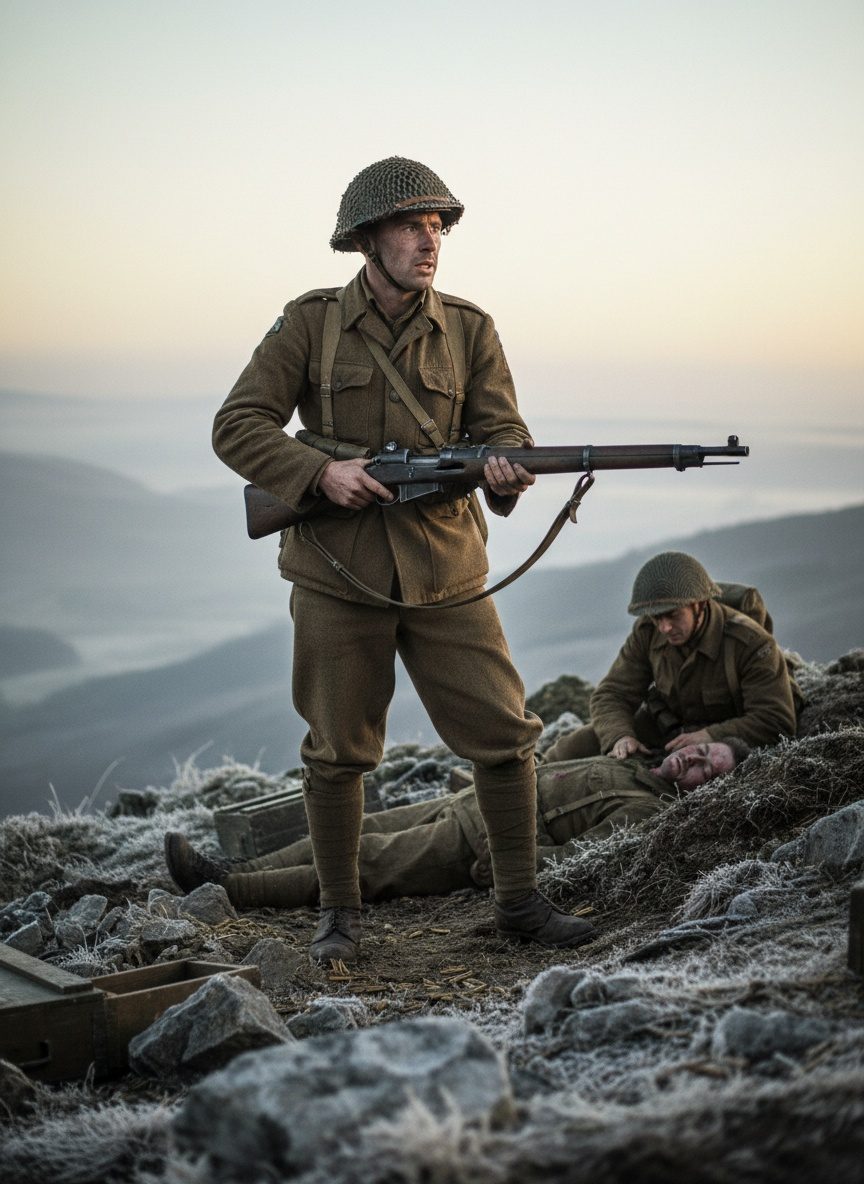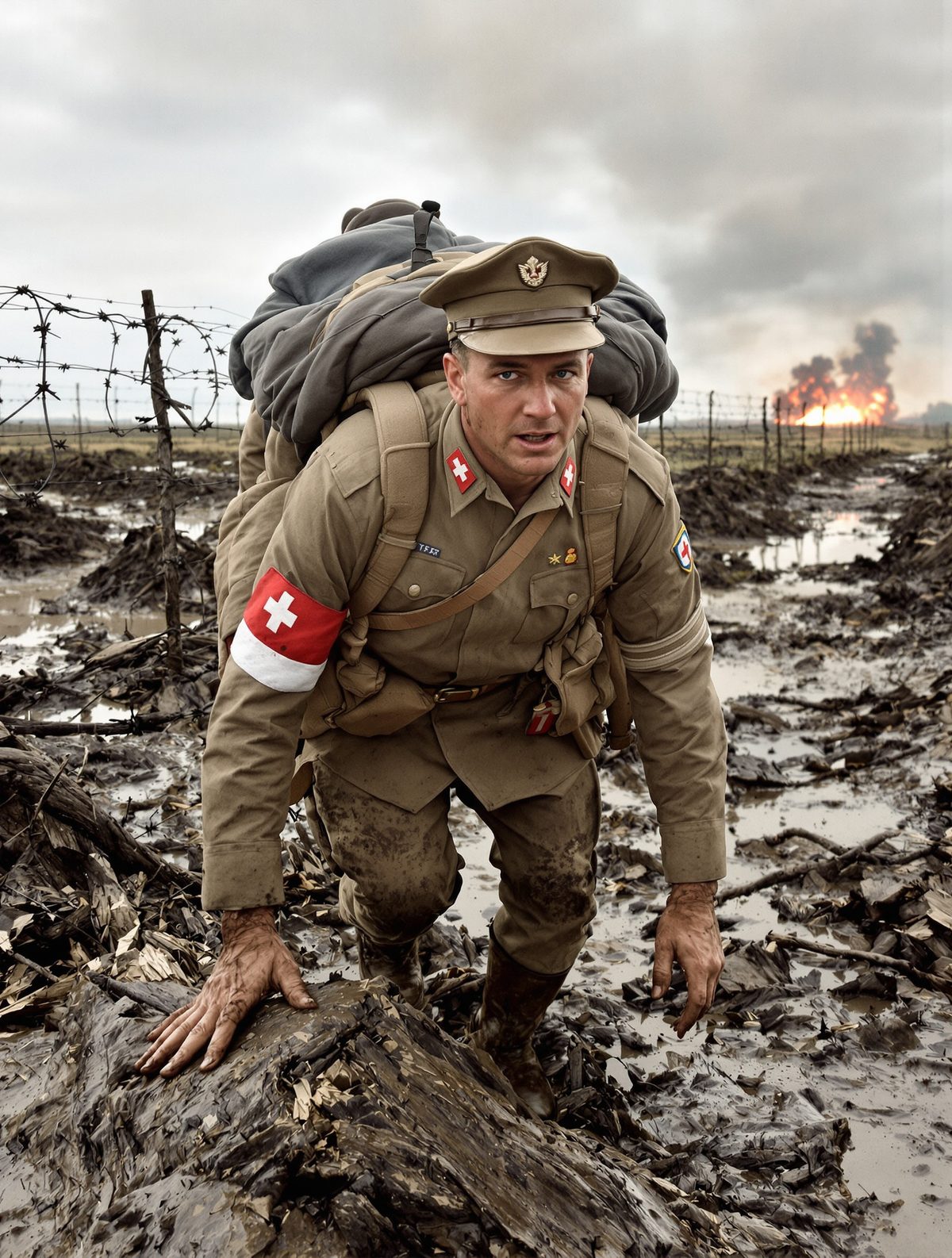
The machine gun bullets whistled overhead like deadly hornets as Captain Noel Chavasse crawled on his belly through the churned mud of no man's land. Shattered bodies lay scattered across the wasteland between the trenches, men crying out for help in the darkness. Most would have stayed in the relative safety of the British lines. But Chavasse wasn't most men. He was already a Victoria Cross holder, already a hero. He had nothing left to prove—except to himself.
What happened next in those blood-soaked fields of Belgium would make him the only person in history to win Britain's highest military honour twice. It would also cost him his life.
The Doctor Who Couldn't Stop Saving Lives
Captain Noel Godfrey Chavasse was born into a family that seemed destined for greatness. His father was the Bishop of Liverpool, his twin brother would become an Olympic sprinter, and Noel himself had already carved out a reputation as one of Britain's most decorated medical officers by 1917. Standing just 5'6" with a slight frame, he hardly looked like a warrior. But appearances, as the Germans would learn, could be devastatingly deceptive.
Chavasse had joined the Royal Army Medical Corps in 1913, fresh from Oxford University where he'd studied medicine. When war broke out, he found himself attached to the 1/10th Battalion, King's (Liverpool Regiment)—the Liverpool Scottish. It was here, in the brutal theatre of the Western Front, that his legend began to grow.
Read next: The Night a Teenage Gunner Held the Bridge at Arnhem
His first Victoria Cross came during the Battle of Guillemont in August 1916, when he spent two days crawling into no man's land to rescue wounded soldiers. The citation described how he "carried an injured man 500 yards to safety, being wounded in the side by a shell splinter during the journey." But that was just the beginning of his heroics that day.
Into the Hell of Passchendaele
By July 1917, the British forces were preparing for what would become known as the Third Battle of Ypres—or more infamously, Passchendaele. The very name would come to symbolize the futility and horror of trench warfare. Field Marshal Douglas Haig's grand plan was to break through German lines in Belgium and capture the ports being used as German submarine bases.
What followed was three months of unimaginable carnage. The preliminary bombardment had destroyed the drainage systems in the low-lying Belgian countryside, turning the battlefield into a hellish swamp of mud, blood, and dismembered bodies. Men didn't just die at Passchendaele—they disappeared, swallowed whole by shell craters filled with contaminated water.
Captain Chavasse and the Liverpool Scottish found themselves in the thick of it on July 31st, 1917, the opening day of the offensive. The attack at Pilckem Ridge was meant to be a breakthrough. Instead, it became a slaughter. As dawn broke over the Belgian countryside, thousands of British soldiers advanced into a storm of German machine gun fire.
Three Days in Hell
What happened over the next 72 hours defied belief. As the attack faltered and British soldiers fell wounded or dying across no man's land, Chavasse made a decision that would define the rest of his short life. He would bring them home, one by one, no matter the cost.
Witnesses later described seeing the diminutive doctor crawling through the maze of shell holes and barbed wire, often under direct enemy fire. He would locate a wounded man, apply field dressings, then drag or carry him back to the British lines. Then, incredibly, he would turn around and go back for another.
On the first day alone, he rescued more than 20 wounded soldiers. But Chavasse wasn't content to work only under cover of darkness. In broad daylight on August 1st, he ventured out again and again, each journey a potential death sentence. German snipers had learned to watch for him, but somehow the doctor seemed to bear a charmed life.
His commanding officer later wrote: "I have never seen such complete disregard for personal safety. Chavasse moved through that hellish landscape as if he were tending patients in a London hospital ward." But there was nothing routine about what he was doing. Each rescue required him to crawl hundreds of yards through sucking mud while machine gun bullets whined overhead and artillery shells exploded around him.
The Final Rescue
By August 2nd, exhaustion was taking its toll. Chavasse had barely slept or eaten for three days. His uniform was caked with mud and blood—some his own from minor shrapnel wounds, most belonging to the men he'd saved. Any reasonable person would have stopped. But reason had little place in the hell of Passchendaele.
It was during his final rescue attempt that disaster struck. As he dragged another wounded soldier back toward the British lines, a German shell exploded nearby. Shrapnel tore into his stomach and skull, inflicting wounds that would prove fatal. Yet even then, incredibly, he managed to complete the rescue before collapsing.
Fellow soldiers rushed to help the man who had saved so many of them. They carried him to a casualty clearing station behind the lines, where surgeons fought to save his life. But the wounds were too severe. Captain Noel Chavasse died on August 4th, 1917, just four days after his extraordinary display of courage began.
In those final hours, delirious with pain, he reportedly kept asking about his men: "Are they safe? Did we get them all?" It was estimated that during those three days at Pilckem Ridge, he had personally rescued over 30 wounded soldiers and attended to countless others in the trenches.
A Legacy Written in Blood and Mud
The second Victoria Cross was awarded posthumously, making Captain Noel Chavasse the only person ever to receive Britain's highest military honour twice. The citation read in part: "His heroism and self-sacrifice were beyond praise." But perhaps more remarkably, in an age when military decorations were often influenced by social class and connections, Chavasse's awards were based purely on witnessed acts of extraordinary courage.
His grave in Brandhoek New Military Cemetery in Belgium bears a simple inscription: "Greater love hath no man than this, that a man lay down his life for his friends." But the true measure of his legacy lies not in the bronze and ribbon of his medals, but in the dozens of men who returned home to their families because one small doctor refused to abandon them in no man's land.
Today, when we debate the nature of heroism and self-sacrifice, Noel Chavasse's story serves as a stark reminder that true courage isn't about grand gestures or glory. It's about crawling through hell one more time because someone needs help. It's about choosing compassion over self-preservation, even when—especially when—the cost might be everything you have to give.
In our modern world of instant fame and manufactured celebrity, perhaps we need to remember the doctor who became a legend not by seeking glory, but by simply refusing to let his fellow human beings die alone in the mud of Passchendaele.