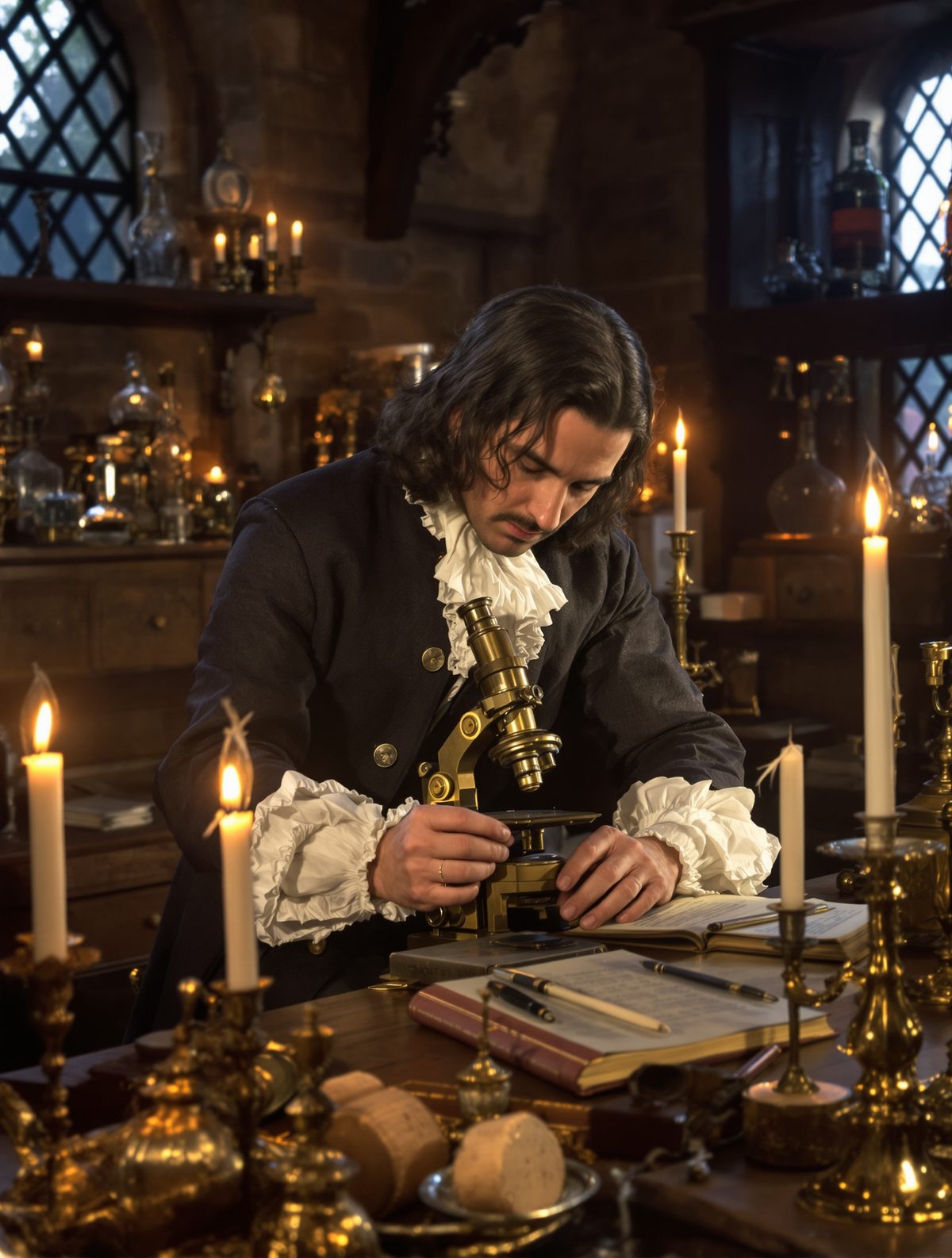
The candle flickered in the cramped laboratory, casting dancing shadows across the polished brass of an extraordinary contraption. It was a crisp September evening in 1665, and London still reeked of the Great Plague's devastation. But in a narrow room at Gresham College, headquarters of the fledgling Royal Society, Robert Hooke was about to witness something no human eye had ever seen. As he carefully positioned a paper-thin slice of cork beneath his handcrafted microscope and leaned forward to peer through the eyepiece, he had no idea he was about to coin a word that would revolutionise our understanding of life itself.
What Hooke saw in that magnified sliver of cork bark would echo through centuries of scientific discovery. Tiny, perfectly ordered chambers stretched before him like the rooms of some miniature monastery. "These pores, or cells," he would later write, appeared "not very unlike a Honey-comb." With those simple words, the term "cell" entered the scientific lexicon forever, though Hooke couldn't have imagined he was looking at the fundamental building blocks of all living things.
The Curator of Experiments Who Saw Everything
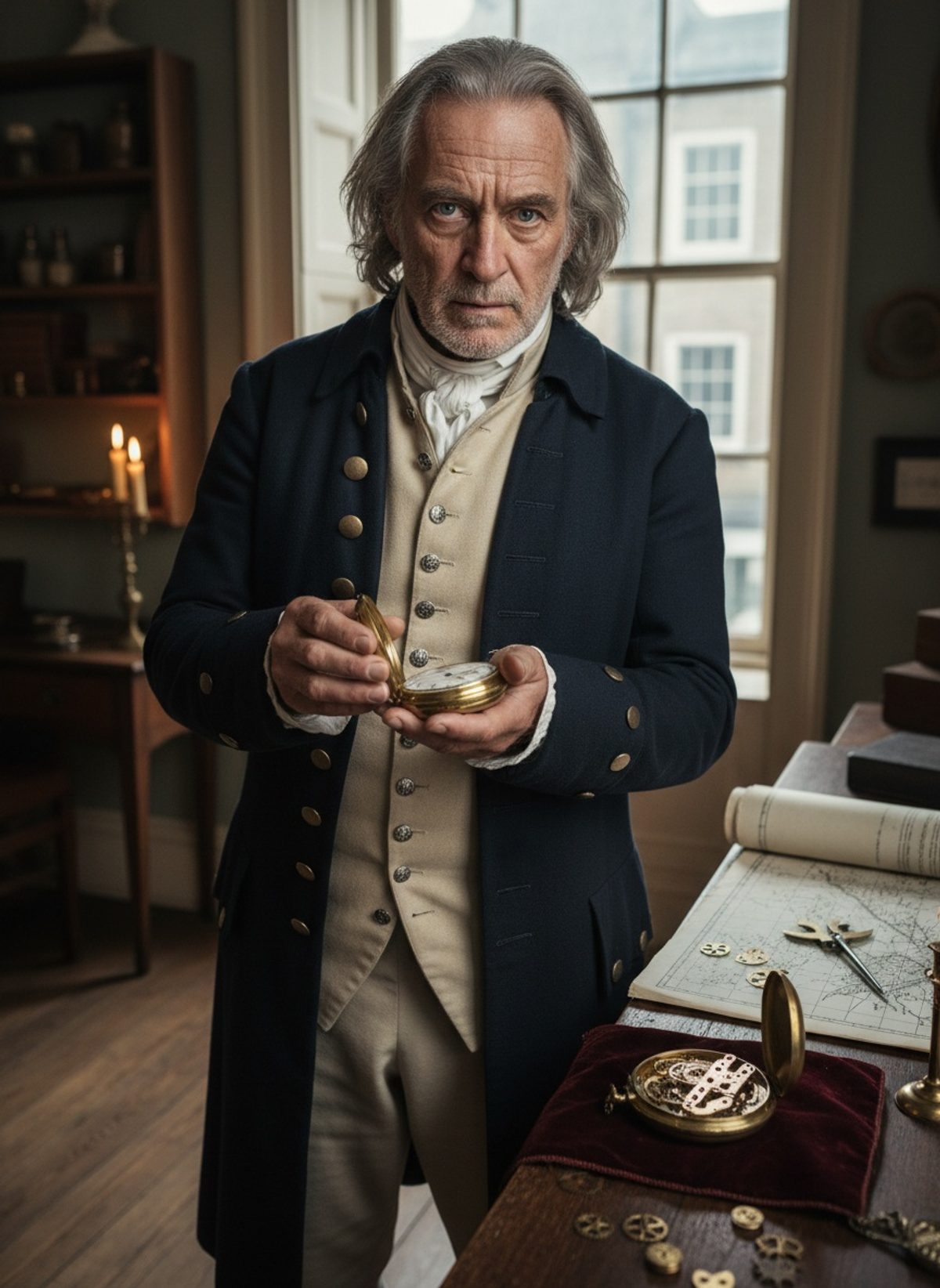
Robert Hooke was no ordinary natural philosopher. Born in 1635 on the Isle of Wight to a curate's family of modest means, this sickly child with a pronounced stoop would grow up to become one of history's most ingenious experimenters. By 1665, at just thirty years old, Hooke held the prestigious position of Curator of Experiments at the Royal Society—essentially, he was paid to be curious about everything.
And curious he was. Hooke's mind bounced between subjects like a hyperactive butterfly: he studied the mechanics of springs, charted the movement of planets, designed buildings (including portions of St. Paul's Cathedral after the Great Fire), and investigated the mysterious force that would later be called gravity. But it was his obsession with seeing the unseen that produced his masterpiece.
Read next: The Day a Deaf Man Gave the World Its First Electric Motor
The microscope itself was still a novelty in 1665. Dutch lens-grinders had pioneered the technology only decades earlier, and most examples were little better than sophisticated magnifying glasses. But Hooke, with his background in optics and mechanical engineering, crafted something extraordinary. His compound microscope could magnify objects up to 50 times their original size—a staggering achievement for the era.
The Miraculous Machine That Revealed Hidden Worlds
Hooke's microscope was a marvel of 17th-century engineering. Standing about fourteen inches tall, it featured a brass tube containing carefully ground lenses, adjustable focusing mechanisms, and an ingenious oil lamp system for illumination. Unlike the simple single-lens microscopes of his Dutch contemporary Antoni van Leeuwenhoek, Hooke's compound design used multiple lenses to achieve higher magnification—though this came at the cost of some clarity.
The preparation of specimens required extraordinary skill and patience. Hooke would spend hours creating samples thin enough for light to penetrate, using razors and needles to slice materials to near-transparency. His steady hands and obsessive attention to detail allowed him to examine everything from insect wings to plant fibers, each observation revealing structures that seemed almost impossibly intricate.
On that fateful evening, Hooke chose cork for a practical reason: it was abundant, easy to slice, and held its shape well under the microscope. Cork came from the bark of Mediterranean oak trees and was commonly used for bottle stoppers—hardly the stuff of scientific revolution. Yet as Hooke adjusted the focus and positioned his oil lamp to cast the perfect amount of light, he was about to make one of biology's most fundamental discoveries.
The Moment That Changed Biology Forever
What Hooke witnessed through his eyepiece defied everything scientists thought they knew about the nature of matter. The cork wasn't solid at all, but composed of countless tiny chambers arranged in precise, geometric patterns. "I could exceedingly plainly perceive it to be all perforated and porous," he wrote in his meticulous notes, "much like a Honey-comb, but that the pores of it were not regular."
The structures reminded him of the sparse chambers where monks lived in monasteries—small, individual rooms called cells. It was this architectural comparison that inspired his choice of terminology. "These pores, or cells... were indeed the first microscopical pores I ever saw," Hooke recorded. He had no way of knowing that what he observed were actually the dead cell walls of once-living plant tissue, the empty husks left behind after the living contents had long since disappeared.
Hooke counted the cells with characteristic precision, estimating that a single cubic inch of cork contained over one billion of these tiny chambers. The mathematical implications staggered him. If such incredible complexity existed in a simple piece of bark, what hidden structures might exist in other materials? His mind raced with possibilities.
Micrographia: The Book That Stunned the World
Hooke's cork observation was just one of many revelations he compiled into his masterwork, "Micrographia," published in early 1665. This extraordinary book contained fifty-seven detailed observations of the microscopic world, each accompanied by Hooke's own intricate illustrations. From the compound eyes of flies to the crystalline structure of frost, Hooke revealed a universe of hidden complexity.
The book became an instant sensation. Samuel Pepys, the famous diarist, called it "the most ingenious book that ever I read in my life." King Charles II himself was reportedly fascinated by Hooke's discoveries. The foldout illustration of a flea, magnified to show its horrifying detail, both delighted and terrified London society. Ladies at court would gather around copies, simultaneously repulsed and entranced by these glimpses into the invisible world that surrounded them.
But it was the modest observation of cork cells that would prove most enduring. Hooke's careful description and detailed illustration provided the first systematic documentation of cellular structure. Though he didn't understand the full implications of his discovery, he had identified the fundamental organizational principle of life itself.
The Discovery That Almost Wasn't
Remarkably, Hooke's cellular discovery nearly vanished into scientific obscurity. The Great Fire of London in September 1666 destroyed much of the city, including many copies of "Micrographia." Hooke himself became consumed with architectural projects, helping Christopher Wren rebuild London's churches and designing the Royal Observatory at Greenwich. His wide-ranging interests, while making him one of history's most versatile scientists, also meant that he rarely followed up on individual discoveries.
Moreover, the true significance of cells wouldn't be understood for another two centuries. It wasn't until the 1830s that German scientists Matthias Schleiden and Theodor Schwann would propose that all plants and animals were composed of cells, and that cells were the basic units of life. Hooke had seen the architecture, but the builders—the living, breathing cellular machinery—remained hidden from his view.
The irony is profound: Hooke observed the aftermath of cellular life, the empty rooms left behind after their inhabitants had departed. He was like an archaeologist studying an abandoned city, able to marvel at the construction but unable to witness the vibrant life that once filled those chambers.
The Legacy of a Single Glance
Today, as we map the human genome and engineer living organisms with precision that would seem like magic to Hooke, it's worth remembering that it all began with a curious man peering at cork by candlelight. Every breakthrough in modern medicine, from antibiotics to cancer treatments, traces back to that fundamental understanding that life is built from cells.
Hooke's legacy extends far beyond biology. His approach—meticulous observation, careful documentation, and fearless curiosity—established the template for modern scientific investigation. He proved that the universe held layers of complexity invisible to the naked eye, and that human ingenuity could build tools to reveal them.
In our age of electron microscopes and molecular imaging, when we can watch individual atoms dance and observe the machinery of life in real-time, Robert Hooke's simple observation of cork cells might seem quaint. But that September evening in 1665 represents something profound: the moment humanity first glimpsed the hidden architecture of life itself. In a world ravaged by plague and ignorance, one man's curiosity illuminated a path toward understanding that we're still following today.