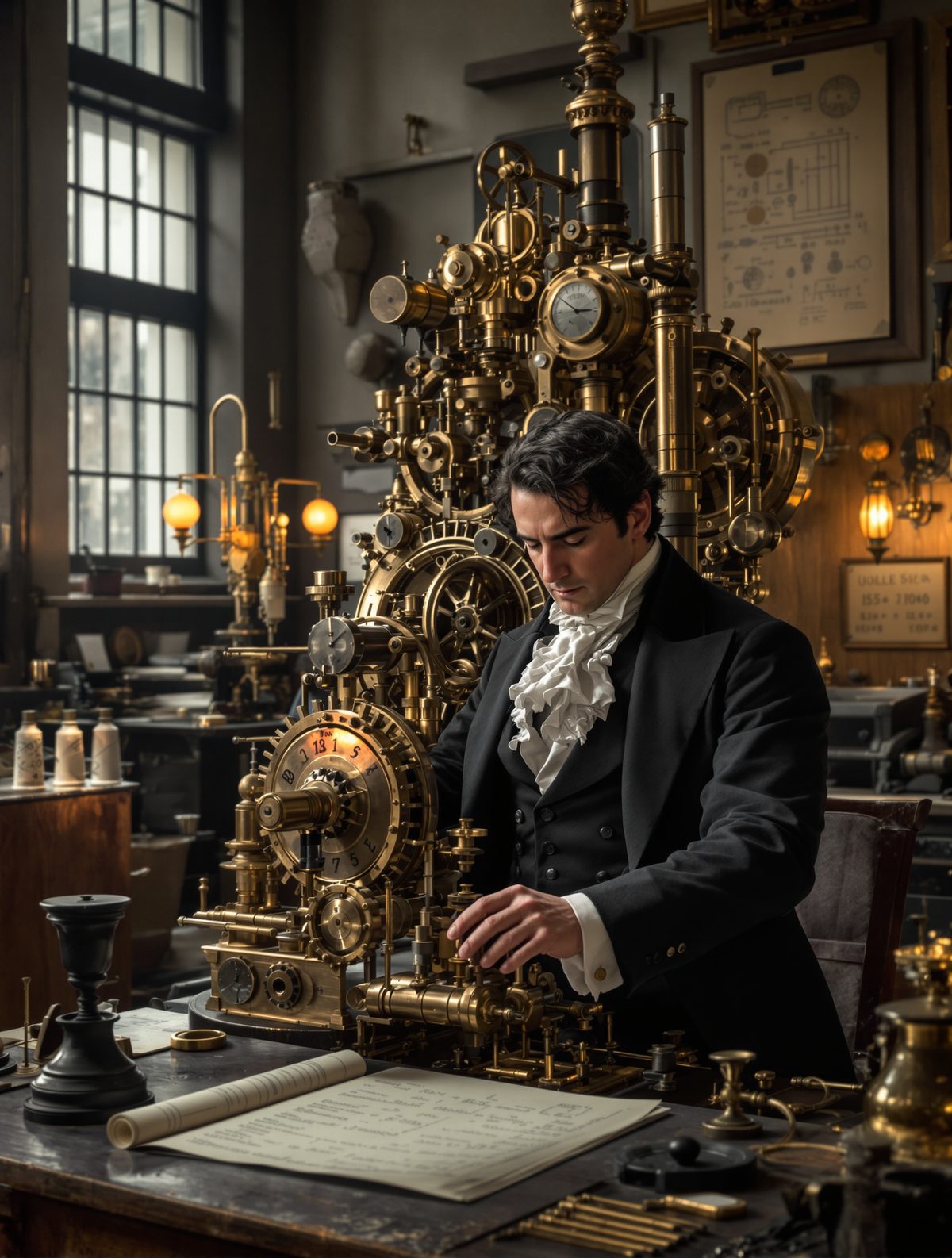
The brass wheels clicked and whirred as Charles Babbage adjusted another gear in his London workshop. Steam hissed from the prototype engine that powered his creation, casting dancing shadows across walls lined with mathematical diagrams and mechanical drawings. It was 1837, and in this cluttered room at 1 Dorset Street, Marylebone, something extraordinary was taking shape—a machine that could think, learn, and remember. While his contemporaries were still using abacuses and slide rules, Babbage was building the world's first computer, complete with memory storage and programmable instructions. He just didn't know that personal computers wouldn't catch up to his vision for another 140 years.
The Mathematician Who Saw Tomorrow
Charles Babbage was no ordinary Victorian gentleman. Born in 1791, this Cambridge mathematics professor possessed a mind that seemed to operate several centuries ahead of his time. While walking through the countryside in 1821, he became frustrated with the endless mathematical errors in astronomical tables—mistakes that were costing ships their lives at sea and making precise navigation nearly impossible.
"I wish to God these calculations had been executed by steam," he reportedly exclaimed to his friend John Herschel. It wasn't just an expression of frustration—it was a declaration of war against human error, and the beginning of an obsession that would consume the next four decades of his life.
Babbage's first creation, the Difference Engine, was already revolutionary enough. This mechanical calculator, standing eight feet high and weighing several tons, could perform polynomial functions and print results automatically. The British government was so impressed they funded it with £17,000—equivalent to about £1.5 million today. But by 1833, something far more ambitious was stirring in Babbage's mind. The Difference Engine could only follow fixed instructions. What if a machine could change its own instructions based on its calculations?
Read next: The Day a Deaf Man Gave the World Its First Electric Motor
The Impossible Machine Takes Shape
In his workshop, surrounded by the industrial symphony of Victorian London, Babbage began sketching the blueprints for something that defied imagination. The Analytical Engine would stand nearly fifteen feet tall, powered by a steam engine, and comprised of over 25,000 precision-crafted metal parts. But size wasn't what made it remarkable—it was the revolutionary concept built into every gear and wheel.
The machine featured four distinct components that would be instantly recognizable to any modern programmer: the Mill (equivalent to a CPU), the Store (memory), the Reader (input device), and the Printer (output). The Mill could perform addition, subtraction, multiplication, and division, while the Store could hold 1,000 numbers of up to 40 digits each—a staggering amount of memory for an age when most calculations were done by hand.
Perhaps most remarkably, Babbage designed the Analytical Engine to read instructions from punched metal cards—an idea he borrowed from the Jacquard looms that were revolutionizing textile manufacturing in nearby factories. These cards could tell the machine to perform different operations based on the results of previous calculations. In essence, Babbage had invented the concept of the computer program a century before anyone knew what to call it.
The World's First Computer Programmer Wore a Ballgown
While Babbage was the architect of the computer age, he found his most brilliant collaborator in an unexpected place: the glittering ballrooms of London society. Ada Lovelace, daughter of the scandalous poet Lord Byron, possessed a mathematical genius that perfectly complemented Babbage's mechanical innovations.
Meeting at a party in 1833, the 17-year-old Ada was immediately captivated by Babbage's Difference Engine demonstration. Their intellectual partnership would prove to be one of history's most productive collaborations. Ada didn't just understand Babbage's machines—she saw possibilities he had missed entirely.
In 1843, Ada published what many consider the world's first computer program: a detailed algorithm for calculating Bernoulli numbers on the Analytical Engine. But her vision extended far beyond mathematics. "The Analytical Engine might act upon other things besides number," she wrote with startling prescience. "Supposing, for instance, that the fundamental relations of pitched sounds in the science of harmony and of musical composition were susceptible of such expression and adaptations, the engine might compose elaborate and scientific pieces of music of any degree of complexity or extent."
Ada Lovelace had essentially predicted digital music, artificial intelligence, and computer graphics—concepts that wouldn't become reality until the late 20th century.
The Tragedy of Perfect Timing
Babbage's greatest enemy wasn't technological—it was temporal. His mind operated with the logic of the digital age, but his hands were limited to the tools of the steam age. Creating the precision gears and wheels required for the Analytical Engine demanded a level of mechanical craftsmanship that barely existed in 1840s Britain.
Each component had to be hand-crafted by skilled metalworkers, with tolerances measured in fractions of millimeters. The government, already £17,000 into Babbage's previous project with little to show for it, began to lose patience. By 1842, funding had completely dried up. Babbage continued working with his own money, but the Analytical Engine remained forever trapped between blueprint and reality.
The steam-powered computer that could have launched the information age in the 1840s instead gathered dust in Babbage's workshop. When he died in 1871, many dismissed him as a brilliant eccentric whose reach had exceeded his grasp. The Times of London wrote dismissively of his "elaborate machines for performing calculations," completely missing the fact that they had just witnessed the death of computing's founding father.
Vindication in Silicon and Steel
For nearly a century, Babbage's vision remained buried in forgotten journals and dusty mechanical drawings. Then, in the 1940s, as electronic computers began emerging from wartime research labs, scientists started reading his notes with growing amazement. Every fundamental principle of computer design was there: stored programs, conditional branching, loops, memory addressing, even the separation of data and instructions.
In 1985, the Science Museum in London began an extraordinary experiment: they would build Babbage's Difference Engine No. 2 using only materials and techniques available in the 1840s. The project took 17 years and cost £500,000, but when completed, the machine worked flawlessly. Every calculation was perfect to 31 digits—proving that Babbage's designs weren't just theoretically sound, they were practically achievable even with Victorian technology.
The Analytical Engine remains unbuilt in its complete form, though working sections have been constructed. Modern estimates suggest the full machine would have weighed over four tons and required a steam engine the size of a small locomotive. Yet in terms of logical capability, it would have been equivalent to an electronic computer from the 1940s—a century ahead of schedule.
Standing in our age of smartphones and artificial intelligence, Babbage's story serves as both inspiration and warning. He proved that revolutionary ideas often arrive long before the world is ready to receive them. But perhaps more importantly, he showed us that the greatest innovations come not from following conventional wisdom, but from having the audacity to imagine machines that think, calculate, and dream—even when powered by nothing more than steam and Victorian ingenuity. In his cluttered workshop, surrounded by brass gears and impossible blueprints, Charles Babbage didn't just build a computer. He built the future, one precisely calibrated wheel at a time.