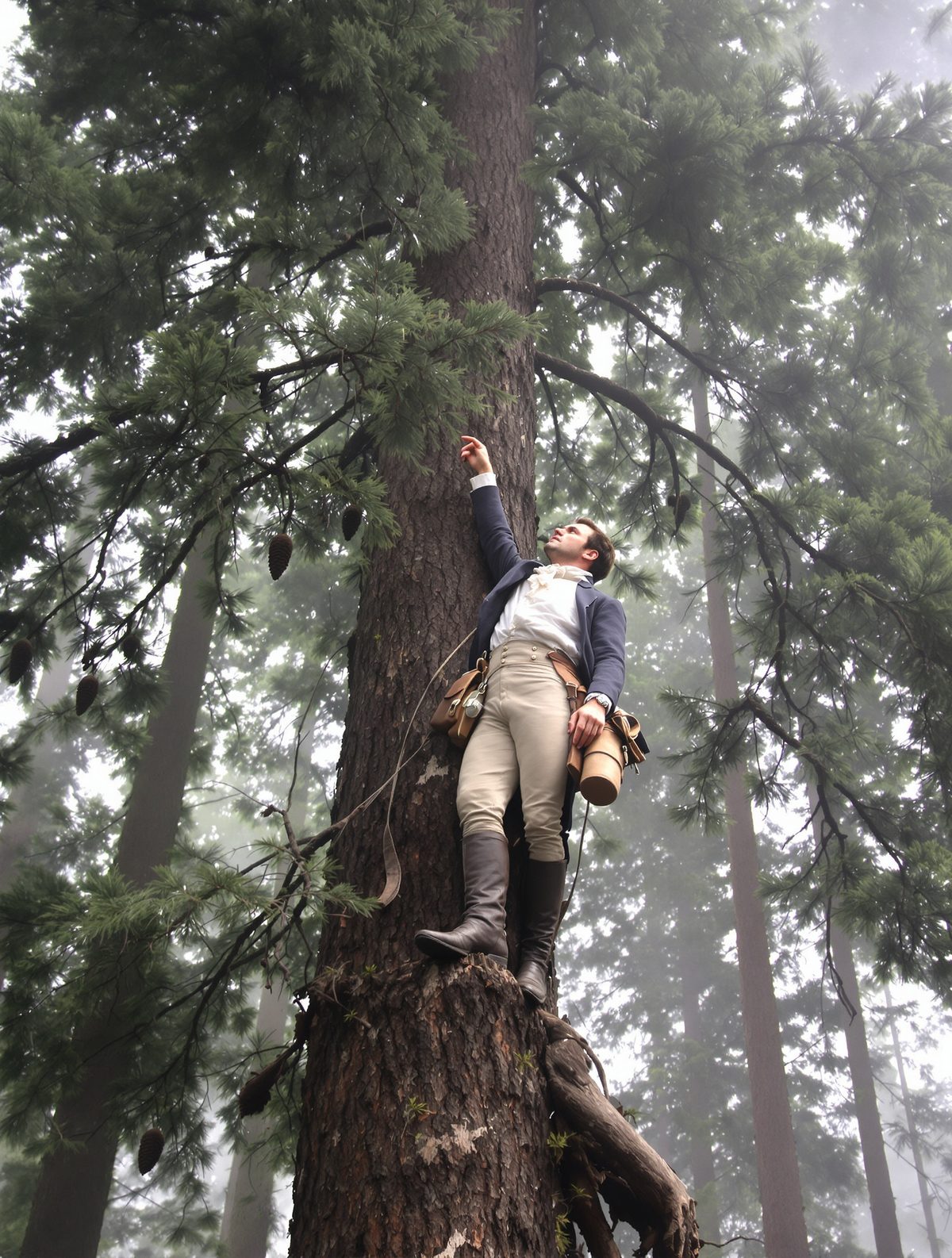
Picture this: a solitary Scottish botanist, 5,000 miles from home, stands at the base of the tallest tree he has ever seen. The ancient Douglas fir towers 270 feet above him, its massive trunk requiring eight men holding hands to encircle it. In its highest branches hang the precious cones he desperately needs—but there's no ladder, no rope, no safety equipment. Just David Douglas, his bare hands, and an obsession with plants that would make him attempt the seemingly impossible on this crisp October morning in 1826.
What happened next would not only save Douglas's reputation but transform the British landscape forever. The story of how one man's death-defying climb changed forestry history is a tale they somehow forgot to put in the textbooks.
The Plant Hunter's Impossible Mission
David Douglas wasn't supposed to be a hero. Born in 1799 to a stonemason in the Scottish village of Scone, he left school at 10 to work as an apprentice gardener. But this quiet, determined young man possessed something extraordinary: an ability to spot valuable plants that others missed entirely. By 1823, the prestigious Horticultural Society of London had noticed his talents and dispatched him on what seemed like a suicide mission—to collect plants from the uncharted wilderness of the Pacific Northwest.
The Pacific Coast in 1826 was no gentleman's garden party. This was the domain of grizzly bears, hostile weather, and terrain that could swallow a man without trace. The few European settlements were tiny Hudson's Bay Company outposts scattered across vast distances. Most 'civilised' men who ventured here did so with armed expeditions and military escorts. Douglas travelled alone, carrying little more than his plant press, notebooks, and an unshakeable belief that the world's most magnificent plants were waiting to be discovered.
Read next: The Day a Devon Captain Mapped the World's Last Shore
He had already spent months in the Oregon Territory, collecting specimens of flowers and shrubs that would later become garden staples across Britain. But Douglas knew his real prize was still out there—something that would justify the enormous expense and risk of his expedition. He just didn't know it would be waiting for him 270 feet in the air.
Giants in the Mist
When Douglas first encountered the coastal forests of Oregon, he literally couldn't find words. His journal entry from September 1826 simply read: "Trees of immense size... beyond anything I had previously seen." These weren't just big trees—they were living skyscrapers that dwarfed even the mightiest oaks of Britain. Some specimens stretched over 300 feet into the sky, their trunks so massive that entire families of settlers could have lived inside them.
But Douglas faced a maddening problem. The most magnificent trees kept their reproductive secrets locked away in cones that grew only in their uppermost branches, far beyond human reach. For weeks, he prowled beneath these giants like a frustrated child beneath a cookie jar, collecting fallen needles and broken twigs that told him nothing about how these monarchs reproduced.
The local Indigenous peoples—members of various tribes including the Umpqua and Klickitat—watched this strange pale man's obsession with growing curiosity. They had their own names for these giants and their own relationships with the forest, but they had never seen anyone quite so determined to possess what couldn't be possessed. Some began following Douglas at a distance, partly from suspicion but increasingly from fascination with his bizarre behaviour.
Then, on October 12th, 1826, Douglas found his tree. It stood alone in a clearing near present-day Cascade Locks, a perfect specimen of Pseudotsuga menziesii—though of course, it didn't have that name yet. To Douglas, it was simply the most beautiful tree he had ever seen, and hanging from its topmost branches were dozens of perfect cones, each containing seeds that could change everything.
The Climb That Defied Death
What Douglas did next violated every rule of common sense. With no climbing experience, no safety equipment, and no backup plan, he began ascending the tree that would later bear his name. The bark was thick and deeply furrowed, providing handholds, but also brittle enough to crumble without warning. One slip, one moment of weakness, and he would plummet to certain death.
By Douglas's own account, the climb took nearly two hours. His hands bled from gripping the rough bark. His legs trembled with exhaustion as he worked his way up, branch by careful branch, past the 100-foot mark where most normal trees ended, then past 150 feet where even church spires rarely reached. At 200 feet, the wind began to sway the tree alarmingly, and Douglas could see for miles across the Oregon wilderness—a view no European had ever experienced.
The watching Indigenous observers had long since concluded they were witnessing either complete madness or something approaching the supernatural. Word spread through the forest, and by some accounts, nearly fifty people had gathered to watch this extraordinary event. Some later told traders they had assumed Douglas was attempting to transform into a bird—the only logical explanation for such behaviour.
At 270 feet, Douglas finally reached the cones. His journal entry, written that evening with still-shaking hands, recorded the moment with typical British understatement: "Reached the top with considerable difficulty and obtained specimens." What he didn't record was the terror, the pain, or the fact that he had to climb down the same impossible route while clutching his precious cones in one hand.
The Seeds of Empire
Those pine cones contained more than seeds—they held the future of British forestry. Douglas carefully preserved dozens of seeds from his death-defying harvest and shipped them back to London, where they arrived in 1827 to considerable excitement. The Royal Horticultural Society immediately recognised their potential, and within years, Douglas fir seedlings were sprouting in estate gardens across Britain.
But the true impact wouldn't be visible for decades. Unlike native British trees, Douglas firs grew with startling speed and reached enormous heights even in Britain's climate. They thrived in poor soil where other trees failed, and their timber proved extraordinarily strong and versatile. Within fifty years, Douglas firs had become the backbone of Britain's timber industry, planted in vast stands across Scotland, Wales, and northern England.
The economic impact was staggering. A single mature Douglas fir could yield more usable timber than three native oaks, and they reached maturity in half the time. During both World Wars, Douglas fir forests provided crucial timber for everything from aircraft construction to mine supports. The tree that Douglas nearly died to collect had become a cornerstone of British industrial capacity.
Perhaps more remarkably, Douglas's seeds sparked a transformation in how people thought about forests. Before the Douglas fir, British forestry was about managing existing woodland. After it, forestry became about actively creating new landscapes—entire hillsides replanted with species from around the world, all because one man had been willing to climb into the sky for science.
The Price of Discovery
Douglas never lived to see his greatest triumph. The man who had survived countless dangers in the American wilderness died in 1834 in Hawaii, aged just 35, gored by a bull in a tragic accident that remains mysterious to this day. He had spent his brief adult life collecting over 200 plant species new to science, fundamentally reshaping British gardens and landscapes.
But his legacy towers over the British countryside like his namesake trees. Today, Douglas firs cover over 100,000 acres of British forest. They frame the horizons of Scotland, provide windbreaks for farms across Wales, and supply timber for millions of homes. Every Christmas, British families unknowingly honor David Douglas when they bring Douglas fir trees into their homes—a tradition that exists only because of that terrifying climb in Oregon nearly 200 years ago.
The Indigenous peoples who witnessed Douglas's climb could never have imagined that those seeds would travel across an ocean to create entirely new forests in a distant land. Their own relationship with these trees—sustainable, spiritual, deeply rooted in millennia of coexistence—was already under threat from the very forces that Douglas represented, however unknowingly.
Today, as we grapple with climate change and wonder whether we can engineer our way out of environmental crisis, David Douglas's story offers a complex lesson. His courage and scientific passion gave Britain forests that have captured millions of tons of carbon and provided sustainable timber for generations. Yet it also reminds us that our relationship with nature has always been one of both wonder and possession—and that the line between discovery and exploitation remains as thin as the air at 270 feet, where a desperate botanist once risked everything for a handful of seeds that would change the world.