On a savage November night in 1755, Captain John Lovett watched in horror as nature claimed its second victim on the Eddystone Rocks. The lighthouse that had guided ships safely past these jagged granite teeth for nearly fifty years was gone—consumed by flames that roared louder than the Atlantic gale itself. As dawn broke over the wreckage fourteen miles southwest of Plymouth, Lovett made a grim declaration that would echo through every tavern and trading house in England: "The sea has won. No structure built by man can survive on those cursed rocks."
He was spectacularly wrong. Within four years, a Yorkshire millwright's son named John Smeaton would not only tame the Eddystone Rocks but revolutionize lighthouse construction forever. His secret weapon? An oak tree.
The Graveyard That Demanded a Guardian
The Eddystone Rocks had been claiming ships since humans first dared to sail. These razor-sharp granite spires, barely visible at high tide, lurked like submarine predators along one of Britain's busiest shipping routes. By the 1690s, with England's maritime trade booming, the death toll had become intolerable. Ships loaded with precious cargo from the Americas, the Indies, and continental Europe regularly met their doom on these rocks, sometimes within sight of Plymouth's safe harbor.
The first man brave—or foolish—enough to attempt a lighthouse was Henry Winstanley, an Essex gentleman with more enthusiasm than engineering sense. His elaborate wooden tower, completed in 1698, resembled something between a lighthouse and a Chinese pagoda, bristling with weathervanes, ornamental ironwork, and even a built-in crane for hoisting supplies. Winstanley was so confident in his creation that he famously declared his wish "to be in the lighthouse during the greatest storm that ever blew under the face of the heavens."
Read next: The Day a Mill Owner Walked Into Parliament for His Children
He got his wish. On November 27, 1703, the Great Storm—the worst tempest in recorded British history—obliterated both Winstanley and his ornate lighthouse without leaving so much as a splinter behind.
The second attempt came from John Rudyard, a silk merchant turned amateur architect. Learning from Winstanley's fate, Rudyard built lower and stronger, using timber throughout but creating a conical design that better deflected the waves. His lighthouse stood for nearly fifty years, guiding countless vessels to safety and earning substantial toll revenues. But wood, as every sailor knew, had one fatal weakness aboard a lighthouse: fire.
On December 2, 1755, sparks from the oil-burning lantern ignited the structure. The lighthouse keeper, Henry Hall, was struck in the face by molten lead from the roof as he tried to fight the blaze. Hall survived long enough to tell his rescuers that he had swallowed some of the lead—a claim doctors dismissed until his autopsy revealed a seven-ounce piece of lead in his stomach, the first recorded case of lead poisoning.
The Millwright Who Studied Trees
When Trinity House—the organization responsible for Britain's lighthouses—sought proposals for a third Eddystone Light, they received the usual submissions from established architects and master builders. Then came an unexpected application from John Smeaton, a 35-year-old Yorkshire man who had never built anything larger than a windmill.
Smeaton was no ordinary millwright. Born in 1724 near Leeds, he had trained as a lawyer before abandoning the profession to pursue his passion for mechanical engineering. He possessed an almost obsessive attention to detail and an insatiable curiosity about why things worked—or failed. While other engineers relied on tradition and guesswork, Smeaton conducted systematic experiments, measured everything, and questioned every assumption.
When Smeaton visited the Eddystone Rocks in 1756, he didn't see an impossible challenge. He saw a physics problem. The two previous lighthouses had failed because they fought the sea's power directly—Winstanley's with elaborate bracing, Rudyard's with sheer bulk. Smeaton realized he needed to work with the forces of nature, not against them.
The inspiration came during a walk through the Yorkshire countryside. Observing how ancient oak trees survived centuries of storms, Smeaton noticed their distinctive profile: broad at the base, tapering smoothly upward, with deep roots anchoring them to the earth. The shape wasn't accidental—it was nature's solution to the problem of resisting enormous lateral forces while maintaining stability.
Stone by Granite Stone
Smeaton's revolutionary design called for a lighthouse built entirely of stone, shaped like an oak tree's trunk and anchored deep into the living rock of Eddystone itself. But the real innovation lay in how the stones would fit together. Instead of relying on mortar alone, Smeaton developed an intricate system of dovetail joints—each block cut with precise projections and recesses that locked into its neighbors like pieces of a three-dimensional puzzle.
The geometry was breathtaking in its elegance. The lighthouse would be 72 feet tall, with its base measuring 26 feet in diameter and its top just 17 feet across. Every course of stones was slightly smaller than the one below, creating the oak tree profile that would deflect rather than resist the waves' impact. Most remarkably, the entire structure would actually grow stronger under pressure—the harder the sea pushed, the more tightly the interlocked stones would compress together.
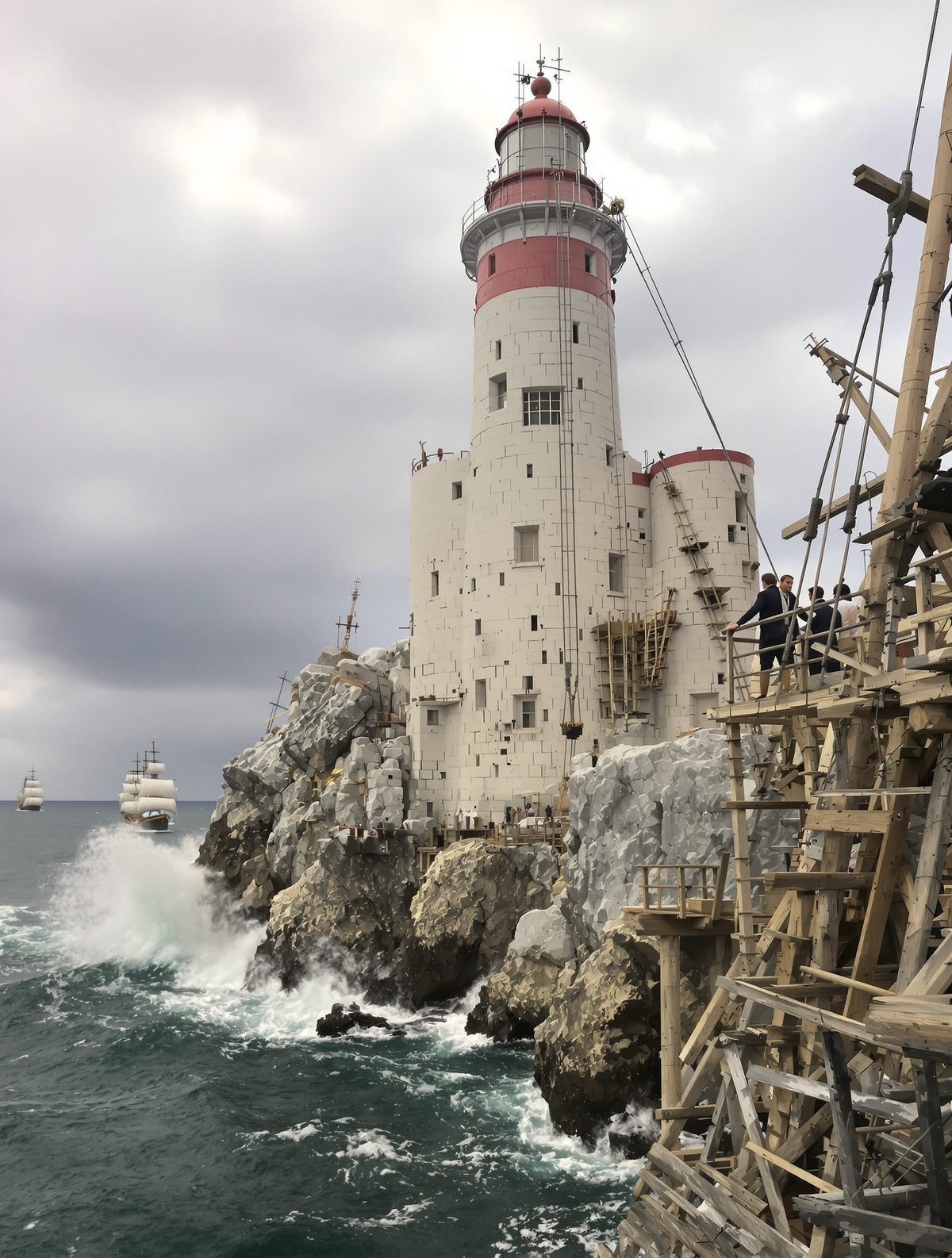
Construction began in earnest during the summer of 1757, and immediately the challenges seemed insurmountable. The Eddystone Rocks were submerged for much of each day, leaving workers just a few hours at low tide to accomplish anything. Atlantic storms regularly scattered men and materials, while the closest harbor lay fourteen treacherous miles away. Equipment had to be ferried out in small boats, then winched up onto the slippery rocks where workers clung to makeshift platforms as waves crashed around them.
Smeaton solved each problem with characteristic ingenuity. He designed specialized boats with flat bottoms that could land directly on the rocks. He created a revolutionary mortar using hydraulic lime—a cement that would actually harden underwater instead of dissolving. He personally supervised the cutting of each granite block, ensuring tolerances measured in fractions of inches.
The Test of Titans
On October 9, 1759, Smeaton's lighthouse first blazed to life. The achievement seemed impossible—a 1,000-ton stone tower rising from rocks that had defeated every previous attempt. Ships' captains who had declared the Eddystone unconquerable now found themselves guided safely past by the steady beam of what sailors dubbed "Smeaton's Wonder."
The real test came with the first major storm. As winter gales lashed the lighthouse, Smeaton stationed observers on nearby headlands with telescopes, anxiously watching for any sign of structural failure. Instead, they witnessed something extraordinary. The waves that struck the lighthouse's base seemed to lose their fury against the curved granite walls, while the tower itself barely trembled. The dovetail joints were performing exactly as designed—each impact driving the stones more tightly together.
Inside the lighthouse, keeper John Horneck reported an almost eerie stability. Where previous lighthouses had swayed and groaned in heavy weather, Smeaton's tower stood as solid as the bedrock beneath it. The oil flames burned steady, the lens apparatus remained undisturbed, and ships continued to navigate safely even in conditions that would have extinguished earlier beacons.
Word of the lighthouse's success spread throughout Europe's engineering community. Visitors came from France, Holland, and Germany to study Smeaton's revolutionary techniques. The dovetail joint system was copied for bridges, harbors, and fortifications across the continent. Perhaps most remarkably, Trinity House calculated that the lighthouse paid for itself within seven years through reduced ship losses alone.
When Giants Fall to Progress
For 123 years, Smeaton's lighthouse stood sentinel over the Eddystone Rocks. Through the Napoleonic Wars, when enemy ships learned to navigate by its beam. Through the advent of steam power, when larger vessels required more powerful beacons. Through the Victorian era's maritime boom, when the English Channel became the world's busiest shipping lane.
The lighthouse's end came not from storm or fire, but from its own success. By the 1870s, the rocks beneath the tower began showing signs of erosion—not from wave action, but from the lighthouse's very stability. The immovable structure had created turbulence patterns that gradually undermined its foundation. In 1882, Trinity House reluctantly decided to replace Smeaton's masterpiece with a taller lighthouse built on a different part of the reef.
Rather than demolish the old tower, they carefully dismantled everything above the foundation and rebuilt it on Plymouth Hoe as a monument. Today, visitors can climb inside Smeaton's lighthouse and see the precision-cut granite blocks that once defied the Atlantic's fury. The dovetail joints, after more than 250 years, still fit together perfectly.
John Smeaton's triumph at Eddystone represents more than just exceptional engineering—it embodies the Industrial Revolution's fundamental shift from craftsmanship to scientific method. By studying nature, conducting experiments, and questioning conventional wisdom, a Yorkshire millwright solved a problem that had defeated architects and master builders. His lighthouse didn't just tame the sea; it proved that careful observation and systematic thinking could overcome seemingly impossible challenges.
In our age of rapid technological change, when engineers routinely accomplish what previous generations deemed impossible, Smeaton's oak tree lighthouse reminds us that the most elegant solutions often come from understanding natural principles rather than fighting them. Sometimes the greatest victory isn't conquering nature—it's learning to dance with it.