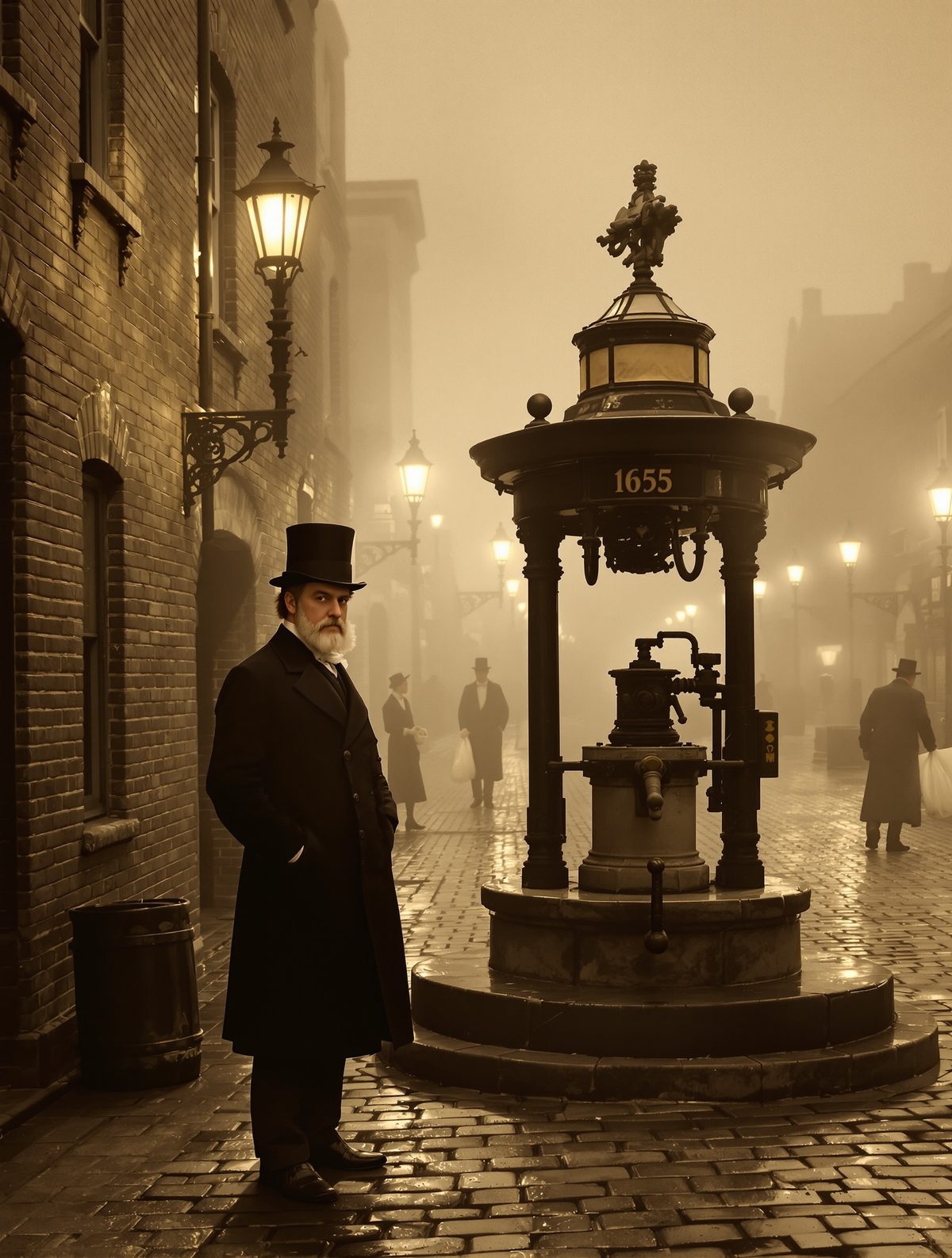
The pump handle was already loose when Dr. John Snow gripped it on the morning of September 8, 1854. With a few determined twists, the corroded metal gave way completely. No ceremony, no fanfare—just a middle-aged physician in a black frock coat, standing beside a broken water pump on Broad Street in Soho, holding what he believed was the key to stopping London's most terrifying killer.
Behind him lay a neighborhood transformed into a charnel house. In the space of just ten days, over 600 people had died agonizing deaths, their bodies wracked with violent diarrhea and vomiting until they simply... stopped. The streets reeked of death and disinfectant. Entire families had been wiped out. Survivors fled in terror, leaving behind a ghost district of shuttered shops and empty houses.
But Snow wasn't running. He was hunting—armed with nothing more than a detailed street map, a stubborn theory that every medical authority in London dismissed as nonsense, and an unshakeable belief that this broken pump held the answer to one of history's greatest medical mysteries.
The Invisible Enemy Strikes
Cholera was Victorian London's worst nightmare made manifest. The disease struck without warning, killed without mercy, and baffled every doctor who encountered it. Victims would wake up healthy and be dead by nightfall, their bodies drained of fluids, skin turned blue-grey, eyes sunken deep into their skulls.
Read next: The Day a Widow's Son Lit Up the Victorian Night
The outbreak began on August 31, 1854, when baby Frances Lewis fell ill at 40 Broad Street. Her mother, Sarah Lewis, had been washing the infant's soiled diapers and pouring the dirty water into a cesspit that, unknown to anyone at the time, leaked directly into the neighborhood's water supply. Within hours, Frances was dead. Within days, her neighbors were following.
By September 2nd, panic gripped Soho. Henry Whitehead, the local curate, would later write that the smell of death hung over the district "like a physical presence." Entire tenement buildings stood empty. The wealthy fled to their country estates. The poor, trapped by circumstance, barricaded themselves indoors and prayed.
The Board of Health's response was swift and utterly wrong. They dispatched teams to burn barrels of tar in the streets, believing the smoke would cleanse the "miasmatic vapors" they were convinced caused the disease. The prevailing medical wisdom, championed by leading physicians and government officials alike, held that cholera spread through "bad air"—noxious gases rising from sewers, rotting organic matter, and the general filth of urban life.
The Doctor Who Saw Differently
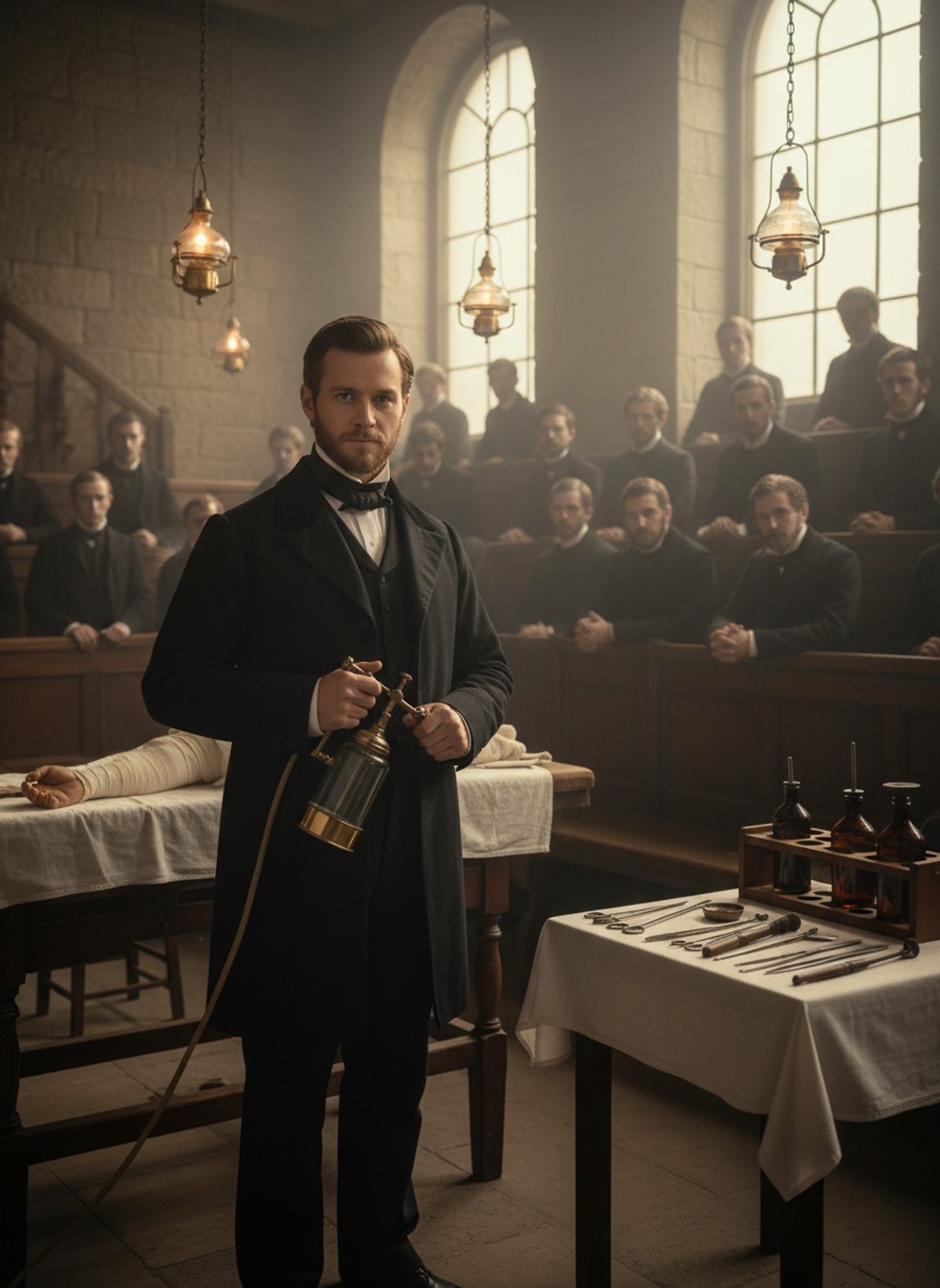
Dr. John Snow was not your typical Victorian physician. The son of a Yorkshire laborer, he'd clawed his way up through apprenticeships and night school to become one of London's most innovative doctors. He'd pioneered the use of chloroform in surgery—he'd even administered it to Queen Victoria during childbirth. But his radical theories about disease transmission had made him something of an outcast in London's medical establishment.
Snow had been studying cholera for years, and he'd reached a shocking conclusion: the disease wasn't spreading through the air at all. It was spreading through water. Contaminated water, to be precise, tainted by the waste of previous victims. In an age when the very concept of germs was still considered fringe science, this theory was nothing short of heretical.
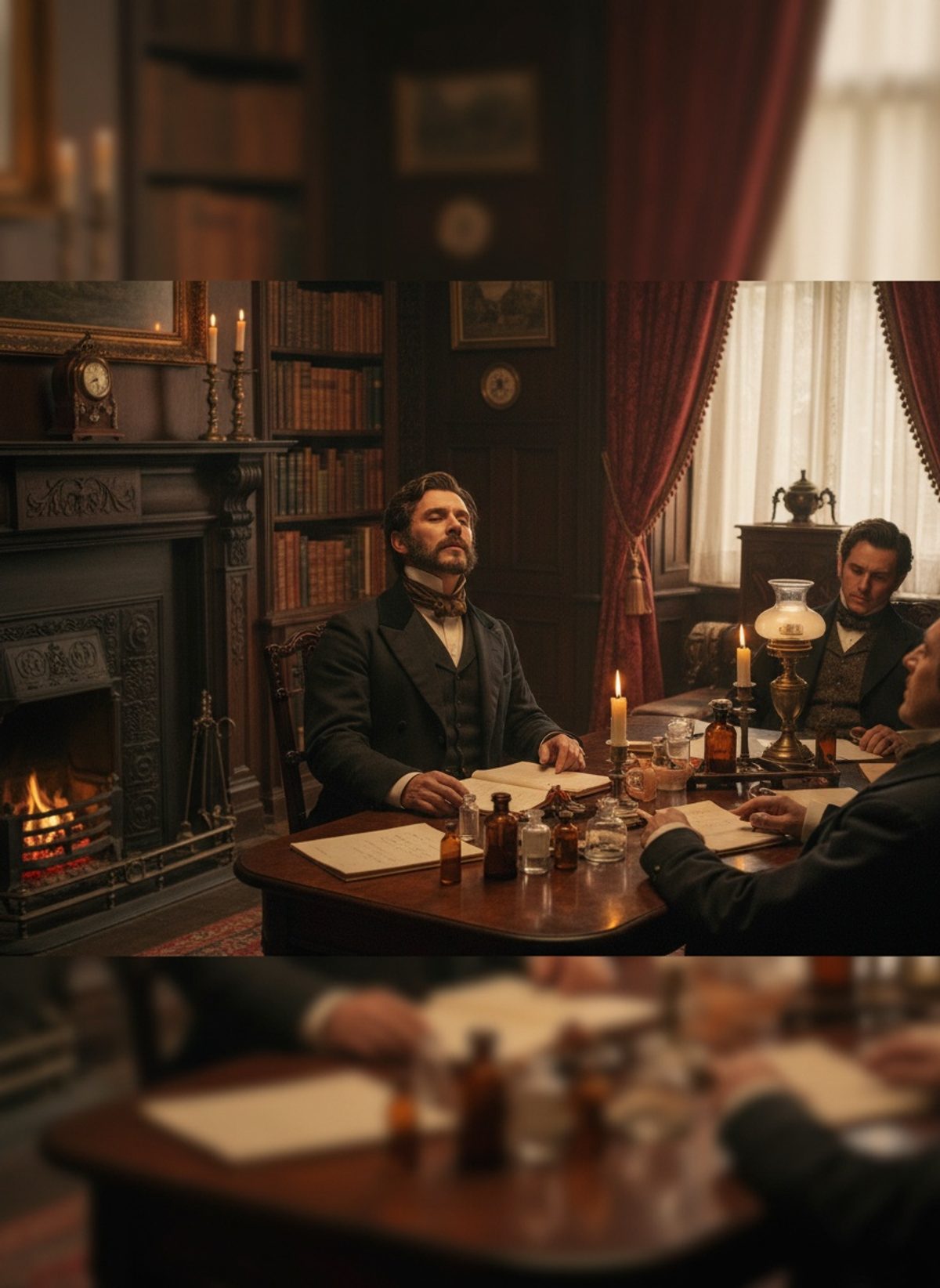
When news of the Soho outbreak reached him at his practice in Sackville Street, Snow didn't reach for bottles of disinfectant or orders for street fumigation. Instead, he grabbed his hat, his notebook, and a detailed map of the neighborhood. He was going to prove his theory once and for all—or die trying.
Following the Breadcrumbs of Death
What Snow did next would revolutionize medicine forever, though few realized it at the time. He began methodically mapping every single cholera death in the area, marking each fatality with a black bar on his street map. House by house, street by street, he traced the epidemic's deadly fingerprint across Soho.
The pattern that emerged was striking. The deaths clustered heavily around Broad Street, with the highest concentration near the intersection with Cambridge Street. But Snow noticed something even more telling—there were curious gaps in the pattern. The workhouse at Poland Street, which housed 535 inmates, had recorded only five deaths. The Lion Brewery on Broad Street, with its 70 workers, had lost none at all.
Snow investigated these anomalies with the persistence of a detective. The workhouse, he discovered, had its own private well. The brewery workers? They received a daily ration of beer and rarely, if ever, drank water. Both groups had avoided the Broad Street pump entirely.
But perhaps the most compelling evidence came from outside the immediate area. Snow documented the case of a widow in Hampstead who had died of cholera on September 2nd—miles from the outbreak's epicenter. Her son revealed that she had specifically requested water from the Broad Street pump, which she remembered fondly from her time living in Soho. A servant had fetched her a large bottle on August 31st. She was dead within days.
The Pump Handle Heard Round the World
Armed with his evidence, Snow approached the Board of Guardians of St James's Parish on September 7, 1854. Picture the scene: a lone physician, dismissed by his peers as a crank, standing before a room of skeptical officials with nothing but a hand-drawn map and an outrageous theory about contaminated water.
The board members were unconvinced. They still believed in miasma theory, still thought cholera spread through bad air. But Snow was persuasive, and more importantly, he was specific. Remove the handle of the Broad Street pump, he urged them. Cut off access to what he was certain was the source of the contamination.
By this point, the outbreak was already waning—many of those susceptible had either died or fled the area. But the next morning, September 8th, workers removed the pump handle on Snow's recommendation. The epidemic, which had killed over 600 people in one of the most densely populated areas of London, effectively ended.
The timing was almost too perfect. Critics would later argue that the outbreak had already peaked, that Snow's intervention was merely coincidental. But the doctor had documentation that told a different story: a clear, undeniable link between proximity to the pump and death rates that couldn't be explained by miasma theory.
The Ghost Map That Changed Everything
Snow's map—which would later be dubbed the "Ghost Map" by historian Steven Johnson—became one of the most important documents in medical history. But its significance wasn't immediately recognized. The medical establishment remained stubbornly committed to miasma theory for decades to come.
It took years of additional research for Snow to piece together the complete story. The cesspit at 40 Broad Street, where baby Frances Lewis's contaminated diapers had been washed, was located just three feet from the public well. Night-soil men had dug the pit improperly, allowing sewage to seep directly into the neighborhood's drinking water supply. Every glass of water drawn from that pump after August 31st carried with it the invisible killer that would claim hundreds of lives.
Tragically, Snow died of a stroke in 1858, largely unrecognized for his revolutionary work. The medical community wouldn't fully embrace germ theory until the 1880s, when researchers like Louis Pasteur and Robert Koch provided the microscopic evidence that Snow had inferred from his meticulous mapping.
But Snow's methodology—his systematic collection of data, his willingness to challenge established wisdom, his understanding that disease patterns could reveal their own causes—laid the groundwork for the entire field of epidemiology. Every contact tracer working to contain COVID-19, every researcher mapping cancer clusters, every public health official tracking foodborne illness owes a debt to the stubborn doctor who removed a pump handle in Soho.
Today, a red granite monument stands near the site of the original Broad Street pump, and the nearby pub bears Snow's name. More importantly, his approach to understanding disease—following the data wherever it leads, even when it contradicts conventional wisdom—remains the gold standard for public health investigation. In an age of global pandemics and emerging diseases, Snow's lesson resonates more powerfully than ever: sometimes the most important breakthroughs come not from those who follow the crowd, but from those brave enough to stand alone with the evidence and say, "You're all wrong. And here's why."