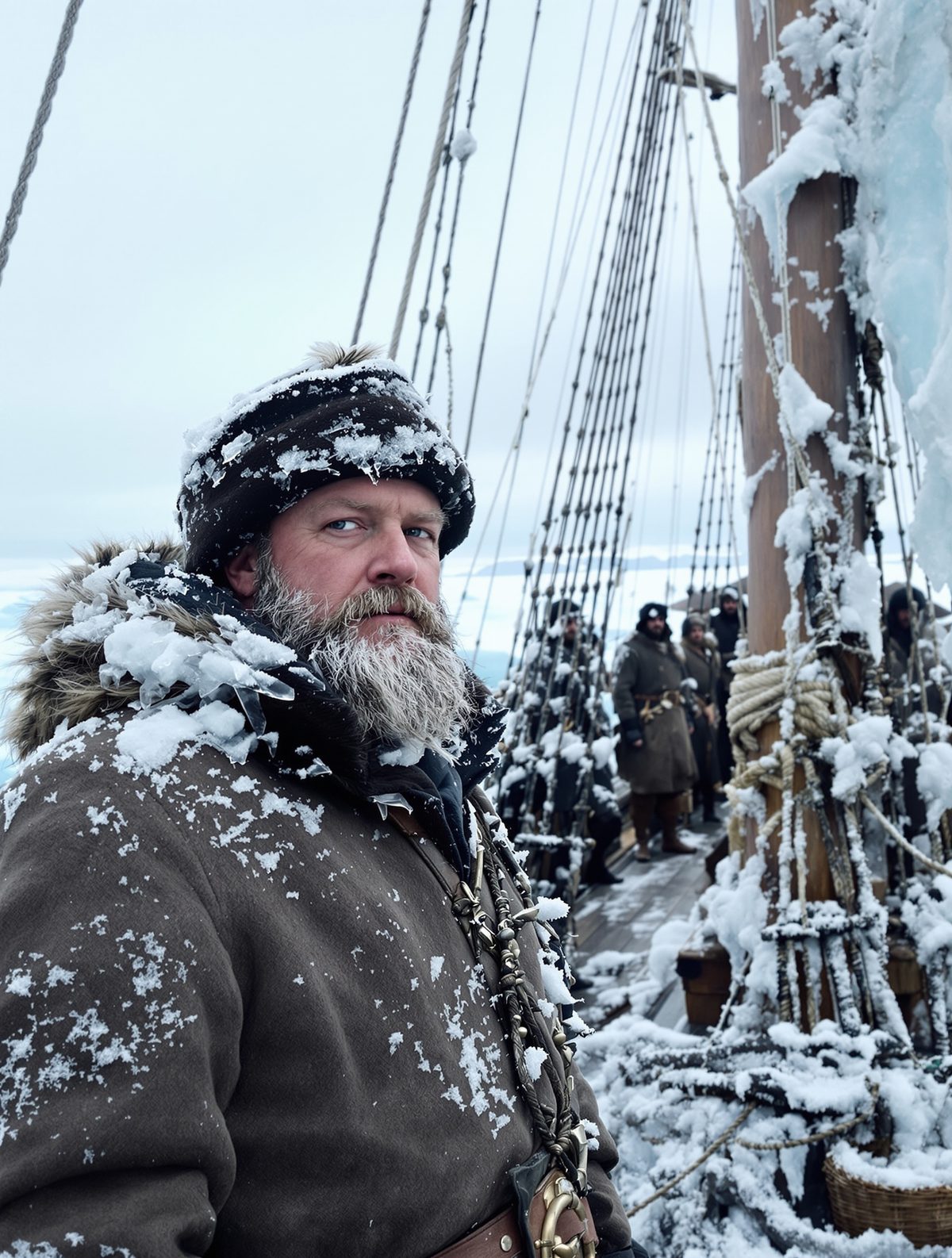
In the bone-chilling dawn of June 23, 1611, English explorer Henry Hudson stood on the deck of his ship Discovery, watching helplessly as his own men lowered a small boat into the ice-strewn waters of what would one day bear his name. Within minutes, he, his teenage son John, and seven loyal crew members would be cast adrift in one of the most remote and unforgiving places on Earth. The man who had sailed closer to the North Pole than any European before him was about to become the victim of one of history's most infamous mutinies—a betrayal that would echo through the centuries as both a cautionary tale of leadership under extreme conditions and a brutal reminder of what desperation can drive men to do.
The Promise of Riches Beyond Imagination
Henry Hudson wasn't supposed to be in Hudson Bay at all. When he set sail from London on April 17, 1610, aboard the 55-ton Discovery with a crew of 23 men, he carried with him the dreams of English merchants who believed the Northwest Passage—a sea route through the Arctic to the riches of Asia—lay within their grasp. Hudson had already made three previous attempts to find northern routes to the Pacific, twice for the Dutch East India Company and once for England's Muscovy Company. Each voyage had ended in failure, but each had also brought tantalizing hints that the passage existed.
What made this fourth voyage different was Hudson's unshakeable conviction that he could succeed where others had failed. Armed with reports from earlier explorers and his own considerable experience navigating Arctic waters, he was certain that the key lay somewhere in the vast, unmapped waters west of Greenland. The crew he assembled included experienced sailors like Robert Juet, his navigator and longtime companion, and Robert Bylot, a skilled helmsman. But it also included troublemakers—men like Henry Greene, a young gentleman with a violent temper whom Hudson had personally recruited despite warnings from friends.
As Discovery pushed through the pack ice of Davis Strait and into the treacherous waters beyond, Hudson's confidence seemed justified. By August 1610, they had found what appeared to be the entrance to the passage—a vast body of water stretching endlessly westward. What Hudson had actually discovered was the massive inland sea that would become known as Hudson Bay, roughly the size of the Mediterranean and containing some of the most dangerous waters in North America.
Read next: The Day a Scots Surgeon Walked Into Timbuktu Alone
Trapped in a Frozen Hell
The euphoria of discovery quickly turned to horror. As autumn approached, Hudson pushed deeper into the bay, convinced that the Pacific lay just beyond the next headland. But with each passing day, the water grew shallower and the coastline more confining. By November, the terrible truth became clear: they were trapped in a massive cul-de-sac, surrounded by ice that grew thicker by the hour.
Hudson made the fateful decision to winter over at the southern tip of what is now James Bay. It was a death sentence he didn't yet realize he'd pronounced. The crew dragged Discovery onto the beach and began the grim business of survival. They built shelters from salvaged timber and ship's canvas, rationed their dwindling food supplies, and settled in for what they hoped would be a few months of hardship before the spring thaw freed them.
But this was no ordinary winter. Temperatures plunged to -40°F, and the bay remained frozen solid month after month. The men survived on a diet of moss, frogs, and whatever birds they could catch. Scurvy set in, causing their teeth to fall out and their bodies to waste away. Several crew members died, and those who survived grew increasingly desperate. The ship's cat, brought along to control rats, was killed and eaten. Even tree bark became a delicacy.
Throughout this ordeal, Hudson's leadership began to unravel. He made increasingly erratic decisions, including demoting Robert Juet from his position as mate and replacing him with Robert Bylot. More dangerously, he was suspected of hoarding food for himself and his favorites while others starved. When the crew discovered that Hudson had been secretly trading with local Cree Indians for food but keeping the best items for himself, their resentment turned to rage.
The Conspiracy Takes Shape
By spring 1611, a conspiracy was brewing among the survivors. The ringleaders were an unlikely pair: Henry Greene, the violent young gentleman Hudson had championed, and Robert Juet, the navigator Hudson had publicly humiliated. Greene had turned against his former patron after Hudson cut his food rations following a dispute. Juet, bitter over his demotion and convinced that Hudson's poor leadership would kill them all, provided the technical expertise and maritime knowledge that gave the plot credibility.
The conspirators faced a crucial problem: mutiny was punishable by death under English law, and they would need to justify their actions if they ever made it home. Their solution was as cold-blooded as it was calculated. Rather than simply killing Hudson outright, they would cast him adrift in a small boat with his most loyal supporters, giving him a theoretical chance of survival while ensuring he could never return to accuse them.
The mutineers carefully selected who would live and who would die. Hudson's teenage son John was marked for death simply because he might seek revenge for his father's fate. Also condemned were the ship's carpenter Philip Staffe, sick crew member Arnold Lodlo, and several others deemed either too loyal to Hudson or too weak to be useful for the journey home. In total, nine men would be sacrificed to give the remaining fourteen a better chance of survival.
On the morning of June 23, 1611, the conspirators struck. They burst into Hudson's cabin, bound his hands, and dragged him on deck. Despite his protests and pleas, they forced him into the ship's small shallop—a boat barely 20 feet long and completely unsuitable for ocean travel. The scene that followed was heartbreaking: Hudson's son John, though not originally targeted, chose to stay with his father rather than abandon him. The loyal carpenter Philip Staffe, despite being offered a chance to remain with the ship, grabbed his tool chest and jumped into the doomed boat, declaring he would rather die with an honest man than live with villains.
The Voyage of the Damned
What happened next became the stuff of maritime legend. The mutineers watched from the deck of Discovery as the overloaded shallop wallowed in the icy waters of Hudson Bay, its nine occupants facing certain death in one of the most hostile environments on Earth. Some witnesses later claimed they saw Hudson and his companions following the ship for hours, desperately trying to keep up, before finally disappearing forever into the Arctic wilderness.
The irony was that the mutineers' victory quickly turned to ash. Under the leadership of Robert Bylot, Discovery began the treacherous journey home, but their troubles were far from over. Attempting to gather food for the voyage, they encountered a group of Inuit hunters who killed Henry Greene and several other mutineers in a violent confrontation. Robert Juet, the conspiracy's mastermind, died of starvation and illness before reaching England.
Of the 23 men who had sailed from London with such high hopes, only eight emaciated survivors limped back to England in autumn 1611. They spun a carefully crafted tale of their ordeal, portraying Hudson as an increasingly unhinged leader whose poor decisions had threatened everyone's survival. The authorities were suspicious but faced a dilemma: prosecuting the mutineers would mean losing the only witnesses to one of the most significant voyages of exploration in English history.
The survivors were eventually pardoned, and some, including Robert Bylot, went on to have distinguished careers in Arctic exploration. But they carried the weight of their crime for the rest of their lives. Several made deathbed confessions admitting their guilt, and their accounts provide some of the most chilling details of the mutiny's planning and execution.
The Legend Lives On
Henry Hudson's fate remains one of exploration's greatest mysteries. Despite numerous searches over the centuries, no trace of the explorer or his companions was ever found. The vast wilderness of Hudson Bay had swallowed them as completely as if they had never existed. Some romantic accounts suggest Hudson might have survived for months or even years, perhaps living among indigenous peoples or eking out an existence in the Arctic wilderness, but no credible evidence has ever emerged to support such theories.
The mutiny's aftermath raises uncomfortable questions about leadership, loyalty, and survival that resonate even today. Hudson was undoubtedly a brilliant navigator and explorer, but he was also an autocratic leader who made fatal errors in judgment under extreme pressure. His men were desperate, starving, and far from home, but their solution—condemning nine people to almost certain death—remains one of maritime history's most cold-blooded betrayals.
Perhaps most troubling is how easily the survivors escaped justice. Their story became the accepted version of events, and Hudson's reputation suffered as much from their testimony as from his actual failures. It's a reminder that in the court of history, the survivors usually get to write the verdict. Today, as we grapple with questions of leadership under crisis, the accountability of those in power, and the lengths to which people will go to survive, Henry Hudson's story serves as a stark reminder that even in our modern world, civilization is often just one catastrophe away from barbarism. The ice-cold waters of Hudson Bay claimed more than just nine lives that day—they swallowed a piece of humanity itself.