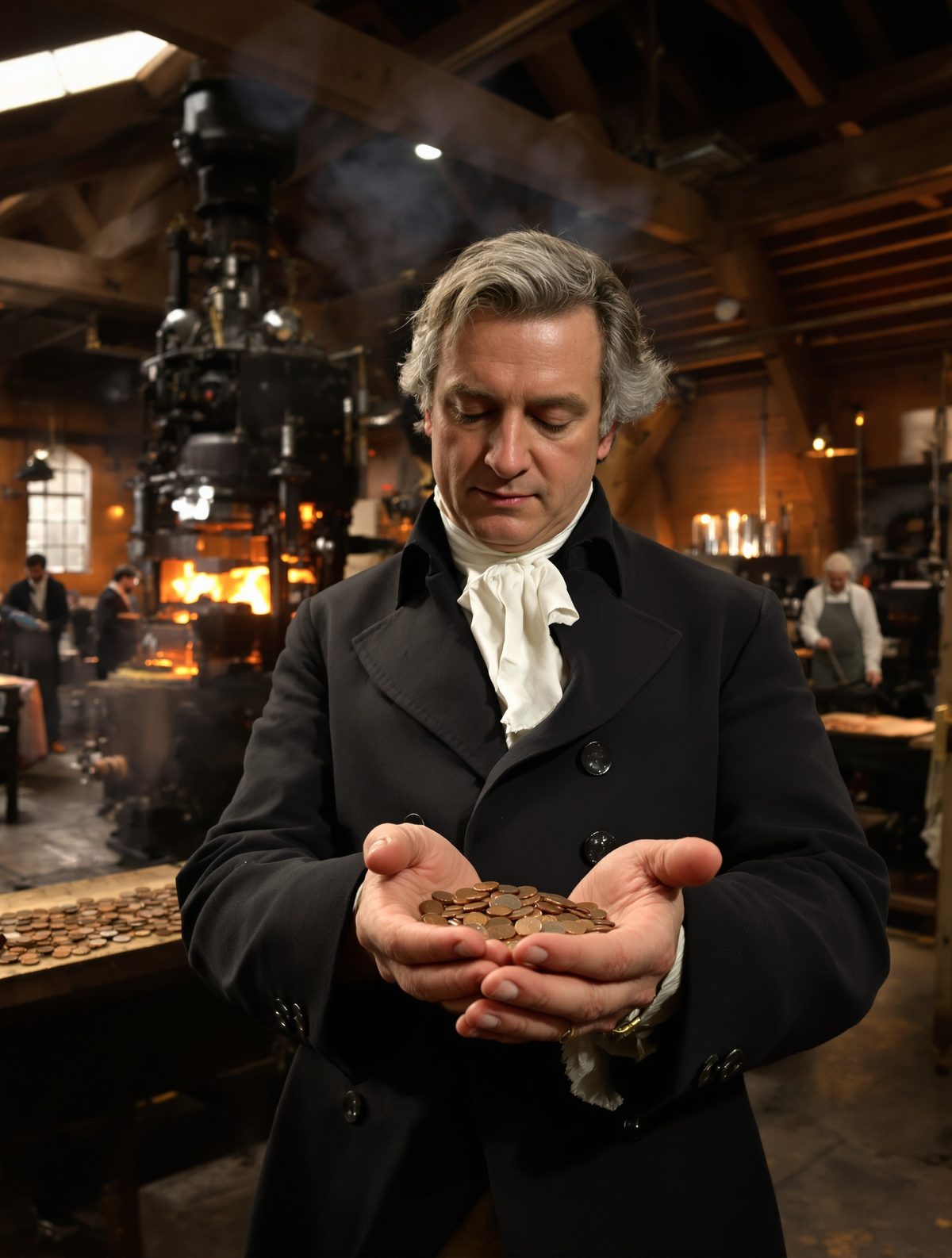
Picture this: you're standing in a London marketplace in 1797, clutching what should be a perfectly good copper penny. The merchant squints at it, turns it over in his weathered hands, then shakes his head firmly. "Won't take it, mate. Could be one of them forgeries." Behind you, frustrated customers shuffle their feet, jingling pockets full of coins that nobody trusts. Welcome to Britain on the brink of monetary collapse—where even buying a loaf of bread had become a gamble.
This wasn't just inconvenient. It was catastrophic. The entire foundation of commerce—trust in money—had crumbled. But salvation was thundering to life in a factory in Soho, Birmingham, where a brilliant industrialist named Matthew Boulton was about to unleash the power of steam on Britain's currency crisis.
When Money Became Worthless
By the 1790s, Britain's coinage system had descended into pure chaos. The Royal Mint, housed in the Tower of London since medieval times, was still operating like it was 1597, not 1797. Workers used hand-operated screw presses that could barely manage 30 coins per minute, and the copper pennies they produced were so crude and inconsistent that forgers had a field day.
The forgeries weren't sophisticated—they didn't need to be. When the genuine article looked like it had been hammered out by a blacksmith having a bad day, even the most amateur counterfeiter could produce something convincingly awful. Contemporary estimates suggest that by 1797, over 90% of copper coins in circulation were fake. Think about that for a moment: nine out of every ten pennies in your pocket would have been worthless.
Read next: The Day a Mill Owner Kept Paying Wages He Could Not Afford
The situation became so dire that Birmingham alone was estimated to produce two-thirds of Britain's circulating copper coins—and Birmingham wasn't even authorized to mint money. These weren't official government coins; they were private tokens created by manufacturers and tradesmen who had simply given up waiting for the Royal Mint to solve the problem. It was monetary anarchy.
The Gentleman Revolutionary of Soho
Enter Matthew Boulton, a man who would have felt perfectly at home in Silicon Valley. Born in 1728 to a Birmingham buckle-maker, Boulton had already revolutionized manufacturing with his Soho Manufactory, a sprawling complex that was part factory, part laboratory, part showcase for the future. By the 1790s, he was James Watt's business partner, the man who had helped perfect the steam engine that would power the Industrial Revolution.
But Boulton wasn't content with just making steam engines. He had been watching Britain's currency crisis with the eye of an engineer who saw a problem begging for a mechanical solution. For years, he had been experimenting with coin production, creating those Birmingham tokens that kept local commerce alive. He had even built experimental coining presses and lobbied the government for permission to mint official currency.
What made Boulton different wasn't just his engineering genius—it was his obsession with perfection. While the Royal Mint was content with "good enough," Boulton envisioned coins so precisely made that forgery would become impossible. He dreamed of steam-powered presses that could strike coins with mathematical precision, producing millions of identical pieces that would restore trust to British commerce.
The Steam-Powered Solution
In 1797, desperation finally overcame tradition. The British government, facing the complete collapse of small change, awarded Boulton the contract to produce the new official copper coinage. The specifications were daunting: they needed millions of pennies and halfpennies, and they needed them fast.
Boulton's response was to unleash industrial technology on an artisanal craft. At his Soho Mint, steam engines drove massive screw presses that could exert up to 120 tons of pressure—enough to stamp coins with crisp, identical detail that was impossible to fake with hand tools. These weren't just coins; they were precision-engineered pieces of metal art.
The famous "cartwheel" pennies and twopences that rolled off Boulton's presses were revolutionary. The penny weighed exactly one ounce of copper, making it inherently valuable and difficult to counterfeit profitably. The raised rim around the edge wasn't just decorative—it was an anti-counterfeiting feature that required sophisticated equipment to reproduce. Each coin was struck with such force that every detail was razor-sharp, from Britannia's flowing robes to the individual leaves on her olive branch.
But here's the detail that will blow your mind: Boulton's steam-powered presses could produce up to 84 coins per minute—nearly three times faster than anything the Royal Mint could achieve. In just two years, his factory produced over 45 million coins, more than the Royal Mint had managed in decades.
The Day Trust Returned to Money
When Boulton's cartwheel coins began circulating in late 1797, the effect was immediate and dramatic. For the first time in years, people could look at a coin and know instantly that it was genuine. The weight, the perfect circular shape, the crisp detail—everything about these coins screamed authenticity.
Contemporary accounts describe something almost magical: the return of confidence to everyday transactions. Merchants who had been refusing copper coins for months suddenly welcomed them again. Markets that had been operating on a bewildering mixture of tokens, foreign coins, and barter began functioning normally. The paralysis that had gripped small-scale commerce evaporated almost overnight.
Even more remarkably, the forgers simply gave up. When your competition is a steam-powered factory producing coins that are works of engineering art, there's no point in trying to compete with crude hand tools. The cottage industry of coin counterfeiting that had plagued Britain for decades virtually disappeared.
The psychological impact went beyond mere commerce. These weren't just better coins—they were symbols of British industrial supremacy. At a time when the nation was locked in an existential struggle with Revolutionary France, Boulton's coins were proof that British engineering and innovation could solve seemingly impossible problems.
The Legacy of Perfect Money
Boulton's success didn't just save Britain's currency—it transformed the very concept of what money could be. His techniques spread across the world as other nations realized that steam-powered minting wasn't just more efficient; it was more secure. The Soho Mint produced coins for Russia, India, Bermuda, and dozens of other countries, each bearing the crisp perfection that had become Boulton's signature.
But perhaps most importantly, Boulton proved that private enterprise could outperform government institutions when armed with superior technology and fresh thinking. The Royal Mint, stung by this embarrassment, was forced to modernize. They acquired their own steam-powered presses and eventually moved from the Tower of London to a purpose-built facility that could compete with Boulton's operation.
The cartwheel pennies themselves became legendary. Though they were too heavy for practical everyday use and were replaced by lighter coins in 1807, they remained in circulation for decades as curiosities and keepsakes. People saved them not because they were rare, but because they represented a moment when engineering genius had rescued the nation from chaos.
Why Matthew Boulton's Revolution Still Matters
Today, as we grapple with cryptocurrencies, digital payments, and questions about the future of money itself, Boulton's story feels remarkably contemporary. He faced the same fundamental challenge that bedevils monetary systems in every age: how do you create trust in something that has value only because people agree it has value?
His answer was elegantly simple: make counterfeiting impossible through superior technology. It's a lesson that echoes in everything from the security features on modern banknotes to the cryptographic algorithms that protect digital currencies. Every time you tap your contactless payment card or verify a transaction on your banking app, you're using the spiritual descendants of Boulton's steam-powered presses.
But there's a deeper lesson here about innovation and crisis. Britain's currency collapse of 1797 wasn't solved by committees or gradual reforms—it was solved by one man who saw the problem clearly and had the engineering audacity to build a better solution. In our own age of disruption, when established institutions struggle to keep pace with technological change, Matthew Boulton's story reminds us that sometimes the most profound revolutions happen not in parliaments or boardrooms, but in the workshops of people crazy enough to believe that impossible problems just need better machines.